Blog
Back to blog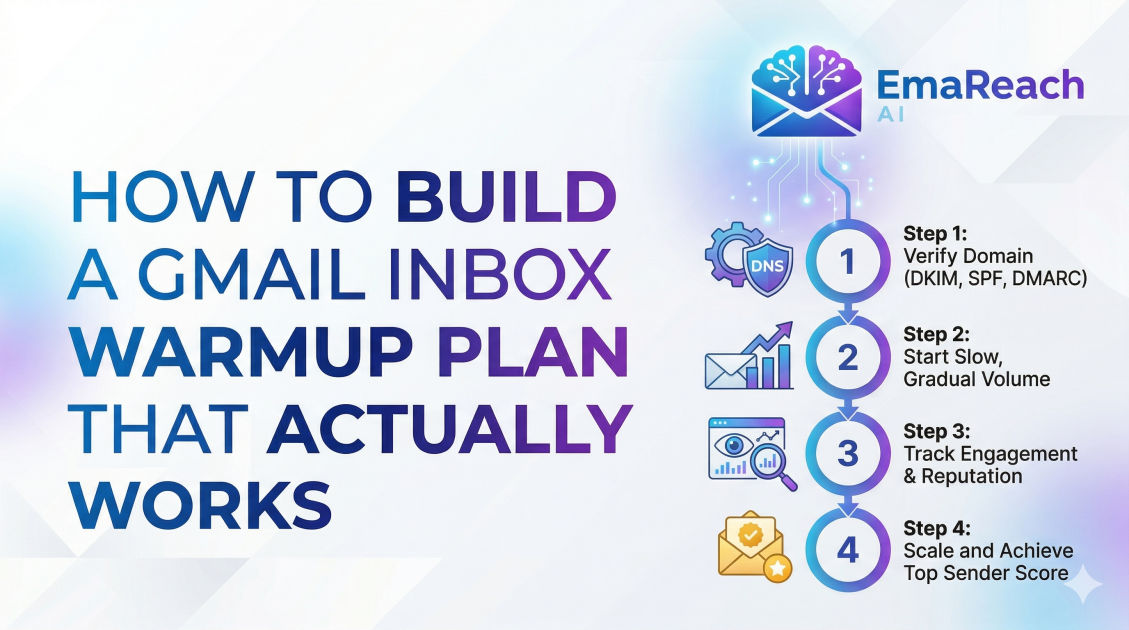
How to Build a Gmail Inbox Warmup Plan That Actually Works
email deliverabilitygmail warmupcold emailoutreach strategyinbox placementsender reputation
Introduction to Email Warmup
Launching a new email account for outreach is often met with a harsh reality: your carefully crafted messages landing straight in the spam folder. For businesses relying on Gmail and Google Workspace, the reputation of your sending domain and specific email address is the gatekeeper of your success. If Google’s filters perceive your account as a 'cold' entity suddenly blasting high volumes of mail, they will flag you as a spammer.
Building an inbox warmup plan is the process of gradually increasing your email volume to establish a positive sender reputation with Internet Service Providers (ISPs). It mimics the behavior of a real human user, signaling to Gmail that you are a legitimate sender. A successful warmup plan isn't just about sending mail; it’s about engagement, consistency, and technical precision.
Why Your Gmail Inbox Needs a Warmup Plan
Gmail uses sophisticated machine learning algorithms to protect its users from unsolicited content. When a new account is created, it has a 'neutral' reputation at best. If you immediately start sending 50 or 100 emails a day, the sudden spike in activity triggers a red flag.
The Mechanics of Sender Reputation
Your sender reputation is a score assigned by ISPs based on several factors:
- Sending Volume: Is the volume consistent or erratic?
- Spam Complaints: How many recipients are marking your emails as spam?
- Bounce Rates: Are you sending to non-existent email addresses?
- Engagement Rates: Do people open, click, and reply to your emails?
- IP and Domain Health: Are you on any blacklists?
Without a warmup period, you risk 'burning' your domain. Once a domain is flagged for spam, it is incredibly difficult to recover. A structured plan ensures you stay under the radar while building the trust necessary for large-scale outreach.
Phase 1: The Technical Foundation
Before sending your first warmup email, you must ensure your technical settings are airtight. This is the 'pre-warmup' phase where you prove your identity to Google.
Setting Up SPF, DKIM, and DMARC
These three records are the 'ID cards' of the email world.
- SPF (Sender Policy Framework): Specifies which mail servers are authorized to send email on behalf of your domain.
- DKIM (DomainKeys Identified Mail): Adds a digital signature to your emails, ensuring the content hasn't been tampered with in transit.
- DMARC (Domain-based Message Authentication, Reporting, and Conformance): Tells receiving servers what to do if an email fails SPF or DKIM checks.
If these are not configured, your warmup efforts will fail regardless of your volume. Modern filters view unauthenticated mail with extreme suspicion.
Custom Tracking Domains
Most outreach platforms use shared tracking domains for open and click rates. If another user on that shared domain sends spam, your deliverability suffers. Setting up a custom tracking domain (a CNAME record pointing to your provider) ensures your reputation is isolated and protected.
Phase 2: The Manual Warmup Strategy
While automation is powerful, the first week of a warmup plan should ideally involve some manual or highly controlled activity. This helps establish the 'human' footprint of the account.
Week 1: Personal Engagement
In the first few days, focus on high-quality interactions rather than quantity.
- Email Friends and Colleagues: Send 5-10 emails per day to people you know will open and reply.
- Ensure Replies: A reply is the strongest signal of a 'good' sender. When a recipient replies to you, it tells Gmail that your content is valuable.
- Newsletter Subscriptions: Sign up for 5-10 reputable newsletters (like Harvard Business Review or industry blogs). Opening these daily and moving them from the 'Promotions' tab to 'Primary' helps train the algorithm.
The Rule of Consistent Growth
A common mistake is increasing volume too quickly. A 'working' plan follows a linear or slightly exponential growth curve. If you send 10 emails on Monday, don't jump to 50 on Tuesday. Aim for a 20-30% increase in volume every few days.
Phase 3: Transitioning to Automated Warmup
Manual warmup is not scalable. To reach the volumes required for professional sales or marketing, you need a system that can simulate human behavior at scale.
Leveraging AI and Peer Networks
Modern warmup works by placing your email into a network of other real accounts. These accounts automatically open your emails, mark them as 'not spam' if they land in the junk folder, and send replies. This creates a feedback loop of positive engagement.
For those looking for an integrated solution, EmaReach provides a comprehensive way to stop landing in spam. EmaReach AI combines AI-written cold outreach with inbox warm-up and multi-account sending—so your emails land in the primary tab and get replies. This type of automated intelligence removes the guesswork from the warmup process.
Phase 4: Constructing the Sending Schedule
A successful warmup plan usually spans 3 to 4 weeks. Below is a blueprint for a standard Gmail/Google Workspace account.
Week 2: Expanding the Circle
- Volume: 15-25 emails per day.
- Focus: Maintain a 25-30% reply rate. If you are using an automated tool, ensure the content of the warmup emails is varied. Generic 'lorem ipsum' text can be detected by filters.
- Monitoring: Check your domain on blacklists using free online tools. If you see a dip in deliverability, pause the volume increase immediately.
Week 3: Building Momentum
- Volume: 30-50 emails per day.
- Focus: Begin mixing in a very small number of actual outbound 'cold' emails (no more than 10% of total volume). These should be sent to highly verified leads to ensure zero bounces.
- Activity: Continue interacting with the newsletters you signed up for in Week 1.
Week 4: Reaching Target Capacity
- Volume: 50-80 emails per day.
- Focus: This is often the 'sweet spot' for a single Gmail account. While Google allows higher daily limits, sending more than 100 cold emails from a single address is a high-risk activity.
- Strategy: If you need to send 500 emails a day, the solution is not to warm up one account to 500, but to warm up 10 accounts to 50.
Critical Factors That 'Make or Break' Your Plan
The Importance of Content Variance
If you send the exact same subject line and body to 50 people in a row, Gmail’s 'fingerprinting' technology will flag it as a template. Even during the warmup phase, use 'spintax' or AI-generated variations to ensure every email is unique. This is where AI-driven platforms excel, as they can generate thousands of unique, contextually relevant messages that mimic human writing.
Bounce Rate Management
A single bounce (sending to an invalid email) can do more damage than 50 successful sends can do good. Before any lead enters your outreach phase (even at the end of a warmup), use an email verification service to scrub your list. Aim for a bounce rate of less than 1%.
Dealing with the Spam Folder
During warmup, some of your emails will land in spam. This is actually an opportunity. When an email is moved from 'Spam' to the 'Inbox' (the 'Mark as Not Spam' action), it sends a powerful positive signal to the ISP. Automated warmup tools do this automatically, but if you are doing it manually, ask your colleagues to check their junk folders for your mail.
Maintaining Your Reputation Post-Warmup
Warmup is not a one-time event; it is a continuous state of health. Even after your 4-week plan is complete, you should never turn off your warmup activity.
The 'Always-On' Approach
As you begin your actual cold outreach, keep the warmup tool running in the background. If you have a day where your cold outreach gets a few spam complaints, the constant stream of positive engagement from the warmup network acts as a buffer, preventing your overall reputation from tanking.
Monitoring Deliverability Tools
Use tools like Google Postmaster Tools to track your domain reputation. It provides a direct view of how Google sees your domain—categorizing it as High, Medium, Low, or Bad. Your goal is to maintain a 'High' rating. If you see it drop to 'Medium,' it's time to throttle back your cold outreach and increase your warmup-to-outreach ratio.
Common Pitfalls to Avoid
- Starting Too Fast: The 'I need leads today' mentality leads to 'I'll have a banned domain tomorrow.' Patience is the highest ROI activity in email marketing.
- Using a New Domain Without a Redirect: If you are using a 'burner' domain (e.g., yourcompany.co instead of yourcompany.com), ensure the secondary domain redirects to your main website. ISPs check if a sending domain has a legitimate web presence.
- Ignoring the 'Promotions' Tab: While landing in Promotions is better than Spam, the goal for cold outreach is the Primary tab. High engagement (replies) is the only way to move from Promotions to Primary.
- Neglecting Account Profile Completeness: A real human has a profile picture (gravatar), a signature, and perhaps a connected Google Calendar. Fill these out to appear more legitimate to Google's algorithms.
Advanced Strategy: Multi-Account Sending
To build a truly resilient system, you should move away from the 'single account' model. Instead of one account sending 100 emails, use five accounts sending 20 emails each. This 'load balancing' ensures that if one account hits a snag, your entire sales pipeline doesn't collapse. Each of these accounts must follow the same 4-week warmup plan independently.
When managing multiple accounts, ensure they are not all sending at the exact same minute. Spreading out the sends throughout the day (day-parting) further mimics human behavior, as humans rarely send 50 emails in a 5-minute burst.
Conclusion
Building a Gmail inbox warmup plan that actually works is a blend of technical setup, disciplined volume increases, and high-quality engagement. By moving from a manual foundation to an automated, AI-supported system, you protect your domain's most valuable asset: its reputation.
Remember that deliverability is a marathon, not a sprint. By following a structured 4-week plan, verifying your leads, and maintaining an 'always-on' warmup strategy, you ensure that your messages reach the people who need to see them. Whether you are a solo founder or a large sales team, the gate to the inbox is only open to those who prove they belong there. Start slow, stay consistent, and watch your reply rates soar as you land where you belong—the primary inbox.
EmaReach AI
Ready to scale your cold email outreach?
Join thousands of teams using EmaReach AI for AI-powered campaigns, domain warmup, and 95%+ deliverability. Start free — no credit card required.
Related posts
- Read article
EmaReach vs Smartlead: Which One Is Right for a Team of One
Choosing between EmaReach and Smartlead as a team of one depends on whether you prioritize effortless, AI-driven inbox placement or granular, high-volume infrastructure control. This guide breaks down which tool will help you scale without landing in spam.
- Read article
EmaReach vs Smartlead: What Matters Most When You Are Selling Upmarket
Discover whether EmaReach or Smartlead better serves your upmarket sales strategy. Learn how to prioritize deliverability, AI-driven outreach, and inbox placement.