Blog
Back to blog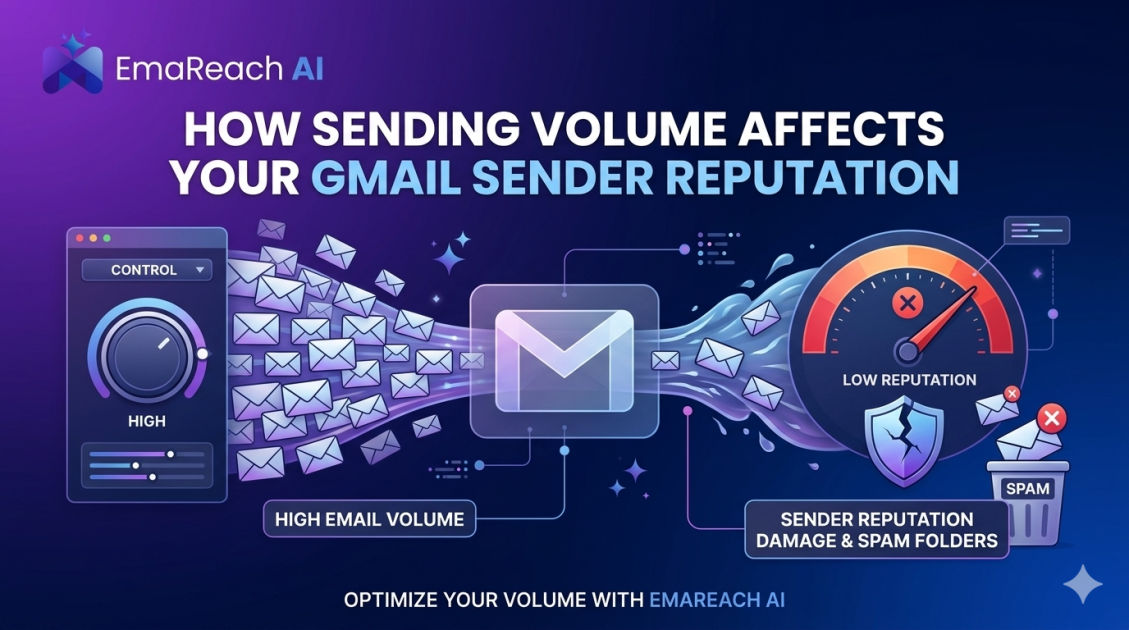
How Sending Volume Affects Your Gmail Sender Reputation
email deliverabilitysender reputationgmail optimizationcold outreachemail warm-upsending volumeemail marketing
Introduction to Gmail Sender Reputation
Gmail is the world’s most popular email service provider, and its filtering algorithms are among the most sophisticated in existence. For anyone involved in outreach, marketing, or business communication, understanding how Gmail perceives your sending behavior is critical. At the heart of this perception is your Sender Reputation. This is essentially a score assigned by Google to your domain and IP address that determines whether your messages land in the Primary tab, the Promotions tab, or the dreaded Spam folder.
One of the most significant factors influencing this reputation is sending volume. Gmail looks for patterns. When a sender suddenly blasts thousands of emails from a fresh account, it triggers red flags. Conversely, a consistent, human-like volume builds trust. Managing your sending volume isn't just about avoiding limits; it’s about signaling to Gmail that you are a legitimate, high-quality sender.
The Mechanics of Volume and Reputation
Gmail’s infrastructure is designed to protect users from unwanted content. To do this, it employs machine learning models that analyze every incoming email. Volume serves as a primary metric for these models because spam is inherently a game of scale. Spammers rely on sending massive quantities of mail because their conversion rates are low. Legitimate business senders, however, typically have more predictable and modest volume patterns.
The Concept of 'Volume Spikes'
In the eyes of an ISP like Gmail, a spike is any sudden, significant increase in the number of emails sent from a domain or IP within a short period. If you normally send 50 emails a day and suddenly jump to 5,000, Gmail’s filters will likely intercept those messages. This is because a sudden surge is a classic sign of a compromised account or a new spam campaign.
When these spikes occur, Gmail may apply 'rate limiting' or 'throttling.' This means they will temporarily reject your emails or delay their delivery to see how recipients react. If the first few hundred recipients mark the email as spam, the rest of the batch will be blocked entirely.
Why Consistency Matters
Consistency is the bedrock of a healthy sender reputation. Gmail prefers senders who have a steady 'pulse.' A predictable volume allows Gmail to build a historical profile of your sending habits. When your volume is consistent, the algorithms can more easily distinguish between your normal operations and a potential security breach.
For businesses, this means it is better to send 500 emails every day of the week than to send 3,500 emails all on Monday. Spreading your volume out mimics natural human behavior and reduces the risk of triggering automated filters.
To achieve this level of consistency without manual effort, many professionals use specialized platforms. EmaReach is a powerful tool designed to help you stop landing in spam. EmaReach AI combines AI-written cold outreach with inbox warm-up and multi-account sending, ensuring your emails reach the inbox. By distributing your volume across multiple accounts and utilizing a natural warm-up process, it helps maintain the consistency Gmail rewards.
The Role of New Accounts and Warm-up
One of the most common mistakes made in email outreach is starting at full capacity with a brand-new domain or email account. A fresh account has 'neutral' reputation, which Gmail treats with high suspicion.
The Warm-up Process
In the early stages of an account's life, the goal is to prove to Gmail that you are a human, not a bot. This is done through a 'warm-up' period. During this time, you start by sending a very small number of emails—perhaps 5 to 10 per day—and slowly increase that number over several weeks.
Critical to this process is the engagement your emails receive. If you send 10 emails and 8 people open and reply to them, Gmail receives a strong signal that your content is valuable. This positive engagement offsets the risks associated with increasing volume. Without a proper warm-up, high volume will almost certainly lead to a reputation collapse.
Understanding Gmail's Sending Limits
It is important to distinguish between Gmail’s technical sending limits and the limits imposed by your reputation. While a standard Google Workspace account might allow for up to 2,000 messages per day, this is a theoretical maximum, not a recommendation.
If your reputation is poor, you might find your emails landing in spam even if you only send 100 messages a day. The 'limit' that matters most is the one determined by your reputation. Exceeding the volume that your current reputation can support results in 'soft bounces' or the 'spam filter trap.'
The Impact of High Volume on Engagement Metrics
Volume and engagement are inextricably linked. When you send at high volumes, you are often reaching out to broader, less-targeted lists. This naturally leads to lower open rates and higher spam complaint rates.
Open Rates and Reputation
Gmail tracks how many of your emails are opened. If you send 10,000 emails and only 2% are opened, Gmail concludes that your content is likely irrelevant or unwanted. As your volume increases, maintaining high engagement becomes significantly harder. If your volume scales faster than your ability to keep users engaged, your reputation will suffer a 'death by a thousand cuts'—a slow decline that is difficult to reverse.
Spam Complaints: The Reputation Killer
High volume increases the statistical likelihood of spam complaints. A spam complaint is the strongest negative signal a recipient can send to Gmail. Even a small percentage of complaints (anything above 0.1%) can devastate your sender reputation. When sending at scale, you must be hyper-vigilant about list hygiene and relevancy to ensure that your high volume doesn't result in a wave of 'Report Spam' clicks.
Technical Considerations for High-Volume Senders
If your business model requires high-volume sending, you must ensure your technical foundation is flawless. Gmail uses several protocols to verify that you are who you say you are.
SPF, DKIM, and DMARC
These three technical records are mandatory for anyone sending more than a handful of emails.
- SPF (Sender Policy Framework): Specifies which mail servers are authorized to send email on behalf of your domain.
- DKIM (DomainKeys Identified Mail): Adds a digital signature to your emails, proving they weren't tampered with in transit.
- DMARC (Domain-based Message Authentication, Reporting, and Conformance): Tells Gmail what to do if an email fails SPF or DKIM checks.
When sending high volumes, any failure in these protocols is magnified. Gmail is much more likely to block an unauthenticated high-volume sender than an unauthenticated low-volume sender.
Managing Volume Across Multiple Accounts
As businesses grow, they often hit the ceiling of what a single email account can safely send without risking reputation. The solution is often 'horizontal scaling'—distributing the total sending volume across multiple accounts and domains.
Instead of sending 1,000 emails from one account, you might send 50 emails from 20 different accounts. This strategy significantly lowers the 'volume profile' of each individual account, making them appear more like standard business users and less like automated marketing hubs.
Platforms like EmaReach specialize in this multi-account sending approach. By intelligently rotating through accounts and managing the volume of each, EmaReach ensures that no single account bears too much load, protecting the overall health of your infrastructure. This is the gold standard for modern outreach, as it allows for scale without the inherent risks of high-volume spikes.
The Relationship Between Volume and IP Reputation
While domain reputation is increasingly important, IP reputation still plays a role, especially for those using dedicated IP addresses. If you send from a dedicated IP, you are solely responsible for the volume patterns associated with that IP.
If you use a shared IP (common in many lower-tier email marketing tools), your reputation is influenced by every other sender on that IP. If someone else on your shared IP sends a massive blast of spam, your volume—even if it is modest—might be flagged by association. This is why many high-volume senders prefer the control of dedicated IPs or the sophisticated management offered by premium outreach platforms.
Monitoring Your Progress with Google Postmaster Tools
To truly understand how your volume is affecting your reputation, you should use Google Postmaster Tools. This free resource provides direct data from Gmail regarding your domain’s health. It tracks:
- Spam Rate: The percentage of emails marked as spam by users.
- IP Reputation: How Gmail views the quality of the IP addresses you send from.
- Domain Reputation: The overall trustworthiness of your sending domain.
- Delivery Errors: Instances where your emails were rejected due to volume limits or technical failures.
Monitoring these dashboards as you increase your volume allows you to catch reputation dips before they become catastrophic. If you see your domain reputation moving from 'High' to 'Medium,' it is a clear signal to scale back your volume and focus on engagement.
Best Practices for Scaling Volume Safely
Scaling your email volume is a marathon, not a sprint. Follow these guidelines to maintain a pristine Gmail sender reputation:
- Incremental Increases: Never increase your daily volume by more than 20% week-over-week. This slow growth is less likely to trigger anomaly detection filters.
- Strict List Hygiene: Periodically remove inactive subscribers. Sending high volumes to 'dead' addresses leads to bounces and low engagement, both of which hurt your reputation.
- Prioritize Quality Over Quantity: It is better to send 100 highly personalized, relevant emails that get a 50% open rate than 1,000 generic emails that get a 5% open rate.
- Use Subdomains for Different Types of Mail: Consider sending transactional emails (receipts, password resets) from your main domain and marketing or outreach from a subdomain. This protects your core business communication if the marketing volume causes a reputation dip.
- Monitor Engagement Closely: If you notice a drop in open rates as you increase volume, stop scaling. Investigate why engagement is falling before adding more volume to the fire.
Conclusion
Sending volume is a double-edged sword in the world of Gmail deliverability. While it allows businesses to reach a wider audience and drive growth, it also places a significant spotlight on your sending practices. Gmail’s sophisticated filters use volume as a key lens to judge your legitimacy. By focusing on consistency, implementing a rigorous warm-up process, and prioritizing recipient engagement, you can scale your volume without sacrificing your reputation. Successful email communication is built on trust, and in the digital age, volume is one of the clearest ways that trust is earned—or lost. Managing your volume with care, and utilizing tools that automate best practices, is the most effective way to ensure your message always finds its home in the inbox.
EmaReach AI
Ready to scale your cold email outreach?
Join thousands of teams using EmaReach AI for AI-powered campaigns, domain warmup, and 95%+ deliverability. Start free — no credit card required.
Related posts
- Read article
The Instantly Alternative That Handles High Bounce Rates Without Panic
Discover how transitioning to an advanced Instantly alternative can safeguard your cold email infrastructure. Learn to handle high bounce rates effortlessly using real-time verification, smart mailbox rotation, and automated safety nets to protect your sender reputation and maintain consistent primary inbox placement.
- Read article
An Instantly Alternative That Does Not Break When You Scale Up
Discover why high-volume cold email outreach campaigns fail during expansion and explore an Instantly alternative engineered to maintain elite inbox deliverability at massive scale.