Blog
Back to blog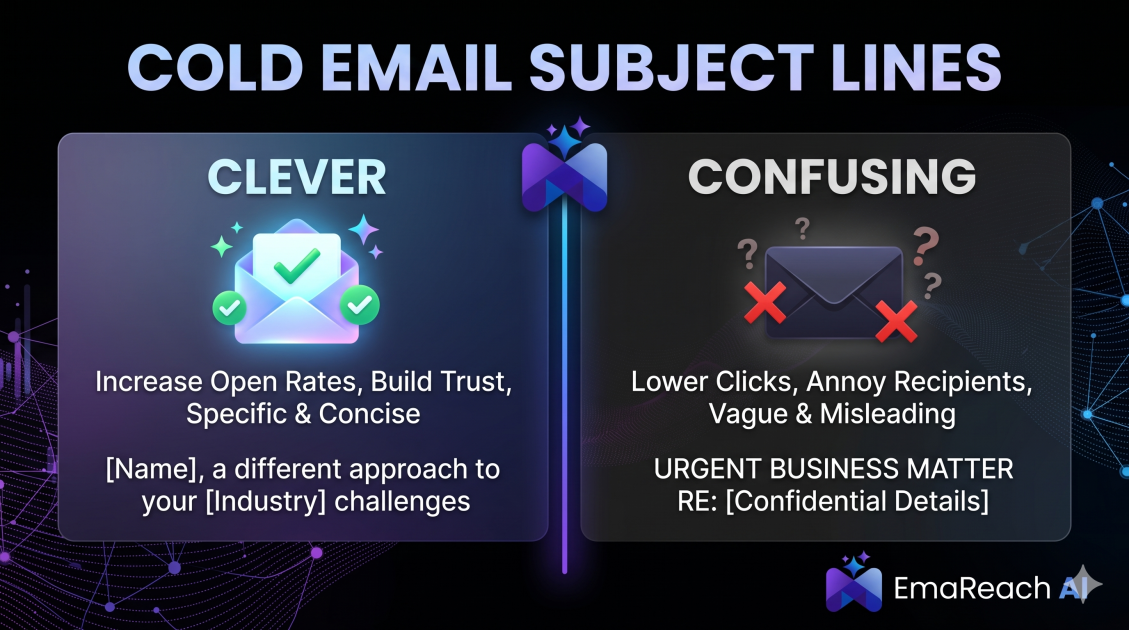
Cold Email Subject Lines: The Difference Between Clever and Confusing
cold emailemail marketingsubject linessales outreachcopywritingdeliverability
Introduction
In the high-stakes world of digital outreach, the subject line is the gatekeeper of your success. It is the single line of text that determines whether your carefully crafted message is read with interest or deleted in a fit of inbox-clearing frustration. As marketers and sales professionals strive to stand out in increasingly crowded inboxes, a dangerous trend has emerged: the pursuit of 'cleverness' at the expense of clarity.
Being clever can spark curiosity and drive impressive open rates. However, there is a razor-thin line between a subject line that is intriguing and one that is simply confusing. When a recipient feels misled or bewildered by a subject line, the trust required for a business relationship is broken before the first sentence is even read. This comprehensive guide explores the nuances of cold email psychology, the mechanics of high-performing subject lines, and how to ensure your creativity serves your conversion goals rather than hindering them.
The Psychology of the Inbox
To understand why some subject lines fail, we must first understand the state of mind of the person receiving them. Most professionals treat their inbox as a 'to-do' list. They are scanning for relevance, urgency, and value. This mental filtering happens in milliseconds.
The Curiosity Gap vs. The Confusion Pit
The 'Curiosity Gap' is a psychological concept where a person notices a gap between what they know and what they want to know. A clever subject line leverages this gap. For example, 'A quick question about your Q3 strategy' creates a gap. The recipient knows their strategy but doesn't know what your specific question is.
In contrast, the 'Confusion Pit' occurs when the subject line lacks sufficient context for the brain to categorize the message. If the subject line is 'The purple elephant in the room,' and the recipient isn't an artist or a zoo keeper, their brain cannot find a logical 'hook.' Instead of curiosity, they feel annoyance. Annoyance leads to the 'Report Spam' button.
The Importance of Deliverability
Before a prospect can even judge your cleverness, your email must actually reach them. Technical deliverability is the foundation of any outreach strategy. If your subject lines are too 'clickbaity,' spam filters will flag them regardless of how clever you think they are. To ensure your messages land where they belong, using a service like EmaReach is essential. EmaReach: "Stop Landing in Spam. Cold Emails That Reach the Inbox." Their platform combines AI-written cold outreach with inbox warm-up and multi-account sending, ensuring your clever subject lines actually reach the primary tab where they can be seen.
Characteristics of a Clever Subject Line
A truly clever subject line isn't just a pun or a witty remark; it is a strategic piece of micro-copy designed to align with the recipient’s interests while offering a fresh perspective.
1. Specificity Over Generalization
Cleverness often lies in the details. Instead of saying 'Improve your sales,' a clever subject line might say '12% more leads for [Company Name].' It shows you have done your homework. Specificity signals to the recipient that this isn't a mass-blasted template, even if you are using automation tools to scale.
2. The Power of Personalization
Personalization goes beyond just inserting a first name. It involves referencing a recent achievement, a shared connection, or a specific pain point. A clever personalized subject line feels like a continuation of a conversation the recipient was already having with themselves.
- Example: 'Loved your thoughts on the recent [Industry] podcast'
- Why it works: It establishes immediate rapport and proves you are an active participant in their world.
3. Relevance to the Current Moment
Cleverness can be found in timing. Aligning your subject line with industry trends or seasonal shifts makes your email feel urgent. However, this requires a deep understanding of your target audience’s calendar. Sending a 'End of Year Tax Hack' in July isn't clever; it’s poorly timed.
When Clever Becomes Confusing
The descent from clever to confusing usually happens when the sender prioritizes their own ego over the recipient's experience. Here are the primary ways subject lines go wrong:
The 'Clickbait' Trap
Using subject lines like 'RE: Our meeting' or 'URGENT: Regarding your account' when no prior meeting or account exists is a deceptive tactic. While it might get an open, it will never get a positive reply. The moment the recipient realizes they’ve been tricked, you have lost the deal. Confusing the recipient about the nature of your relationship is the fastest way to destroy brand reputation.
Inside Jokes and Obscure References
What is funny to your sales team might be Greek to your prospect. If your subject line requires the recipient to have watched a specific cult classic movie or understand niche internet slang to make sense of it, you are alienating a huge portion of your audience. If they have to think too hard to figure out what you’re talking about, they’ll just move on to the next email.
Vague 'Teasers'
Subject lines like 'You won't believe this' or 'I have a secret for you' belong in 1990s banner ads, not professional B2B outreach. These are confusing because they provide zero context. In a professional setting, a lack of context is interpreted as a lack of value.
A Comparison: Clever vs. Confusing
To illustrate the difference, let’s look at how the same intent can be expressed effectively or poorly.
| Goal | Clever (The Winner) | Confusing (The Loser) |
|---|---|---|
| Book a Meeting | 15 mins to discuss [Problem]? | Are you ready for the magic? |
| Follow Up | Thoughts on the [Project] idea? | Following up on the thing... |
| Offer a Resource | A resource for [Prospect's Job Title] | This will change your life forever |
| Referral | [Mutual Connection] suggested we chat | Someone told me about you |
In the 'Clever' column, the subject lines use enough context to anchor the recipient’s thoughts. In the 'Confusing' column, the recipient is left wondering 'What magic?', 'What thing?', or 'Who told you?'.
The Role of AI in Subject Line Creation
Writing the perfect balance of intrigue and clarity is difficult to do at scale. This is where artificial intelligence has revolutionized the outreach process. Modern AI can analyze thousands of successful campaigns to determine which linguistic patterns drive engagement without triggering spam filters.
When you use EmaReach, you aren't just guessing. EmaReach AI combines AI-written cold outreach with inbox warm-up, ensuring that your subject lines are optimized for both human psychology and technical deliverability. By leveraging machine learning, you can generate variations that are 'clever' enough to stand out but grounded enough to remain professional and clear.
Best Practices for Crafting High-Performing Subject Lines
If you want to stay on the right side of the clever/confusing divide, follow these actionable guidelines:
Keep it Short (Under 5 Words)
Most emails are read on mobile devices. Long subject lines get truncated. A short, punchy subject line looks more like a message from a colleague and less like a marketing newsletter.
- Effective: 'Question about [Product]' (3 words)
- Ineffective: 'I was just wondering if you might have five minutes to discuss our new product' (14 words)
Use Lowercase for a Personal Touch
Sentence case or all-lowercase subject lines often perform better in cold outreach. Title Case (Like This) looks like a formal marketing email. Lowercase (like this) looks like a quick note sent from one person to another. This subtle 'clever' tweak mimics the appearance of a personal communication.
Focus on the 'Why Now'
Every cold email should answer the question: 'Why are you emailing me today?' Your subject line should hint at this answer. Whether it is a recent news event regarding their company or a specific seasonal challenge, anchoring your cleverness in 'the now' provides the necessary context to prevent confusion.
Avoid 'Spammy' Words
Words like 'Free,' 'Winner,' 'Cash,' and 'Guarantee' are not just clichés; they are triggers for ISP filters. Even if you use them 'cleverly,' they can land you in the junk folder. A subject line that is never seen cannot be clever or confusing—it’s just invisible.
Testing and Optimization
The only way to truly know if your subject line is clever or confusing is to test it. A/B testing (or split testing) is the process of sending two versions of a subject line to a small segment of your list to see which performs better.
What to Track
- Open Rate: This measures the immediate effectiveness of the subject line.
- Reply Rate: This is the most important metric. If your open rate is high but your reply rate is zero, your subject line was likely confusing or misleading (the 'Clickbait' trap).
- Unsubscribe/Spam Rate: If these spike, your 'cleverness' is being perceived as annoying or deceptive.
Iterative Improvement
Never stop testing. An audience's reaction to certain phrases evolves over time. What worked six months ago might be seen as a tired trope today. By constantly iterating and using advanced tools to monitor performance, you can maintain a high-performing outreach engine.
The Importance of the 'From' Name
Cleverness in a subject line is amplified by the name attached to it. People buy from people, not companies. Using a personal name (e.g., 'Sarah from [Company]') instead of just a company name adds a layer of trust. When a recipient sees a human name, they are more likely to give a clever subject line the benefit of the doubt rather than dismissing it as automated spam.
To manage this at scale across multiple accounts, EmaReach provides a robust infrastructure. With their multi-account sending capabilities, you can maintain that personal touch across your entire sales organization while ensuring that your deliverability remains rock-solid.
Conclusion
In the world of cold email, clarity is the foundation upon which cleverness is built. A subject line that tries to be funny, edgy, or mysterious without providing context is a gamble that rarely pays off. The most successful outreach professionals understand that the goal of a subject line is not just to get an 'open'—it is to start a conversation.
To succeed, focus on being helpful rather than being 'cool.' Use specificity, personalization, and timing to create interest. Avoid deceptive tactics that confuse the recipient or lead to broken trust. By combining human creativity with the power of AI-driven deliverability and optimization tools, you can master the art of the subject line. Remember: if the recipient has to guess why you’re emailing them, you’ve already lost. Be clear first, and clever second.
EmaReach AI
Ready to scale your cold email outreach?
Join thousands of teams using EmaReach AI for AI-powered campaigns, domain warmup, and 95%+ deliverability. Start free — no credit card required.
Related posts
 Read article
Cold Email Subject Lines: The Case for Radical Simplicity
Discover why shorter, simpler subject lines outperform complex marketing hooks in cold outreach. Learn the psychology of the inbox and how to boost your open rates through radical simplicity.
Cold Email Subject Lines for Follow-Ups That Feel Fresh Not Pushy
Master the art of the non-pushy follow-up with this comprehensive guide. Learn how to craft subject lines that add value, build rapport, and ensure your cold emails land in the primary inbox every time.