Blog
Back to blog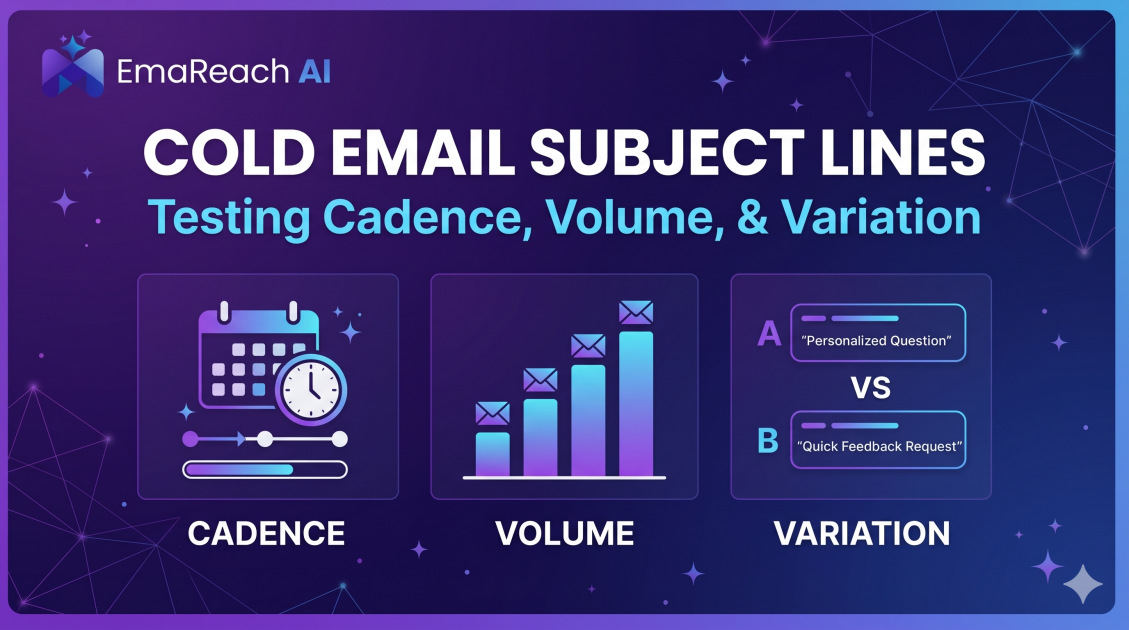
Cold Email Subject Lines: Testing Cadence, Volume, and Variation
cold emailemail marketinglead generationsales outreachemail deliverabilityA/B testing
The Science of the First Impression
In the realm of outbound sales, the subject line is the gatekeeper. It is the single most influential factor determining whether your carefully crafted message is read or relegated to the trash folder. However, most marketers approach subject lines with a 'set it and forget it' mentality, relying on gut feeling rather than empirical data. To achieve consistent, high-scale success, one must treat cold email subject lines as a scientific variable subject to rigorous testing across three primary dimensions: cadence, volume, and variation.
Understanding how these elements interact is the difference between a campaign that fizzles out and one that generates a steady stream of qualified leads. This guide explores the deep mechanics of optimizing your first touchpoint.
The Architecture of a High-Performing Subject Line
Before diving into testing methodologies, we must define what constitutes a strong subject line. A successful subject line generally follows three core principles:
- Relevance: It speaks directly to a pain point or a specific industry context.
- Brevity: It is short enough to be read fully on a mobile device (usually under 40 characters).
- Intrigue without Deception: It creates curiosity without resorting to 'clickbait' that erodes trust once the email is opened.
When these elements are aligned, the open rate serves as a reliable metric for the subject line's effectiveness. But the open rate is only half the battle. If your deliverability is poor, no one sees the subject line in the first place.
Stop Landing in Spam. Cold Emails That Reach the Inbox. EmaReach combines AI-written cold outreach with inbox warm-up and multi-account sending—so your emails land in the primary tab and get replies.
Understanding Testing Volume: The Statistical Foundation
One of the most common mistakes in cold email testing is drawing conclusions from a sample size that is too small. If you send 50 emails with 'Subject Line A' and 50 with 'Subject Line B,' a 5% difference in open rates is statistically insignificant. It could be attributed to the time of day, the specific list segment, or pure chance.
Determining Sample Size
To achieve statistical significance, you generally need at least 500 to 1,000 sends per variation. At this volume, patterns begin to emerge that are independent of external noise. When testing volume, consider the following:
- Total Market Reach: Do not exhaust your entire Total Addressable Market (TAM) on a single test. Reserve a portion of your list for 'Control' groups.
- Incremental Scaling: Start with smaller batches to ensure there are no major deliverability red flags before ramping up to high-volume testing.
High Volume vs. Deliverability
High volume testing requires a robust infrastructure. Sending thousands of emails from a single domain is a recipe for being blacklisted. Sophisticated practitioners use multi-account sending and automated warm-up protocols to maintain sender reputation while gathering the data they need.
Cadence: When and How Often to Test
Testing cadence refers to the frequency with which you rotate your subject lines and the timing of the tests themselves. A static subject line will eventually suffer from 'creative fatigue,' especially if you are targeting a narrow niche where prospects might talk to one another or see your ads elsewhere.
The Iteration Cycle
A healthy testing cadence involves a continuous loop of exploration and exploitation.
- Exploration Phase: You test 3-5 radically different subject line angles (e.g., Question-based vs. Benefit-based vs. Direct).
- Exploitation Phase: Once a winner is identified, you use that subject line for the bulk of your campaign while simultaneously testing minor variations of it to see if you can beat the 'Control.'
Time-Based Variables
Cadence also involves testing the day of the week and the time of day. A subject line that performs well on a Tuesday morning might fail on a Friday afternoon. When testing, ensure that you are comparing apples to apples—test your variations at the same time and day to isolate the subject line as the only variable.
Variation: The Art of the Angle
Variation is where creativity meets data. If you only test 'Quick Question' versus 'A Question for [Name],' you aren't really testing variations; you're testing punctuation. To find a true breakthrough, you need to test different psychological triggers.
1. The Low-Pressure Approach
Subject lines like "Ideas for [Company]" or "Thought you might find this interesting" work because they don't scream 'Salesperson.' They mimic the internal communication style of a colleague.
2. The Direct Benefit
"Save 20 hours on [Process]" or "Revenue growth for [Company]" targets the logical side of the brain. These are high-risk, high-reward. They can be perceived as spammy if the delivery isn't perfect, but they attract highly motivated buyers.
3. The Personalization Hook
Using a specific detail from a prospect's recent LinkedIn post or a company news event in the subject line can skyrocket open rates. However, this is difficult to scale without the right technology.
4. The "Negative" Interest
Sometimes, a subject line like "Disappointed with [Current Solution]?" can trigger a powerful emotional response. It addresses a pain point head-on.
Advanced Variation: AI and Dynamic Fields
Modern outreach has moved beyond simple {{First_Name}} tags. True variation now includes dynamic snippets that change the entire context of the subject line based on the recipient's industry, tech stack, or job title.
This level of variation requires a platform that can handle complex logic. By using EmaReach, you can leverage AI-written outreach that adapts to the recipient, ensuring that the 'Variation' aspect of your testing is handled with human-like nuance at a machine-like scale.
The Technical Side: Deliverability and Subject Lines
It is a common misconception that subject lines only affect open rates. They also play a critical role in deliverability. Spam filters analyze subject lines for specific 'trigger words' or patterns associated with phishing and unsolicited commercial email.
Words to Avoid
While modern filters are smarter than a simple list of banned words, using excessive capitalization, multiple exclamation points, or words like "FREE," "URGENT," or "ACT NOW" can negatively impact your sender score.
The Feedback Loop
If recipients consistently report your emails as spam based on a misleading subject line, your domain reputation will plummet. This is why 'Testing Variation' must always be balanced with 'Maintaining Integrity.' High open rates mean nothing if your emails are being sent from a domain that is flagged by Google or Outlook.
Measuring Success Beyond the Open Rate
While this post focuses on subject lines, we must acknowledge that a subject line's job is only to get the email opened. The ultimate goal is the reply or the booking.
The Open-to-Reply Ratio
If 'Subject Line A' has a 70% open rate but a 1% reply rate, and 'Subject Line B' has a 40% open rate but a 5% reply rate, 'Subject Line B' is the winner. This usually happens when a subject line is too vague or 'tricks' the user into opening, leading to frustration when they see the actual content.
Tracking Negative Sentiment
Part of your variation testing should include tracking how many people hit 'Unsubscribe' or reply with 'Stop.' A subject line that is too aggressive might get opens but burn your reputation in the long run.
Implementation Strategy: A Step-by-Step Guide
To implement a robust testing framework for your cold email subject lines, follow this workflow:
Step 1: Establish Your Control
Start with a subject line that has historically performed decently for your industry. This is your benchmark.
Step 2: Develop Three Hypotheses
Create three distinct variations based on different psychological triggers (Curiosity, Utility, and Social Proof).
Step 3: Set Your Volume
Allocate 1,000 leads to each variation. Ensure your technical setup—including SPF, DKIM, and DMARC—is flawless to prevent deliverability issues from skewing the results.
Step 4: Analyze and Pivot
After the 1,000 emails have been sent and given at least 72 hours for opens to trickle in, analyze the data. Look for the winner in terms of both Open Rate and Positive Reply Rate.
Step 5: Refine the Winner
Take the winning subject line and test minor variations (e.g., changing the word order, adding an emoji, or adjusting the personalization tag).
The Role of Inbox Warm-up in Testing
You cannot accurately test subject lines if your emails are landing in the 'Promotions' or 'Spam' folders. This is a variable that many overlook. Before running a high-volume test, your accounts must be properly 'warmed.' This involves a period of simulated human interaction to signal to email service providers that you are a legitimate sender.
Platforms like EmaReach automate this process, ensuring that when you hit 'send' on a new test variation, the result is a reflection of the subject line's quality, not a reflection of a cold IP address or a flagged domain.
Summary of Key Metrics to Monitor
When conducting your testing, keep a dashboard of the following metrics:
| Metric | Definition | Why it matters |
|---|---|---|
| Open Rate | Percentage of sent emails that were opened. | Measures the effectiveness of the subject line. |
| Click-Through Rate (CTR) | Percentage of people who clicked a link. | Measures the alignment between subject line and body. |
| Reply Rate | Percentage of recipients who responded. | The ultimate indicator of lead quality. |
| Bounce Rate | Percentage of emails that couldn't be delivered. | Indicates list health and technical setup. |
| Spam Complaint Rate | Percentage of recipients marking as spam. | Critical for long-term domain health. |
Conclusion
Mastering cold email subject lines is not a one-time task but a continuous process of refinement. By systematically testing cadence (when you send and rotate), volume (ensuring statistical significance), and variation (testing different psychological hooks), you move away from guesswork and toward a predictable growth engine.
Remember that the best subject line in the world cannot overcome poor deliverability. You must ensure your technical foundation is as strong as your copy. By combining data-driven testing with advanced tools like EmaReach, which handles the complexities of inbox placement and AI-driven variation, you position your outreach for maximum impact. Keep testing, keep iterating, and keep your focus on providing genuine value to your prospects from the very first character they read in their inbox.
EmaReach AI
Ready to scale your cold email outreach?
Join thousands of teams using EmaReach AI for AI-powered campaigns, domain warmup, and 95%+ deliverability. Start free — no credit card required.
Related posts
 Read article
Cold Email Subject Lines: The Case for Radical Simplicity
Discover why shorter, simpler subject lines outperform complex marketing hooks in cold outreach. Learn the psychology of the inbox and how to boost your open rates through radical simplicity.
Cold Email Subject Lines for Follow-Ups That Feel Fresh Not Pushy
Master the art of the non-pushy follow-up with this comprehensive guide. Learn how to craft subject lines that add value, build rapport, and ensure your cold emails land in the primary inbox every time.