Blog
Back to blog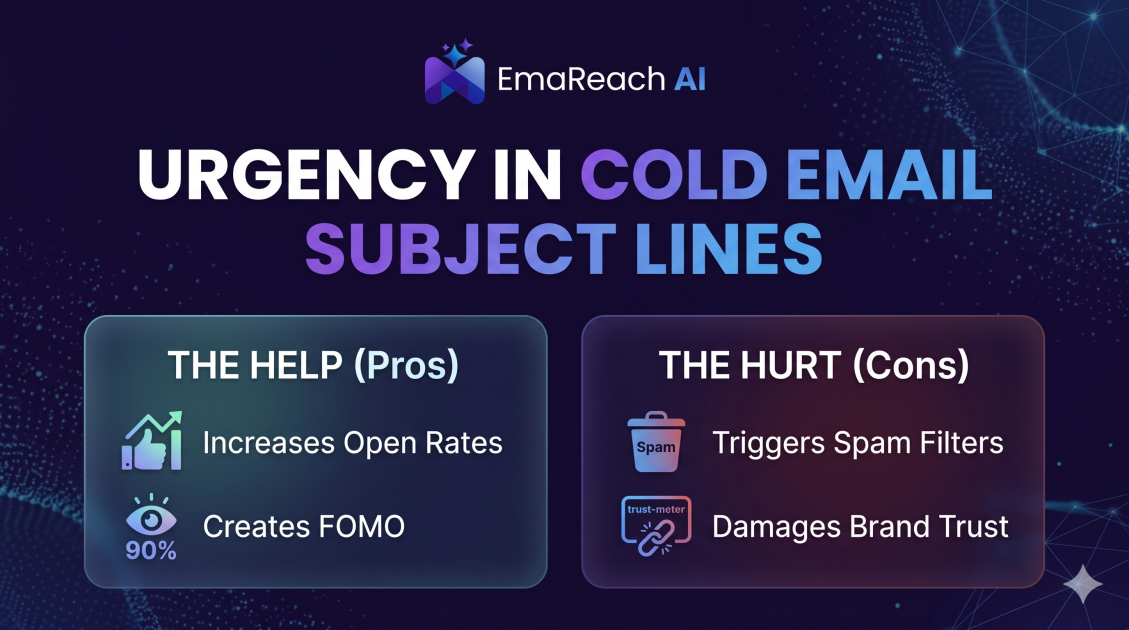
How Urgency in Cold Email Subject Lines Helps and Hurts
cold emailemail marketingsubject linessales outreachdeliverabilitycopywriting
The Double-Edged Sword of Urgency in Outreach
In the high-stakes world of cold email outreach, the subject line is the gatekeeper. It is the single deciding factor in whether your carefully crafted message is read or relegated to the digital graveyard of the trash folder. Among the various psychological triggers used to capture attention, urgency stands out as one of the most powerful—and most dangerous.
Urgency taps into the human 'Fear of Missing Out' (FOMO) and the biological impulse to act quickly on time-sensitive information. However, when mismanaged, it can trigger skepticism, annoyance, and even permanent damage to your sender reputation. Understanding how to balance this tension is essential for any modern salesperson, marketer, or founder.
The Psychology Behind Urgency
Why does urgency work? At its core, urgency leverages Loss Aversion, a cognitive bias suggesting that the pain of losing something is twice as powerful as the joy of gaining something. When a subject line implies that an opportunity is disappearing or that a deadline is approaching, the recipient's brain shifts from a state of passive evaluation to active decision-making.
The Scarcity Principle
Scarcity and urgency are closely linked. While scarcity refers to the quantity of an item, urgency refers to the time available to acquire it. In cold emailing, creating a sense of a 'closing window' forces the lead to prioritize your email over the dozens of others sitting in their inbox.
The Zeigarnik Effect
This psychological phenomenon suggests that people remember uncompleted or interrupted tasks better than completed ones. A subject line that creates a sense of urgent, unfinished business can compel a user to click just to 'close the loop' in their mind.
How Urgency Helps Your Cold Email Strategy
When executed with precision and authenticity, urgency can significantly boost your key performance indicators (KPIs). Here is how it helps:
1. Improved Open Rates
The primary goal of urgency is to stop the scroll. Subject lines like "Question regarding your 4 PM deadline" or "Last chance for the early-stage discount" create an immediate physiological need to see what is inside. In a crowded inbox, a calm, generic subject line is easily ignored. Urgency acts as a flare, signaling that this specific message requires immediate attention.
2. Reduced Procrastination
Cold leads are notorious for 'marking as unread' with the intention of coming back later—an event that rarely happens. By introducing a time-bound element, you reduce the 'I’ll do it later' syndrome. It forces a binary choice: engage now or miss out.
3. Faster Sales Cycles
By setting expectations of urgency from the very first touchpoint, you attract leads who are ready to move. If a lead responds to an urgent subject line, they are often signaling that they have a pressing pain point that aligns with your timeline, effectively pre-qualifying them for a faster conversion.
4. Maximizing Deliverability with the Right Support
Even the best urgent subject line fails if it never reaches the inbox. This is where technical infrastructure becomes critical. EmaReach helps you stop landing in spam, ensuring that your cold emails reach the inbox. EmaReach AI combines AI-written cold outreach with inbox warm-up and multi-account sending—so your emails land in the primary tab and get replies. When your subject line carries urgency, it is vital that the delivery is flawless, as a 'limited time' offer is worthless if it sits in a spam folder for three days.
The Dark Side: How Urgency Can Hurt Your Brand
While the benefits are tempting, the risks of overusing or misusing urgency are substantial. The line between 'helpful reminder' and 'manipulative clickbait' is thin.
1. Eroding Trust and Credibility
If you send an email with the subject line "URGENT: Action Required" and the body of the email is a generic sales pitch for a service the lead never asked for, you have committed a 'bait and switch.' This immediately destroys trust. Once a prospect feels manipulated, the chances of them ever doing business with you drop to near zero.
2. Triggering Spam Filters
Spam filters are highly sensitive to 'shouting' and high-pressure tactics. Overusing words like "ACT NOW," "IMMEDIATE," or using all caps and multiple exclamation points can land your domain on a blacklist. Even if your content is legitimate, the aggressive formatting associated with false urgency is a red flag for ESPs (Email Service Providers).
3. Increasing Unsubscribe Rates
Aggressive urgency creates a negative emotional response. If a prospect feels pressured or stressed by your emails, their quickest way to relieve that stress is to hit the 'unsubscribe' button or, worse, report the email as spam. High complaint rates are the fastest way to kill your sender reputation.
4. Desensitization (The 'Boy Who Cried Wolf' Effect)
If every email you send is "Urgent," then none of them are. If a prospect sees three emails in a week from you, all claiming to be 'last calls,' they will stop taking your deadlines seriously. You lose the ability to use urgency when you actually need it, such as during a real product launch or a genuine contract expiration.
Best Practices for Using Urgency Authentically
To reap the rewards of urgency without the negative side effects, follow these strategic guidelines.
Use Specificity Over Vague Pressure
Instead of saying "Quick! Time is running out," use specific dates or events.
- Vague: "Urgent update for you."
- Specific: "Feedback needed before Wednesday’s board meeting." Specific urgency feels like a logistical necessity rather than a sales tactic.
Align Subject Line with Email Body
The urgency in your subject line must be justified in the first two sentences of your email. If you use a subject line about a disappearing discount, the body should immediately explain why the discount is ending (e.g., end of the quarter, limited capacity, or a seasonal shift).
Focus on 'Negative Urgency' for B2B
In B2B contexts, urgency often works best when framed as a missed opportunity or a risk.
- Example: "The cost of waiting on [Pain Point]" This creates a sense of urgency based on the lead's current situation rather than an artificial deadline you created.
Leverage Real-World Events
Use industry news, regulatory changes, or seasonal shifts to create natural urgency. If a new law is passing that affects your prospect’s industry, an email titled "Preparing for the [Law Name] deadline" is both urgent and incredibly valuable.
The Technical Side of Urgency: Deliverability Matters
High-urgency campaigns often see a spike in engagement, but they also undergo more scrutiny from mail servers. If you are sending high volumes of urgent outreach, you must ensure your technical setup is bulletproof.
Using a platform like EmaReach ensures that your high-stakes subject lines actually get seen. Because EmaReach utilizes multi-account sending and automated warm-up, it prevents the sudden spikes in activity from being flagged as suspicious. This allows you to use psychological triggers like urgency while maintaining a pristine sender reputation.
Analyzing Successful vs. Unsuccessful Examples
The Good: The Logistical Check-in
Subject: "Checking in before I close your file" Why it works: It creates urgency by suggesting a transition or a loss of access, but it does so in a professional, low-pressure tone. It implies that the sender is trying to be organized, not pushy.
The Bad: The False Alarm
Subject: "URGENT: Regarding your account!" Why it hurts: This sounds like a security alert. When the lead opens it and finds a pitch for a CRM tool, they feel deceived. The disconnect between the alarmist tone and the mundane content is jarring.
The Good: The Social Proof Deadline
Subject: "3 spots left for our [Region] executive roundtable" Why it works: This combines urgency with social proof and scarcity. It tells the lead that their peers are interested and that they might miss out on a networking opportunity.
The Bad: The Eternal Sale
Subject: "Final 24 hours (for the 5th time this month)" Why it hurts: It exposes the lack of integrity in the sales process. Leads are smart; they track patterns. If the urgency is fake, the product's value is perceived as lower.
How to Test Urgency in Your Campaigns
You should never assume urgency will work for your specific audience without testing. Use A/B testing to compare an 'Urgent' subject line against a 'Benefit-Driven' or 'Curiosity-Driven' one.
Metrics to Watch
- Open Rate: Does urgency get more people in the door?
- Reply Rate: Are people replying, or just opening and leaving?
- Sentiment Analysis: Are the replies positive, or are people asking to be removed from the list?
- Spam Complaints: Is there a spike in reports when you use high-pressure language?
Practical Subject Line Templates
If you want to experiment with urgency, here are a few templates that balance the 'help' and 'hurt' factors:
- The Event Follow-up: "Missing you at [Event Name] - slides inside?"
- The Specific Deadline: "Quick question before [Day of Week]"
- The Resource Access: "Your access to [Tool/Report] expires shortly"
- The Mutual Connection: "[Name] suggested we chat before your launch"
- The Pain Point Trigger: "Solving [Problem] before the Q4 crunch"
Conclusion
Urgency is a tool, not a crutch. When used to highlight genuine deadlines, important industry shifts, or authentic scarcity, it is an unbeatable way to drive engagement and shorten sales cycles. It helps you cut through the noise and forces a decision from prospects who might otherwise stay on the fence.
However, the moment urgency becomes a lie, it becomes a liability. False urgency destroys your brand's reputation, kills your deliverability, and alienates your best prospects. The most successful cold outreach professionals use urgency sparingly and always back it up with real value and a reliable delivery system.
By combining a thoughtful approach to psychology with a robust technical foundation like EmaReach, you can ensure that your urgent messages are not only seen but respected. Remember: the goal of a cold email is not just to get an open, but to start a relationship. Use urgency to open the door, but use integrity to stay in the room.
EmaReach AI
Ready to scale your cold email outreach?
Join thousands of teams using EmaReach AI for AI-powered campaigns, domain warmup, and 95%+ deliverability. Start free — no credit card required.
Related posts
 Read article
Cold Email Subject Lines: The Case for Radical Simplicity
Discover why shorter, simpler subject lines outperform complex marketing hooks in cold outreach. Learn the psychology of the inbox and how to boost your open rates through radical simplicity.
Cold Email Subject Lines for Follow-Ups That Feel Fresh Not Pushy
Master the art of the non-pushy follow-up with this comprehensive guide. Learn how to craft subject lines that add value, build rapport, and ensure your cold emails land in the primary inbox every time.