Blog
Back to blog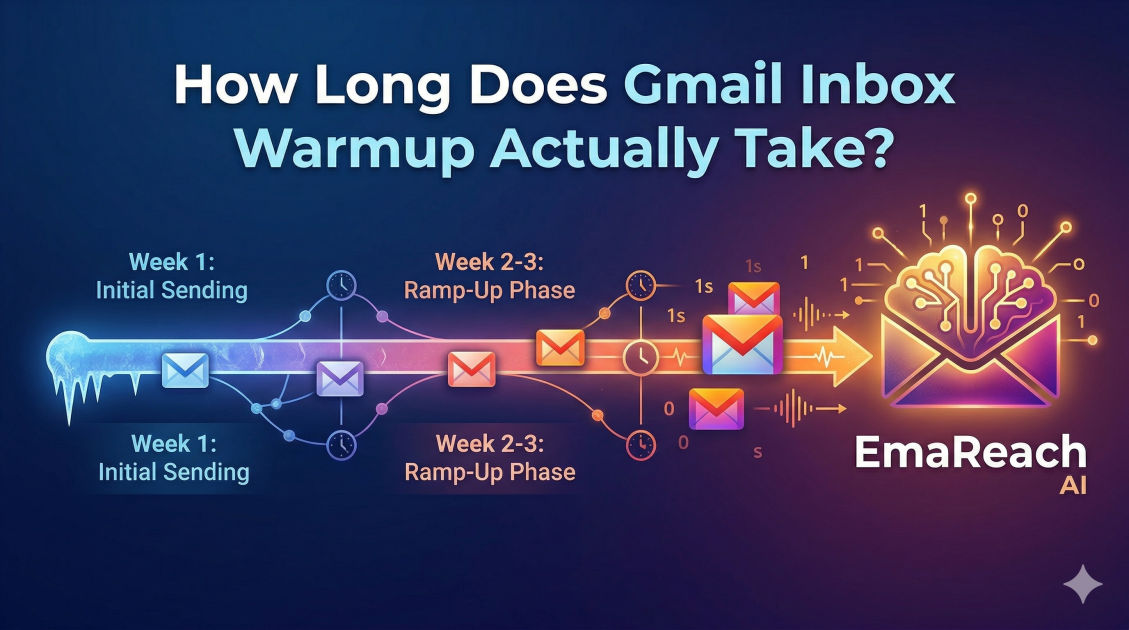
How Long Does Gmail Inbox Warmup Actually Take?
Gmail WarmupEmail DeliverabilityCold OutreachSender ReputationEmail MarketingInbound Strategy
Introduction to Gmail Inbox Warmup
In the world of digital communication and cold outreach, the reputation of your email address is your most valuable asset. When you create a new Gmail or Google Workspace account, you are essentially starting with a blank slate—or worse, a suspicious one. Internet Service Providers (ISPs) and email filters are naturally wary of new accounts that suddenly begin sending a high volume of messages. This is where the concept of inbox warmup comes into play.
Inbox warmup is the process of gradually increasing the sending volume of an email account to build a positive sender reputation. But the question every marketer, salesperson, and founder asks is: How long does it actually take? While there is no magic number that applies to every scenario, understanding the mechanics of Gmail’s filters can help you navigate this period effectively without risking your domain's health.
The Mechanics of Sender Reputation
To understand the timeline, we must first understand what Gmail is looking for. Gmail uses sophisticated machine learning algorithms to determine whether an email belongs in the Primary tab, the Promotions tab, or the dreaded Spam folder. These algorithms evaluate several factors:
- Sending Consistency: Do you send emails at a regular pace, or do you have massive spikes in activity followed by silence?
- Engagement Rates: Do recipients open your emails? Do they reply? Do they mark them as 'Not Spam' if they happen to land there?
- Bounce Rates: Are you sending to valid addresses, or is your list full of outdated data?
- Spam Complaints: How many people are manually clicking the 'Report Spam' button?
If you take a brand-new account and send 100 emails on day one, Gmail’s filters will flag this as 'bot-like' behavior. A human being typically starts slow, emailing colleagues and friends before scaling up to professional outreach. Warmup mimics this natural human behavior.
The Short Answer: The Minimum and Maximum Timelines
Generally speaking, a proper Gmail inbox warmup takes between 4 to 12 weeks.
- The 4-Week Sprint: This is the absolute minimum for accounts that already have an established domain reputation but are using a new inbox. Even then, it is risky.
- The 8-Week Standard: For most professional outreach campaigns, two months of consistent, automated, or manual warming is the industry standard to ensure high deliverability.
- The 12-Week Safety Zone: For brand-new domains (less than 30 days old), a three-month warmup period is recommended. New domains are under intense scrutiny, and rushing the process can lead to a permanent blacklisting of the entire domain.
Phase-by-Phase Breakdown of the Warmup Process
Phase 1: The Foundation (Days 1–14)
During the first two weeks, the goal isn't to send marketing material; it's to establish that a human owns the account. You should focus on high-engagement activities. This includes signing up for newsletters, emailing known contacts who will definitely reply, and keeping the daily volume extremely low—perhaps 5 to 10 emails per day.
Phase 2: Incremental Growth (Days 15–30)
Once the initial two weeks have passed without the account being suspended, you can begin to ramp up. Increase your volume by 2 to 5 emails every few days. By the end of the first month, you might be sending 30 to 50 emails per day. It is crucial during this phase to monitor your 'Sent' vs. 'Open' ratio. If opens start to dip, you are scaling too fast.
Phase 3: Engagement Stabilization (Days 31–60)
This is where the "warmup" transitions into "maintenance." You should be aiming for a volume that mirrors your intended daily outreach. If you plan to send 100 emails a day, you should reach this level by the end of month two. However, volume alone isn't enough. You need consistent replies. Services like EmaReach can be invaluable here. EmaReach AI combines AI-written cold outreach with inbox warm-up and multi-account sending, ensuring your emails land in the primary tab and get real replies, which signals to Gmail that your content is valuable.
Factors That Influence Your Specific Timeline
Not every Gmail account follows the same path. Several variables can speed up or slow down your progress.
1. Domain Age
If your domain has been active for five years, Gmail already trusts the root domain. A new inbox on an old domain might only need 3-4 weeks. If the domain was registered yesterday, you are in the "sandbox" period and must wait longer.
2. Previous Reputation Issues
If you have had an account on the same domain flagged for spam in the past, Google’s filters will be more aggressive toward any new accounts you create. In this case, a longer, slower warmup is mandatory to "cleanse" the domain's reputation.
3. The Quality of Your Content
Plain text emails generally perform better during the warmup phase than HTML-heavy emails. If your warmup emails contain tracking links, large images, or 'spammy' keywords (like "free," "buy now," or "guaranteed"), the filters will penalize you, extending the time it takes to reach the Primary tab.
Manual vs. Automated Warmup
Years ago, people warmed up inboxes manually. They would ask team members to send emails back and forth and reply to each other. While effective, this isn't scalable.
Automated warmup tools have changed the game. These tools use a network of real inboxes to send and receive emails on your behalf. They automatically move your emails from the spam folder to the inbox and mark them as important. While this accelerates the process, it still cannot be bypassed instantly. Even with the best automation, Gmail requires time to observe the pattern of behavior.
Signs Your Gmail Account is Ready
How do you know when the warmup is over? Look for these key indicators:
- Consistent Primary Tab Placement: Send test emails to various Gmail accounts you control. If they consistently land in the Primary tab (not Promotions or Spam), you are on the right track.
- High Open Rates: On a small sample of cold outreach, are you seeing open rates above 40-50%? Low open rates are often a sign of 'shadow-banning' or poor placement.
- Zero 'Soft Bounces': Your emails should be delivered immediately without being held up by Google's servers for 'review.'
Common Mistakes That Reset the Clock
If you make a mistake during the warmup period, you don't just stop moving forward—you often go backward.
- The Sudden Spike: Doubling your volume overnight is the fastest way to get your account restricted.
- Buying Shady Email Lists: If you start sending to a list with a high bounce rate during your warmup, Gmail will assume you are a spammer and kill your reputation instantly.
- Inconsistent Sending: Sending 50 emails on Monday and zero for the rest of the week looks suspicious. Consistency is key to building trust.
Maintaining Reputation After Warmup
Warmup isn't a one-and-done task. It is a state of being. Even after your 8-week period is over, you should continue running warmup software in the background at a lower volume. This provides a "safety net" of positive engagement that offsets any occasional spam complaints from disgruntled recipients.
For those running serious operations, using a platform like EmaReach ensures that this process is handled with AI-level precision. It handles the nuances of multi-account sending so you can focus on the strategy while the technical deliverability is managed automatically.
Conclusion
So, how long does Gmail inbox warmup actually take? While you can start seeing results in 4 weeks, a 6 to 8-week period is the most realistic timeframe for sustainable success. Rushing the process is a gamble where the stakes are your domain's ability to communicate with the world. By being patient, focusing on engagement, and using the right tools to maintain a steady flow of positive interactions, you can ensure that your cold outreach actually reaches the people who need to see it. Remember, in the world of email deliverability, slow and steady doesn't just win the race—it reaches the inbox.
EmaReach AI
Ready to scale your cold email outreach?
Join thousands of teams using EmaReach AI for AI-powered campaigns, domain warmup, and 95%+ deliverability. Start free — no credit card required.
Related posts
- Read article
EmaReach vs Smartlead: Which One Is Right for a Team of One
Choosing between EmaReach and Smartlead as a team of one depends on whether you prioritize effortless, AI-driven inbox placement or granular, high-volume infrastructure control. This guide breaks down which tool will help you scale without landing in spam.
- Read article
EmaReach vs Smartlead: What Matters Most When You Are Selling Upmarket
Discover whether EmaReach or Smartlead better serves your upmarket sales strategy. Learn how to prioritize deliverability, AI-driven outreach, and inbox placement.