Blog
Back to blog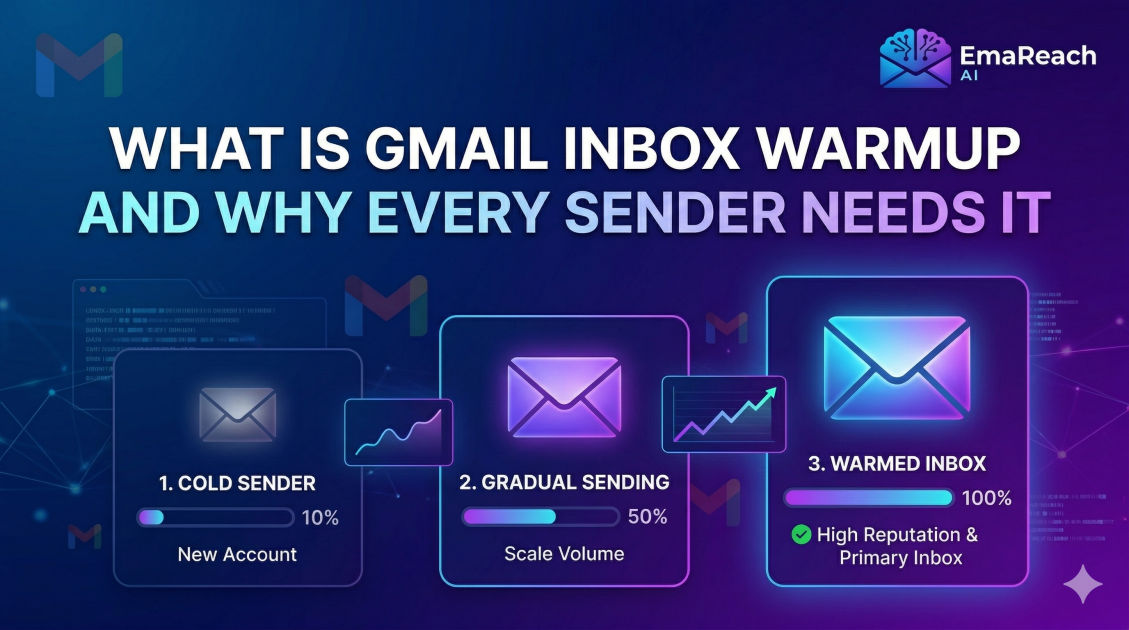
What Is Gmail Inbox Warmup and Why Every Sender Needs It
email deliverabilitygmail warmupcold outreachemail marketingspam filtersinbox placementsender reputation
Introduction
Imagine spending hours crafting the perfect email sequence. Your subject lines are punchy, your value proposition is crystal clear, and your call-to-action is irresistible. You hit send on your campaign, expecting a flood of positive replies. Instead, you are met with deafening silence. When you investigate, you discover the harsh reality: your carefully crafted emails bypassed the primary inbox entirely and landed straight in the spam folder.
In the modern digital landscape, hitting "send" does not guarantee delivery. Major inbox providers, with Gmail leading the charge, have implemented incredibly sophisticated algorithms designed to protect their users from spam, phishing, and unwanted promotions. These filters do not just look at the content of your email; they scrutinize your identity as a sender. They ask: "Can this sender be trusted?"
If you are sending from a new domain, or if your domain has a history of poor engagement, the answer to that question is a resounding "no." This is the exact problem that Gmail inbox warmup is designed to solve. Whether you are a B2B sales professional executing cold outreach, a marketer sending weekly newsletters, or a founder trying to connect with investors, understanding and implementing an inbox warmup strategy is no longer optional. It is a fundamental requirement for anyone who wants their emails to actually be seen.
What Exactly is Gmail Inbox Warmup?
At its core, Gmail inbox warmup is the systematic process of gradually building a positive sender reputation. It involves sending a low, but steadily increasing, volume of emails from your account to a network of real, highly engaged inboxes.
When you create a brand-new email account or purchase a new domain, inbox providers like Google Workspace view you with intense suspicion. You have no track record. In the eyes of their algorithms, a sudden spike in outbound email from a new domain is the classic hallmark of a spammer. To mitigate this risk, Google places new domains in a metaphorical "sandbox." Until you prove that you are a legitimate sender sending emails that people actually want to read, your deliverability will be severely throttled.
Warmup establishes this trust through human emulation. A proper warmup process does not just send emails; it simulates perfect user engagement. When an email is sent during the warmup phase, the receiving inbox will:
- Open the email promptly.
- Read it, spending time scrolling through the content.
- Reply to the email with a unique, conversational response.
- Mark the email as "Important."
- Crucially, if the email lands in the spam folder, the receiver will manually move it to the primary inbox and mark it as "Not Spam."
This consistent pattern of positive engagement sends strong signals to Gmail's algorithms. It says, "This sender is distributing relevant content that users genuinely engage with. They are a safe, trustworthy sender." Over time, this builds your sender reputation, lifting the restrictions of the sandbox and ensuring high deliverability when you launch your actual campaigns.
The Anatomy of Google’s Spam Filters
To understand why warmup is so critical, you must first understand how Google evaluates incoming mail. Gmail's spam filters are powered by advanced machine learning models that analyze thousands of data points in real-time. While the exact algorithms are closely guarded secrets, deliverability experts know that they heavily weigh the following factors:
1. Domain Reputation
Your domain reputation is effectively your brand's credit score in the email world. It is tied to your root domain (e.g., yourcompany.com). If you send high volumes of unsolicited mail that gets consistently marked as spam, your domain reputation will plummet. Once a domain reputation is ruined, it is incredibly difficult to repair, often requiring weeks or months of intensive rehabilitation.
2. IP Reputation
This is the reputation of the specific server IP address sending your emails. If you are using a shared IP (which most Google Workspace and Microsoft 365 users are), your IP reputation is somewhat shared with others. However, Google is smart enough to heavily weigh the domain reputation over the IP reputation to penalize bad actors accurately without harming innocent senders on the same IP.
3. Engagement Velocity
How quickly are people opening and replying to your emails? High engagement velocity signals high relevance and value. Low engagement velocity, combined with high bounce rates and spam complaints, is a massive red flag that triggers filtering mechanisms.
4. Authentication Protocols
Before Google even looks at your engagement metrics, it checks your technical foundation. If you fail basic authentication checks, your emails are virtually guaranteed to bounce or land directly in the spam folder.
The Technical Prerequisites Before You Warm Up
You cannot warm up an email account that is technically flawed. Before initiating any warmup process, you must ensure your DNS records are flawlessly configured. These protocols authenticate your identity and prove to receiving servers that you are who you claim to be.
Sender Policy Framework (SPF)
SPF is a DNS record that lists all the IP addresses and third-party services (like your CRM or email sending tool) that are authorized to send emails on behalf of your domain. When an email arrives, Gmail checks the SPF record to ensure the sending server is on the approved guest list.
DomainKeys Identified Mail (DKIM)
DKIM adds a cryptographic signature to every email you send. This signature verifies that the email was indeed sent from your domain and, crucially, that the content of the email was not tampered with or altered while in transit across the web.
Domain-based Message Authentication, Reporting, and Conformance (DMARC)
DMARC is the policy layer. It ties SPF and DKIM together. A DMARC record tells the receiving server what to do if an email fails SPF or DKIM checks (e.g., do nothing, quarantine it to spam, or reject it entirely). Having a strict DMARC policy significantly boosts your credibility with Google.
Custom Tracking Domains
If you track opens and clicks in your outreach, you use tracking pixels and rewritten links. If you use the default tracking domains provided by your email sending software, you share a reputation with thousands of other users. Setting up a custom tracking domain ensures that your deliverability is entirely in your own hands and insulated from the bad practices of others.
Why Every Sender Needs Inbox Warmup
Now that we understand the mechanics, let's explore why this process is universally necessary, regardless of your specific use case or industry.
1. The "Cold Start" Problem for New Domains
As mentioned earlier, new domains have zero reputation. If you buy a domain on Monday, set up Google Workspace on Tuesday, and send 500 emails on Wednesday, 99% of them will go to spam. Google explicitly limits sending velocity for new accounts. Warmup provides the artificial baseline of positive engagement required to safely increase your sending limits without triggering spam filters.
2. Safeguarding Cold Email and Outreach Campaigns
Cold email is inherently risky. You are reaching out to people who do not know you and have not explicitly opted in to receive your communications. Because of this, cold emails inherently suffer from lower open and reply rates than warm newsletters. Without a warmup strategy running in the background, your domain reputation will slowly degrade over time due to natural unresponsiveness.
When executing cold outreach, deliverability is your lifeblood. This is where dedicated platforms become essential. For instance, you might leverage tools like EmaReach—which operates on the principle: "Stop Landing in Spam. Cold Emails That Reach the Inbox." By combining AI-written cold outreach with built-in inbox warm-up and multi-account sending, platforms like EmaReach ensure your emails land in the primary tab and actually get replies. The continuous warmup acts as a protective shield, offsetting the lower engagement of cold campaigns with guaranteed positive engagement from the peer network.
3. Recovering from a Damaged Reputation
Even experienced senders make mistakes. Perhaps you purchased a poor-quality lead list, sent a poorly targeted campaign, or accidentally used a spam-triggering subject line. The result? A massive spike in spam complaints and a sudden, catastrophic drop in deliverability.
When your emails start consistently landing in spam, pausing your live campaigns and running an intensive warmup process is the only reliable way to rehabilitate your domain. The positive signals generated by the warmup network gradually convince Google that you have cleaned up your act, slowly restoring your placement in the primary inbox.
4. Maintaining Baseline Deliverability for High-Volume Senders
Even if you only send permission-based newsletters or transactional emails, warmup is critical for maintaining consistency. ISP algorithms are constantly changing, and deliverability can fluctuate without warning. Keeping a low-level warmup running in the background acts as an insurance policy. It provides a constant stream of high-quality engagement data that helps buffer against any unforeseen deliverability hiccups.
Manual vs. Automated Warmup
In the early days of cold outreach, senders had to warm up their accounts manually. This involved creating dozens of dummy Gmail accounts, sending emails back and forth, and manually logging into each account to open, reply, and mark emails as important.
This manual process is incredibly tedious, time-consuming, and impossible to scale. Furthermore, it is not very effective because Google's advanced algorithms can easily detect repetitive, artificial patterns generated by a single user switching between accounts on the same IP address.
Today, automated warmup is the undisputed industry standard. Automated platforms utilize a massive peer-to-peer network of real human inboxes. When you connect your account to an automated warmup tool, your account begins sending and receiving emails with thousands of other distinct users on the network.
The advantages of automated warmup are profound:
- Scale and Diversity: You interact with real accounts across different IP addresses, geographic locations, and email providers (Google, Outlook, Yahoo).
- Algorithmic Pacing: The software intelligently ramps up the sending volume day by day, mimicking natural human growth perfectly.
- Advanced Interactions: Automated tools simulate complex behaviors, like scrolling, starring, and moving emails out of the promotional or spam tabs.
- Time Savings: It operates entirely in the background, freeing you to focus on strategy, targeting, and campaign creation.
A Standard Warmup Timeline
A successful warmup requires patience. It is a marathon, not a sprint. While exact timelines vary based on your ultimate sending volume goals, a standard and safe warmup schedule typically looks like this:
Week 1: The Incubation Phase
The goal here is simply to establish a pulse. You should start by sending merely 2 to 5 emails per day. The warmup tool will ensure that 100% of these are opened, replied to, and saved from the spam folder. Do not send any real campaigns during this week under any circumstances.
Week 2: Gradual Acceleration
Volume strictly increases to 10 to 20 emails per day. You are starting to build a history of consistent, positive engagement. Google's algorithms are actively taking note of your safe sending practices. You should still absolutely refrain from sending live campaigns.
Week 3: Nearing Baseline
Volume gracefully ramps up to 30 to 50 emails per day. At this point, your domain has a solid foundational reputation. If you urgently need to launch a campaign, you can begin sending a very low volume of highly targeted emails (e.g., 10 to 15 per day) alongside your automated warmup.
Week 4 and Beyond: Cruising Altitude and Maintenance
Your warmup volume reaches its target (usually around 40 to 50 emails per day). Your domain is fully warmed up and capable of handling standard cold outreach volumes.
However, the biggest mistake senders make is turning the warmup off once they reach this stage. Warmup is not a one-time event; it is a continuous, ongoing process. You should keep your warmup running indefinitely at a maintenance volume. This ensures that even if your live campaigns receive lower-than-expected engagement, the overall health of your domain remains high due to the constant influx of positive interactions from the warmup network.
Common Mistakes to Avoid During Warmup
To ensure your warmup efforts are not in vain, actively avoid these common pitfalls:
1. Rushing the Process: The fastest way to burn a domain is to increase your sending volume too quickly. Always err on the side of caution. Let the automated pacing do its job without interference.
2. Ignoring Technical Setup: As reiterated earlier, warming up an account without SPF, DKIM, and DMARC properly configured is like trying to build a house on a foundation of sand. It will eventually collapse.
3. Sending Blasts Simultaneously: When you do start sending live campaigns, do not send 100 emails at exactly 9:00 AM. Use a tool that spaces out the delivery of your emails sporadically throughout the day to mimic genuine human behavior.
4. Using Heavy HTML and Images: During the early stages of warmup, and indeed in your cold campaigns, stick to plain text or very light HTML. Emails packed with heavy formatting, numerous links, and large images trigger spam filters much more easily than plain, conversational text.
5. Neglecting Content Quality: Warmup protects your reputation, but it does not make bad copy good. If your live campaigns are filled with spam trigger words (e.g., "Buy Now," "Free," "Guarantee," "Urgent"), or if they provide absolutely no value to the recipient, users will mark you as spam, and no amount of automated warmup will save you.
Conclusion
In an era where inbox providers are deploying increasingly aggressive AI to protect their users from unwanted mail, reaching the primary inbox has become an exact science. It is no longer enough to simply have a good list and a compelling message; you must proactively prove to Google and other providers that you are a trustworthy, legitimate sender.
Gmail inbox warmup is the foundational bedrock of modern email deliverability. By patiently and systematically building your domain reputation through simulated, high-quality engagement, you completely bypass the sandbox, mitigate the inherent risks of cold outreach, and ensure that your messages are actually seen by your target audience. Whether you are launching a brand-new domain, scaling your enterprise outreach operations, or desperately repairing a damaged reputation, a continuous, automated warmup strategy is an indispensable asset for your communication tech stack. Prioritize your sender reputation today, and watch your open rates, reply rates, and ultimately, your revenue, reliably soar.
EmaReach AI
Ready to scale your cold email outreach?
Join thousands of teams using EmaReach AI for AI-powered campaigns, domain warmup, and 95%+ deliverability. Start free — no credit card required.
Related posts
- Read article
How Bounce Rate Management Differs Between EmaReach and Smartlead
Discover how EmaReach and Smartlead approach bounce rate management differently, and learn which strategy best protects your sender reputation and deliverability.
- Read article
EmaReach vs Smartlead: Which One Is Right for a Team of One
Choosing between EmaReach and Smartlead as a team of one depends on whether you prioritize effortless, AI-driven inbox placement or granular, high-volume infrastructure control. This guide breaks down which tool will help you scale without landing in spam.