Blog
Back to blog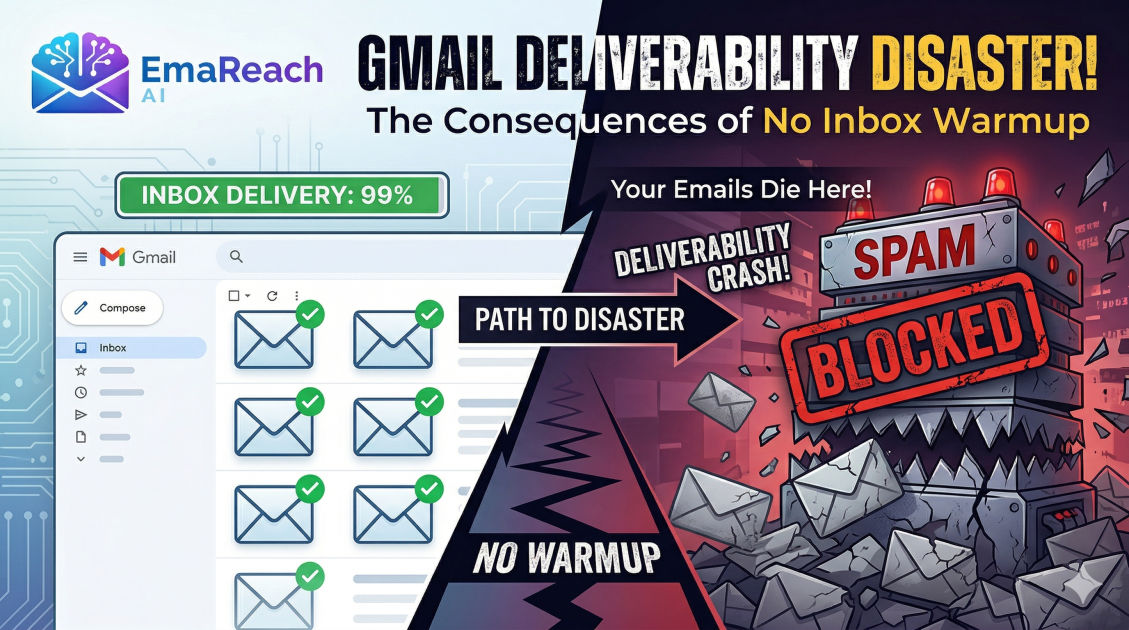
What Happens to Your Gmail Account Without Inbox Warmup
gmail warmupemail deliverabilitycold email strategysender reputationspam filtersgoogle workspaceemail marketing
Introduction
Launching a cold email campaign or transitioning to a new professional Gmail account is often met with high expectations. You have a list of prospects, a compelling offer, and a clean interface ready to go. However, many users overlook a critical technical phase known as inbox warmup. When you skip this process, you aren't just taking a shortcut; you are stepping into a minefield of deliverability issues that can permanently damage your sender reputation.
Understanding the mechanics of Gmail’s filtering system is essential for anyone relying on email for business growth. Without a deliberate warmup strategy, your Gmail account is essentially a 'blank slate' to Google’s sophisticated algorithms. In the world of cybersecurity and anti-spam measures, a blank slate is often treated with extreme suspicion. This article explores the cascading series of negative consequences that occur when you bypass the warmup phase.
The Mechanics of Sender Reputation
Before diving into the consequences, we must understand the concept of sender reputation. Google evaluates every Gmail account based on its historical behavior. This reputation is calculated using factors like your IP address health, domain age, and—most importantly—the engagement levels of your recipients.
When a Gmail account is 'cold,' it has no positive history. If you suddenly start sending fifty or one hundred emails a day from such an account, Google’s automated triggers flag this as 'bursty' behavior. To an algorithm, this looks exactly like a hijacked account being used by a botnet to spread malware or unsolicited commercial content. Without the foundation of a warmup, your reputation begins at a neutral point but can drop into the negative zone within hours.
The Immediate Consequence: The Spam Folder Trap
The most immediate and visible result of skipping warmup is the 'Spam Folder Trap.' When you send emails from an un-warmed account, Gmail’s filters are on high alert. If even a small percentage of your initial emails go unopened or are marked as 'Report Spam' by recipients, the filter concludes that your content is unwanted.
Once you are in the spam folder, it is incredibly difficult to get out. Recipients rarely check their spam folders, meaning your open rates will plummet toward zero. Because Google sees that no one is opening your emails, it assumes the spam filter was correct, creating a feedback loop that reinforces your poor reputation.
The 'Greyzone' and the Promotions Tab
Not every email that bypasses the primary inbox goes to spam. Sometimes, Google places your emails in the 'Promotions' or 'Updates' tabs. While better than the spam folder, these tabs are where emails go to be ignored. Without the engagement signals generated during a warmup process—such as recipients moving your emails from Promotions to Primary—your Gmail account will struggle to ever reach the main view of your prospects.
Warmup mimics organic human behavior, which signals to Google that your emails are important and personal. Without this, your professional communication is categorized alongside mass-marketing newsletters and discount vouchers.
Drastic Drops in Deliverability Rates
Deliverability is not just about whether an email is 'sent'; it is about whether it is 'delivered' to the intended destination. Without warmup, you will notice a steady decline in your delivery success. You might start with a 90% delivery rate on day one, but by day seven, you could see that drop to 40% or lower.
This happens because Google communicates with other Mail Transfer Agents (MTAs). If Gmail’s internal systems flag your account as suspicious, other providers like Outlook or Yahoo may also begin to throttle your incoming messages based on shared blacklists and reputation databases. Skipping warmup doesn't just hurt your standing with Google; it hurts your standing with the entire global email ecosystem.
Account Throttling and Rate Limiting
Google imposes strict limits on how many emails a Gmail or Google Workspace account can send per day. However, these limits are 'ceilings,' not guarantees. For a new or inactive account, Google often applies 'dynamic throttling.'
If you attempt to send 200 emails in a single hour without a history of gradual increases, Google may temporarily block your ability to send any further messages for 24 hours. This is an automated defense mechanism. Without warmup, you are constantly hitting these invisible 'tripwires,' leading to inconsistent campaign performance and disrupted workflows.
The Risk of Permanent Account Suspension
The most severe outcome of ignoring the warmup process is the permanent suspension of your Google Workspace or Gmail account. Google’s Terms of Service are very clear about the use of their platform for spam. If your account shows a pattern of high-volume sending with low engagement and high bounce rates, Google may determine that you are a 'bad actor.'
Once an account is suspended for spamming, the recovery process is grueling and often unsuccessful. You lose access to your emails, your contacts, and any integrated Drive files. For a business, this is a catastrophic loss of infrastructure that could have been avoided with a simple 2-4 week warmup period.
Domain Blacklisting: A Long-term Nightmare
It is important to distinguish between your Gmail address and your domain (e.g., @yourcompany.com). If you use a Google Workspace account and skip the warmup, you risk your entire domain being blacklisted.
Domain blacklists are managed by organizations like Spamhaus or Barracuda. If your domain ends up on one of these lists because of aggressive sending from an un-warmed Gmail account, every single person in your company will face deliverability issues. Even your internal emails or communications to existing clients might start bouncing. Cleaning up a blacklisted domain can take months of technical work and outreach to postmasters, costing your business time and money.
The Psychological Impact: Prospect Burnout
Beyond the technical aspects, there is a human element. When you don't warm up an account, you are often tempted to use broader, less personalized lists to 'see what sticks.' This leads to high 'unsubscription' and 'mark as spam' rates.
Prospects who receive poorly timed or unsolicited emails from an un-warmed account develop a negative association with your brand. You aren't just burning your Gmail account; you are burning your market. A proper warmup period allows you to refine your messaging on a smaller scale, ensuring that when you do reach higher volumes, your content is optimized for the primary inbox.
Why Manual Warmup Fails for Most
Some users attempt to warm up their accounts manually by sending emails to friends or colleagues and asking them to reply. While noble in intent, this is rarely effective at scale. To satisfy Google’s algorithms, you need a diverse range of interactions: different IP addresses, varied reply lengths, and consistent daily growth.
Manual warmup is inconsistent. If you forget to send emails for two days, the algorithm sees a 'dead' account and resets its trust level. This is why automated solutions are the industry standard for professional outreach.
How EmaReach Solves the Deliverability Puzzle
If you want to ensure your Gmail account remains healthy and your outreach is effective, you need a strategy that covers both technical reputation and content quality. This is where EmaReach (https://www.emareach.com/) provides a vital advantage.
EmaReach allows you to Stop Landing in Spam. It ensures your Cold Emails Reach the Inbox by combining AI-written cold outreach with a robust, automated inbox warm-up system. Instead of worrying about the technical nuances of Gmail's filters, EmaReach manages multi-account sending so your emails land in the primary tab and get the replies your business needs to grow. It handles the gradual volume increase and engagement simulation that is nearly impossible to do manually, protecting your domain and your sender reputation.
The Science of Positive Signals
To understand what you miss without warmup, you have to look at what warmup actually provides. A healthy warmup process generates 'Positive Signals' for Google, including:
- Open Rates: High percentages of recipients opening the mail.
- Reply Rates: Meaningful back-and-forth conversations.
- Mark as Not Spam: When an automated system moves an email from spam to the inbox, it is the strongest possible vote of confidence for your account.
- Starring and Archiving: These actions show Google that the recipient values the content and is organizing it rather than deleting it.
Without warmup, you have zero positive signals to counter-balance the inevitable negative signals (like bounces or the occasional 'report spam' click) that come with any outreach.
The Financial Cost of Poor Deliverability
Skipping warmup is a financial decision, and usually a poor one. Consider the cost of your lead list, the salary of the person managing the outreach, and the potential value of a closed deal. If your deliverability is 20% due to a lack of warmup, you are effectively throwing away 80% of your investment.
In contrast, taking the time to warm up an account ensures that your 'cost per lead' remains low because your messages actually reach the people you are paying to contact. The 'time saved' by skipping warmup is quickly lost when you have to spend weeks setting up new domains and accounts because the first ones were burned.
Best Practices to Avoid Gmail Penalties
If you are starting with a fresh Gmail or Google Workspace account, follow these steps to ensure you don't fall victim to the issues mentioned above:
- Verify SPF, DKIM, and DMARC: Ensure your technical DNS settings are perfect. These are your 'digital IDs.'
- Start Small: Send no more than 5-10 emails per day in the first week.
- Increase Incrementally: Add 5-10 emails to your daily limit each week.
- Prioritize Quality: Send your first emails to people you know will open and reply to them.
- Use Automation for Consistency: Human error is the biggest threat to a warmup. Use a dedicated tool to maintain the schedule.
Conclusion
Your Gmail account is a powerful tool for business communication, but it is also a sensitive one. Treating it like a mass-blasting machine without the prerequisite warmup phase is a guaranteed way to land in the spam folder, get your domain blacklisted, or face permanent account suspension.
The 'hidden' mechanics of email deliverability favor those who are patient and strategic. By simulating organic growth and fostering positive engagement signals, you build a sender reputation that can withstand the rigors of professional outreach. Whether you are a solo founder or a large sales team, the rule remains the same: warm up your inbox, or prepare to be ignored by the very people you are trying to reach.
EmaReach AI
Ready to scale your cold email outreach?
Join thousands of teams using EmaReach AI for AI-powered campaigns, domain warmup, and 95%+ deliverability. Start free — no credit card required.
Related posts
- Read article
The Instantly Alternative That Handles High Bounce Rates Without Panic
Discover how transitioning to an advanced Instantly alternative can safeguard your cold email infrastructure. Learn to handle high bounce rates effortlessly using real-time verification, smart mailbox rotation, and automated safety nets to protect your sender reputation and maintain consistent primary inbox placement.
- Read article
Beyond Instantly: The Cold Email Platforms Worth Taking Seriously
Discover the top advanced cold email platforms that go beyond basic multi-inbox rotation. Learn how to optimize your technical infrastructure, leverage advanced personalization, and scale your B2B sales pipeline safely without landing in the spam folder.