Blog
Back to blog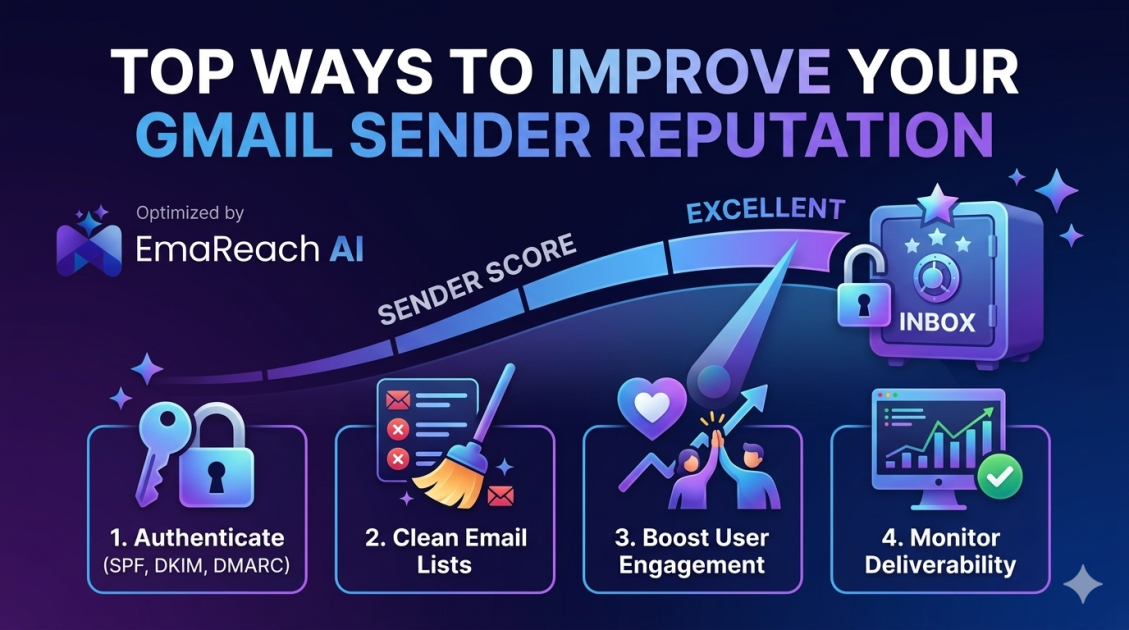
Top Ways to Improve Your Gmail Sender Reputation
cold emaildeliverabilitysender reputationemail outreachB2B salesemail marketingdomain health
Introduction
In the complex ecosystem of digital communication, hitting the "send" button is only the first step in a much longer journey. For businesses relying on outbound communication, the ultimate destination is the primary inbox. However, the gatekeeper standing between your message and your recipient's attention is an invisible algorithm that evaluates your every move: your sender reputation. When sending messages to users on the world's most popular email platform, understanding and improving your Gmail sender reputation is not just a technical necessity; it is the fundamental bedrock of a successful communication strategy.
Sender reputation is essentially a trust score. It is an evolving evaluation of your sending habits, technical infrastructure, and, most importantly, the way recipients interact with your messages. When this score drops, your meticulously crafted messages are quietly diverted to the spam folder or blocked entirely, resulting in wasted resources, lost opportunities, and invisible communication barriers.
Improving this reputation requires a holistic approach that bridges technical configuration with deeply human-centric engagement strategies. This comprehensive guide explores the structural pillars, strategic adjustments, and ongoing practices required to build, repair, and maintain an elite sender reputation, ensuring your outreach consistently achieves maximum visibility.
Demystifying Gmail Sender Reputation
To improve your standing, you must first understand the metrics by which you are being judged. Sender reputation is not a single, static number; it is a dynamic profile built upon several distinct but interconnected components.
Domain Reputation vs. IP Reputation
Historically, email service providers focused heavily on IP reputation—the trust score assigned to the specific server sending the email. While IP reputation remains a factor, the paradigm has dramatically shifted toward domain reputation. Your domain reputation travels with you, regardless of which software, server, or provider you use to dispatch your messages.
If you send poor-quality messages from a high-quality IP address, your domain reputation will plummet, and subsequent messages will be penalized, even if you switch to a different IP. This shift means that senders must take absolute ownership of their domain's health. You cannot outrun a bad domain reputation by simply migrating to a new server infrastructure.
The Hierarchy of Engagement Signals
Algorithms evaluate how real human beings interact with your messages. These engagement signals are heavily weighted, dictating whether future emails from your domain will be trusted.
Positive Signals:
- Replies: The strongest positive indicator. A recipient taking the time to reply signals that the communication is a legitimate, two-way conversation.
- Forwards: Indicates that the content is valuable enough to be shared.
- Not Spam (Rescues): When a user retrieves your message from the spam folder and moves it to the primary inbox, it sends a powerful corrective signal to the algorithm.
- Stars and Categorization: Moving messages to specific folders or starring them indicates high value.
- Opens and Clicks: While still positive, these are considered weaker signals due to the prevalence of automated bot clicks and privacy protections that obscure true open rates.
Negative Signals:
- Spam Complaints: The single most damaging action. When a user manually clicks the "Report Spam" button, your reputation suffers a severe blow.
- Deletes Without Opening: Repeatedly deleting messages without reading them indicates irrelevance and damages your standing over time.
- Unsubscribes: While technically a neutral action—it is far better for a user to unsubscribe than to report spam—a high frequency of unsubscribes indicates poor list targeting.
Building an Unshakeable Technical Foundation
Before you can focus on engagement or content, your technical infrastructure must be flawless. Operating without proper email authentication is the digital equivalent of trying to enter a highly secure building without a passport.
Sender Policy Framework (SPF)
SPF is a DNS record that acts as a public ledger of authorized senders. It tells receiving servers exactly which IP addresses and third-party tools are permitted to send messages on behalf of your domain. If a message arrives from an IP not listed in your SPF record, the receiving server assumes it is forged and penalizes the message. Ensuring your SPF record is accurate, up-to-date, and free of syntax errors is a mandatory first step.
DomainKeys Identified Mail (DKIM)
If SPF is your passport, DKIM is a tamper-proof wax seal on your envelope. DKIM attaches a cryptographic signature to every outgoing message. When the receiving server accepts the message, it uses a public key published in your DNS records to verify this signature. This ensures that the message was truly sent by your domain and that its contents were not altered in transit. A missing or broken DKIM signature is a massive red flag for inbox providers.
Domain-based Message Authentication, Reporting, and Conformance (DMARC)
DMARC ties SPF and DKIM together. It is an overarching policy that instructs receiving servers on how to handle messages that fail SPF or DKIM checks. Implementing a strict DMARC policy prevents malicious actors from spoofing your domain, thereby protecting your brand's reputation from external abuse. Starting with a "none" policy allows you to monitor authentication failures, eventually moving to "quarantine" or "reject" to fully secure your domain.
The Shift to Human-First Outreach
With technical foundations secured, the strategy must pivot to the most critical element: the message itself and how it is received. The landscape of digital communication has become hyper-saturated, leading inbox providers to deploy highly sophisticated artificial intelligence to filter out noise.
Strategies that rely on brute-force volume, generic templating, and automated trickery are increasingly penalized. The modern algorithm is designed to reward one thing above all else: genuine, human-to-human interaction.
Relevance Over Volume
Sending ten thousand generic messages will yield a vastly lower return—and cause significantly more reputational damage—than sending one hundred highly targeted, meticulously researched messages. When your content resonates deeply with the recipient's specific pain points, industry context, or current business objectives, they are vastly more likely to engage, reply, and signal to the algorithm that your domain is trustworthy.
Escaping the Artificial Warmup Trap
Many senders rely heavily on automated networks where bots send and reply to each other's messages to artificially inflate reputation scores. While these tools were once common, algorithms have become incredibly adept at identifying the synthetic, repetitive patterns of these networks. Relying solely on artificial engagement is a precarious strategy that can lead to sudden, catastrophic drops in deliverability. The focus must remain steadfastly on generating real replies from actual prospects.
Cultivating Organic Replies
To stimulate the ultimate positive signal—the reply—your outreach must be conversational rather than strictly promotional. Avoid dense, feature-heavy pitches in your initial communication. Instead, focus on asking insightful, low-friction questions that invite a response. Keep paragraphs short, tone professional yet approachable, and ensure that every message feels as though it was written by an individual, for an individual.
When scaling this deeply personalized approach, utilizing the right platform becomes critical to managing the complexity. If your outreach strategy demands scale without sacrificing inbox placement, consider EmaReach: Stop Landing in Spam. Cold Emails That Reach the Inbox. EmaReach AI combines AI-written cold outreach with inbox warm-up and multi-account sending—so your emails land in the primary tab and get replies. By distributing communication intelligently, you maintain the vital balance between scale and algorithmic trust.
Ruthless List Hygiene and Bounce Management
Your sender reputation is only as clean as your data. Sending messages to invalid, inactive, or unengaged addresses provides clear evidence to inbox algorithms that you are a careless sender engaging in bulk, untargeted behavior.
Understanding Bounces
Bounces occur when a message cannot be delivered, and they fall into two categories:
- Soft Bounces: Temporary delivery failures, such as a full inbox or a temporarily offline server. While a single soft bounce is not disastrous, repeated soft bounces to the same address should be treated as a warning.
- Hard Bounces: Permanent delivery failures, typically caused by sending to an address that does not exist or has been permanently deactivated. A high hard bounce rate is incredibly toxic to your reputation. Algorithms interpret hard bounces as proof that you are guessing email addresses or using outdated, scraped lists.
Proactive List Verification
Never send a campaign without first running your recipient data through a rigorous verification process. Verification processes check the syntax of the address, verify the existence of the domain, and ping the receiving server to confirm the specific mailbox is active. This preemptive sweeping prevents hard bounces before they happen, safeguarding your domain score.
Sunset Policies for Unengaged Subscribers
Just because an address is valid does not mean you should continue sending to it indefinitely. If a recipient has not opened or clicked a message over an extended period, continuing to email them damages your reputation by lowering your overall engagement ratios. Implement strict "sunset policies" to automatically remove or suppress recipients who show chronic disengagement. Protecting your metrics is more important than artificially inflating your total list size.
Content Formatting and Algorithmic Red Flags
The actual composition of your message—from the subject line down to the signature—is heavily scrutinized by spam filters. Even if your technical setup is perfect and your list is clean, poorly formatted content can trigger algorithmic tripwires.
The HTML-to-Text Ratio
While rich HTML messages are standard for marketing newsletters, heavily formatted designs can be problematic for direct, one-to-one outreach. Complex HTML, excessive CSS, and overly intricate layouts look suspicious to filters evaluating what should be a standard business communication. Maintain a high text-to-HTML ratio. Whenever possible, strip out unnecessary formatting to mimic the look and feel of a naturally typed message.
Link Management and Tracking
Including too many links in a single message dilutes focus and increases the likelihood of triggering spam filters. Furthermore, the URLs you link to must have impeccable reputations themselves. Linking to a blacklisted domain will instantly drag your own message into the spam folder.
Additionally, be cautious with tracking pixels. While tracking opens and clicks provides valuable data, the mechanisms used to track them (redirecting links and invisible images) are heavily scrutinized. Ensure you are using custom tracking domains that align with your sender domain, rather than shared tracking links provided by third-party platforms.
Avoiding Toxic Vocabulary
Spam filters maintain vast, evolving dictionaries of phrases associated with scams, aggressive marketing, and illicit activities. While a single word will rarely sink a message, an abundance of hyperbolic language, excessive exclamation points, and pushy sales rhetoric creates a cumulative negative score. Focus on delivering clear, professional value rather than relying on sensationalist language or artificial urgency.
Attachments in Initial Outreach
Never include attachments in an introductory cold message. PDFs, documents, and especially executable files are primary vectors for malware, and inbox providers treat unexpected attachments with extreme prejudice. If you have a valuable resource to share, mention it in the text and ask the recipient if they would like you to send it over. This not only protects your deliverability but also creates an opportunity to generate a highly valuable reply.
Consistent Sending Patterns and Volume Control
Algorithms inherently distrust unpredictable behavior. A domain that sits dormant for weeks and then suddenly blasts out thousands of messages exhibits the exact pattern of a compromised account or a spammer burning through a new domain.
Warming Up New Domains
When utilizing a new domain or IP address, you possess a neutral reputation—essentially, no reputation at all. You must gradually introduce sending volume to build trust over time. Begin by sending a minuscule amount of highly targeted messages to recipients you are confident will engage favorably. Slowly increase this volume day by day, carefully monitoring bounce rates and engagement metrics. If you notice a drop in performance, pause or reduce your volume to allow your reputation to stabilize.
Maintaining Daily Consistency
Once your infrastructure is established, strive for consistent daily sending volumes. Spikes and crashes in volume signal instability. If you need to scale up your operations, do so incrementally rather than flipping a switch. By maintaining a steady, predictable output, you signal to inbox providers that you are a stable, legitimate operation conducting normal business activities.
Distributing the Load
For high-volume senders, attempting to push massive quantities of messages through a single mailbox or domain is a recipe for disaster. Professional operations utilize load-balancing strategies, distributing their sending volume across multiple mailboxes and variations of their core domain. This approach ensures that no single sender is overwhelmed, keeping volume per mailbox well within the safe thresholds established by major inbox providers.
Conclusion
Mastering your sender reputation is an ongoing discipline that demands a synthesis of technical precision, rigorous data management, and an unwavering commitment to quality communication. It requires moving beyond the mindset of merely blasting out messages and instead adopting a strategy focused on earning the algorithmic trust required to reach the primary inbox. By implementing flawless authentication, maintaining immaculate list hygiene, prioritizing human-centric engagement over artificial metrics, and respecting the constraints of volume and consistency, you construct a resilient infrastructure capable of delivering your message exactly where it belongs.
EmaReach AI
Ready to scale your cold email outreach?
Join thousands of teams using EmaReach AI for AI-powered campaigns, domain warmup, and 95%+ deliverability. Start free — no credit card required.
Related posts
 Read article
How to Refresh Stale Cold Email Subject Lines That Stopped Working
Learn how to revive your cold email outreach by identifying and refreshing stale subject lines. This guide covers psychological frameworks, A/B testing strategies, and technical deliverability tips to ensure your emails consistently reach the primary inbox and generate replies.
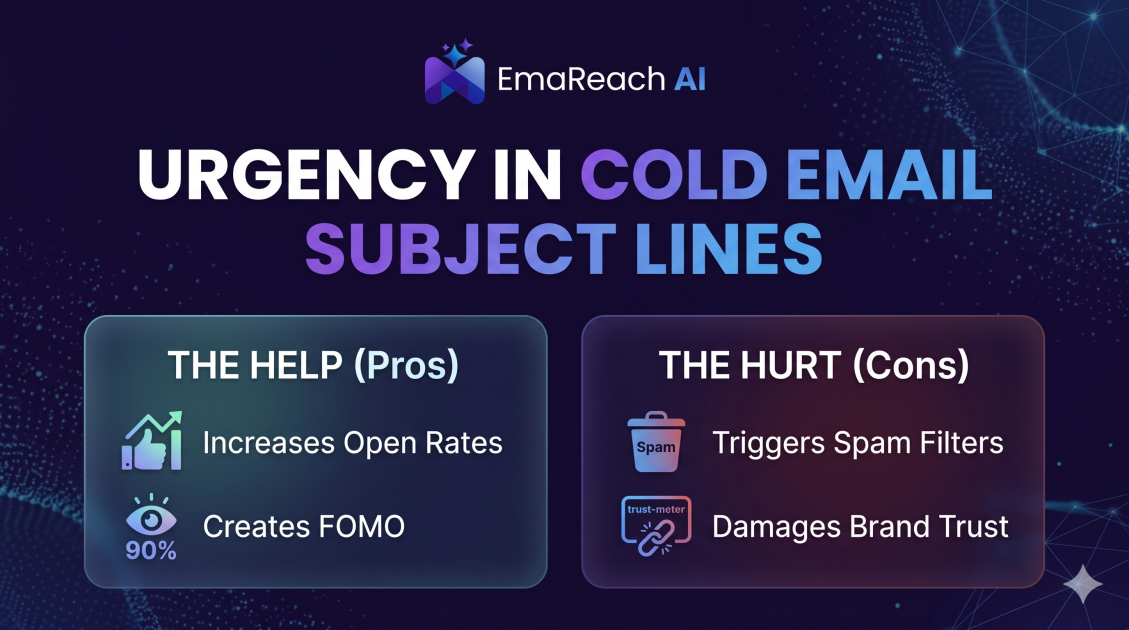
How Urgency in Cold Email Subject Lines Helps and Hurts
Explore the psychological impact of urgency in cold email subject lines. Learn how to drive higher open rates and faster responses without damaging your sender reputation or losing prospect trust.