Blog
Back to blog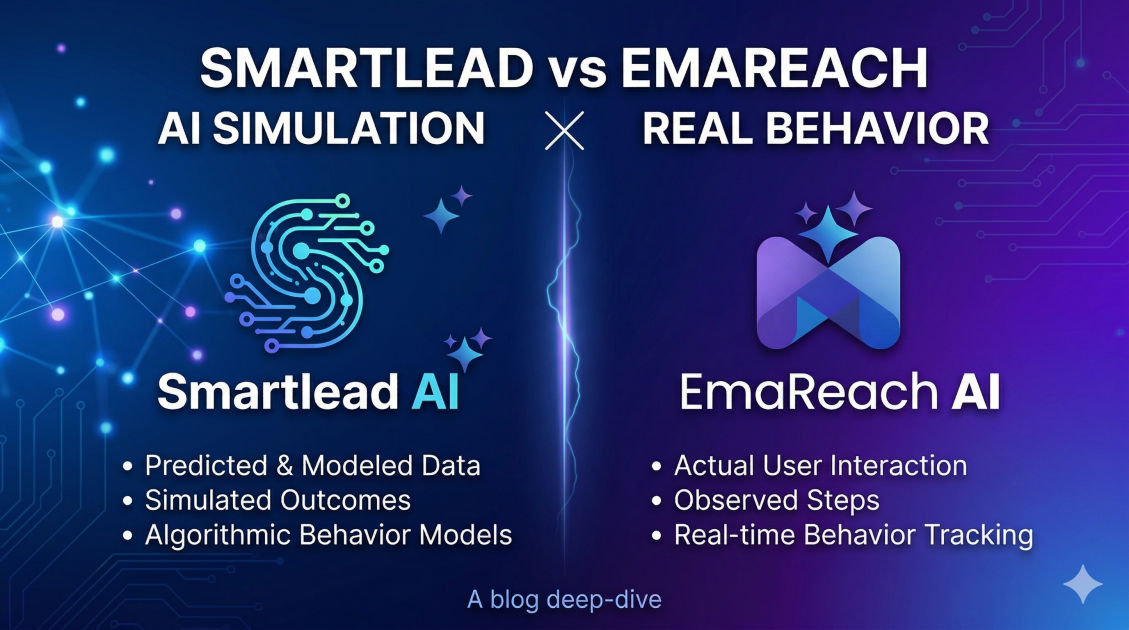
Smartlead vs Emareach: AI Simulation vs Real Behavior
cold emailoutreachdeliverabilityemail automationlead generationAI sales tools
Introduction: The Evolution of Cold Outreach
In the competitive landscape of digital sales, the methods used to reach potential clients have undergone a massive transformation. We have moved past the era of mass-blasting generic templates to thousands of unsuspecting recipients. Today, the game is won or lost in the inbox. If your message doesn't land in the primary tab, it doesn't exist.
Two major philosophies have emerged in the world of email automation: AI Simulation and Real Behavior. While many platforms focus on scaling volume, the industry is shifting toward authenticity. This brings us to a critical comparison: Smartlead, a titan of scale, versus Emareach, a pioneer in behavioral authenticity. Understanding the difference between simulating activity and mirroring real human behavior is the key to sustainable deliverability.
The Philosophy of AI Simulation
AI simulation in cold email refers to the use of algorithms to mimic human-like patterns in sending and warming up accounts. For years, this was the gold standard. Tools like Smartlead built their reputation on allowing users to manage hundreds of sender accounts from a single dashboard, using automated 'warm-up' protocols to convince ISPs (Internet Service Providers) that the accounts were active.
How Simulation Works
Simulation usually involves a network of 'seed' accounts that talk to each other. These accounts send templated messages back and forth, move emails out of spam folders, and mark them as important. On paper, this looks like engagement. However, as Google and Microsoft have updated their spam filters, they have become increasingly adept at identifying these artificial loops.
The Limitations of Automated Loops
When thousands of accounts are all performing the exact same 'random' actions provided by the same software provider, patterns emerge. If the simulated behavior lacks the nuance of a real human workday—varying response times, diverse IP addresses, and unique content—the ISP eventually flags the entire network. This is where simulation often fails: it is predictable by nature.
The Power of Real Behavior: The Emareach Approach
In contrast to pure simulation, Real Behavior focuses on creating an environment that is indistinguishable from a legitimate business user. This is where EmaReach takes a different path. Instead of relying solely on repetitive loops, it emphasizes the technical and creative fundamentals that satisfy modern spam filters.
Stop Landing in Spam. Cold Emails That Reach the Inbox. EmaReach AI combines AI-written cold outreach with inbox warm-up and multi-account sending—so your emails land in the primary tab and get replies.
By focusing on Real Behavior, the system prioritizes the quality of the interaction. This includes deep personalization that makes every email unique, ensuring that no two messages sent from your domain are identical. ISPs view unique, high-value content as a sign of a legitimate sender, whereas repetitive, simulated templates are the hallmark of a spammer.
Smartlead: A Powerhouse for Volume
Smartlead has long been a favorite for agencies and high-volume lead generation firms. Its infrastructure is built for those who need to send thousands of emails per day across a wide array of domains.
Key Features of Smartlead
- Master Inbox: A centralized hub to manage replies from hundreds of different accounts.
- Automated Warm-up: A built-in feature designed to slowly ramp up sending volume.
- Multi-channel Capabilities: Integrating LinkedIn and other channels into the workflow.
While Smartlead provides incredible infrastructure, the burden of 'Real Behavior' often falls on the user. If the user doesn't meticulously craft their templates and manage their reputation, the 'simulation' aspect of the warm-up can only do so much to protect them from the latest algorithm updates.
Emareach: Precision and Deliverability
Emareach is designed for the modern era where 'sending more' is no longer the solution. Instead, the focus is on 'landing more.' The platform bridges the gap between AI efficiency and human-level authenticity.
The EmaReach Edge
- AI-Driven Content Creation: Unlike standard templates, EmaReach uses advanced AI to write emails that feel personal and relevant. This avoids the 'fingerprinting' that occurs when the same template is sent to hundreds of people.
- Sophisticated Warm-up: The warm-up process isn't just about volume; it's about building a reputation through diverse interactions.
- Inbox Placement Focus: The entire architecture is geared toward the primary tab. By mimicking real user behavior—such as varying the time between sends and using human-like drafting patterns—it bypasses the 'Promotions' and 'Spam' filters.
Technical Deep Dive: Simulation vs. Reality
To understand why Real Behavior wins, we must look at how ISPs like Gmail and Outlook analyze incoming mail. They look at hundreds of data points, including:
1. The Content Fingerprint
Simulation tools often use 'Spintax'—a method of swapping words (e.g., {Hi|Hello|Hey}). While this provides some variety, the underlying structure of the email remains the same. Modern AI can detect these structures easily. Real Behavior requires the AI to actually understand the context of the recipient and write a unique message from scratch, which is exactly what EmaReach facilitates.
2. Sending Patterns
Simulated systems often send emails in bursts or at perfectly regular intervals (e.g., one email every 3 minutes). A real human doesn't work like that. A real human might send three emails, take a coffee break, reply to an incoming thread, and then send ten more. Emareach mimics these irregular, human rhythms to stay under the radar of sophisticated detection systems.
3. Engagement Ratios
In a simulated environment, the 'replies' often come from other accounts within the same warm-up pool. ISPs are starting to track the 'quality' of the accounts you interact with. If your only engagement is with other brand-new, warm-up accounts, it looks suspicious. Real behavior involves reaching out to established domains and receiving genuine replies, which signals to the ISP that you are a trusted entity.
Why Deliverability is the Only Metric That Matters
You can have the best sales pitch in the world, but if your email lands in the spam folder, your conversion rate is 0%. The shift from Smartlead’s simulation-heavy model to a more behaviorally-focused model like Emareach reflects a change in the industry’s priorities.
The Cost of Poor Deliverability
- Burned Domains: Once a domain is blacklisted, it is incredibly difficult to recover.
- Lost Revenue: Every missed inbox is a missed opportunity for a meeting or a sale.
- Brand Damage: Landing in spam can hurt your professional reputation if prospects eventually find your mail there.
By choosing a platform that prioritizes real behavior, you are essentially buying 'insurance' for your domain's reputation. EmaReach ensures that your cold emails reach the inbox by combining the scale of AI with the nuance of human interaction.
Scalability vs. Sustainability
Smartlead is often praised for its ability to scale. If you want to connect 500 email accounts today, Smartlead makes it easy. However, the question isn't whether you can scale, but whether that scale is sustainable.
Sustainability in cold email requires a platform that evolves as fast as the spam filters do. As Google and Microsoft implement stricter AI-detection and bulk-sender policies, the 'simulation' methods used by older tools become less effective. The future belongs to tools that don't just simulate activity but actually generate high-quality, human-centric interactions.
When to Choose Smartlead
- You have a massive team and need complex sub-account management.
- You are running multi-channel campaigns that require heavy LinkedIn integration.
- You have an in-house deliverability expert who can manually fine-tune every setting.
When to Choose Emareach
- Your primary goal is ensuring emails land in the Primary Tab.
- You want AI to handle the heavy lifting of writing personalized, high-converting copy.
- You need a system that manages deliverability automatically using behavioral science rather than just volume-based simulation.
Implementing a Behavioral Strategy
If you are ready to move away from pure simulation and toward a behavior-based outreach strategy, here are the steps you should take:
Step 1: Diversify Your Infrastructure
Don't put all your eggs in one basket. Use multiple domains and multiple providers. This is a core tenet of the EmaReach philosophy—spreading the load to ensure no single point of failure.
Step 2: Leverage Advanced AI for Content
Stop using templates. Use AI to analyze your prospect's website or LinkedIn profile and generate a first line that is truly unique. This is the ultimate 'Real Behavior' signal.
Step 3: Monitor Your Reputation Constantly
Deliverability isn't a 'set it and forget it' task. You need a platform that gives you real-time feedback on your sender score and inbox placement.
Conclusion: The Future is Authentic
The battle between Smartlead and Emareach isn't just about features; it's about a shift in the philosophy of communication. While simulation served its purpose in the early days of automation, the modern inbox demands more. It demands relevance, timing, and authenticity.
Smartlead remains a powerful tool for those who need sheer infrastructure and have the expertise to manage it. However, for businesses that want to ensure their messages actually get read, the focus must shift to behavior. By mimicking the way real humans communicate—and using AI to scale that authenticity—Emareach provides a path forward in an increasingly filtered world.
In the end, the most successful outreach isn't the one that sends the most emails; it's the one that builds the most relationships. To do that, you need to stay out of the spam folder and in the conversation. Choose the path of real behavior, and your deliverability will follow.
EmaReach AI
Ready to scale your cold email outreach?
Join thousands of teams using EmaReach AI for AI-powered campaigns, domain warmup, and 95%+ deliverability. Start free — no credit card required.
Related posts
- Read article
The Instantly Alternative That Finally Gets Outbound Analytics Right
Discover why high-volume cold email requires a shift from surface-level vanity metrics to deep, data-driven revenue attribution, and explore the ultimate alternatives for mastering outbound engineering.
- Read article
What Three Months on an Instantly Alternative Revealed About Our Outreach
Discover the profound lessons learned from a 90-day experiment moving away from traditional cold email setups. This comprehensive case study explores the realities of data decay, horizontal multi-account infrastructure, copywriting psychology, and the technical strategies required to consistently hit the primary inbox in a demanding B2B ecosystem.