Blog
Back to blog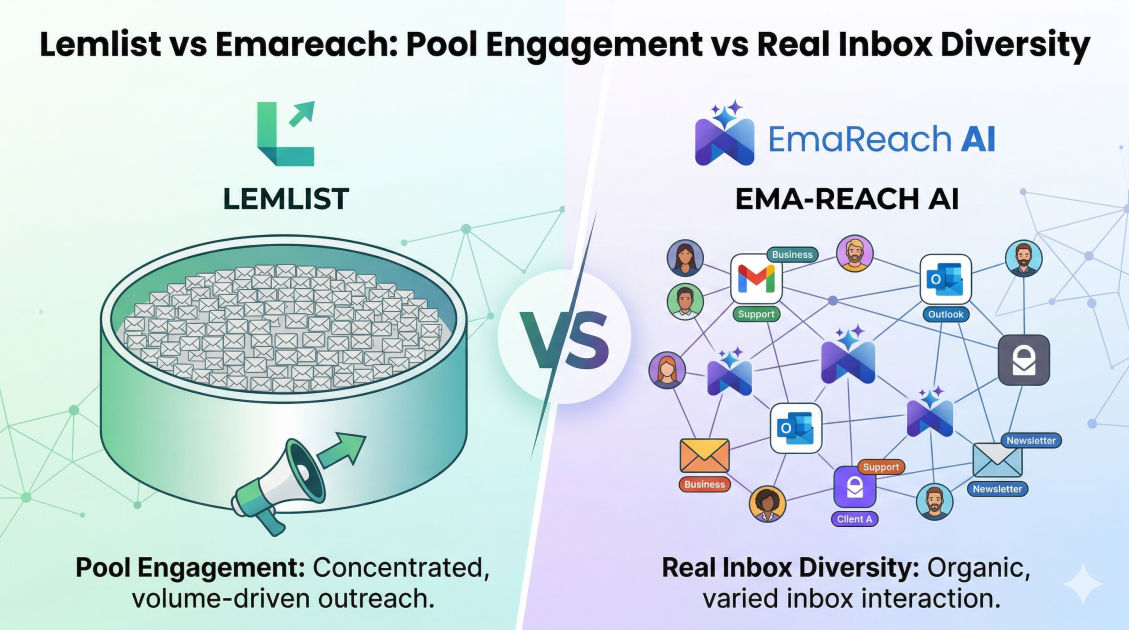
Lemlist vs Emareach: Pool Engagement vs Real Inbox Diversity
cold emailemail deliverabilityoutreach strategysales automationemail warm-upB2B marketing
Introduction to the Cold Outreach Evolution
Cold email has undergone a massive transformation. Gone are the days when you could simply blast thousands of generic messages from a single Gmail account and hope for the best. Today, the gatekeepers—service providers like Google and Microsoft—have deployed sophisticated algorithms designed to protect users from unsolicited noise. This shift has birthed a specialized industry of outreach tools, each claiming to have the secret sauce for bypassing spam filters.
At the heart of the modern deliverability debate are two distinct philosophies: Pool Engagement and Real Inbox Diversity. While legacy tools like Lemlist have popularized the concept of 'warm-up pools,' newer, more advanced platforms like EmaReach are championing a more sophisticated approach. Understanding the nuance between these two methodologies is the difference between a campaign that generates revenue and one that gets your domain blacklisted.
The Lemlist Philosophy: The Power and Limits of the Pool
Lemlist entered the market as a pioneer of personalization. They realized early on that images and videos could increase response rates. However, as deliverability became harder to maintain, they integrated a feature known as Lemwarm. This was one of the first mainstream 'warm-up' tools designed to simulate human activity.
How Pool Engagement Works
Lemlist’s warm-up strategy relies on a closed ecosystem—a 'pool.' Within this pool, thousands of Lemlist users' accounts automatically send emails to one another. When your account sends an email to another user in the pool, their account automatically opens it, marks it as 'not spam,' and replies. This reciprocal activity signals to ISPs (Internet Service Providers) that your account is active and respected by other users.
The Strengths of the Pool Model
- Safety in Numbers: With a massive user base, the sheer volume of the pool allows for a high frequency of interactions.
- Ease of Use: It is largely a 'set it and forget it' system for beginners.
- Positive Signaling: It creates a baseline of engagement that is better than sending cold emails from a completely cold domain.
The Critical Weaknesses of Pool Systems
Despite its popularity, the pool model has a significant flaw: predictability. Because the interactions occur between a finite set of users who are all using the same software, ISPs can eventually identify the patterns. If Google notices that 10,000 accounts are all emailing each other in a closed loop, the 'positive' signals lose their weight. The engagement becomes artificial, and if the pool itself is flagged, every account within it suffers a reputation hit by association.
Enter EmaReach: The Shift to Real Inbox Diversity
While traditional tools focus on internal loops, a new standard has emerged. Stop Landing in Spam. Cold Emails That Reach the Inbox. EmaReach was built on the realization that ISPs don't just look for engagement; they look for diverse and authentic engagement. EmaReach AI combines AI-written cold outreach with inbox warm-up and multi-account sending—so your emails land in the primary tab and get replies.
What is Real Inbox Diversity?
Real Inbox Diversity refers to an outreach strategy that mimics the natural behavior of a high-level executive or a legitimate business professional. Instead of just talking to other 'warm-up bots,' your domain interacts with a wide variety of ESPs (Email Service Providers), different domain ages, and varied IP reputations. This creates a 'noise' profile that is indistinguishable from genuine human business activity.
Why Diversity Matters for Deliverability
ISPs use machine learning to profile 'good' senders. A good sender doesn't just email other marketers; they email customers, vendors, and colleagues across different platforms (Outlook, Google Workspace, Zoho, etc.). If your warm-up activity only targets one or two of these, your reputation is lopsided. EmaReach focuses on diversifying these interactions to ensure your domain is trusted globally, not just within a specific tool's ecosystem.
Technical Comparison: Under the Hood
To truly understand the difference between Lemlist and EmaReach, we have to look at the technical mechanics of how they handle your sender reputation.
1. AI vs. Template Personalization
Lemlist is famous for its liquid syntax and custom images. While visually appealing, these are still fundamentally templates. Modern spam filters are now capable of 'reading' the underlying structure of an email. If they see the same template structure being used by thousands of senders, they may flag it as bulk mail.
EmaReach takes a different path by leveraging AI-driven content generation. By using AI to craft unique variations for every single recipient, EmaReach ensures that no two emails are identical. This breaks the pattern-matching algorithms of spam filters, making each message appear as a one-to-one communication.
2. Multi-Account Orchestration
Sending 100 emails a day from one account is risky. Sending 20 emails a day from five accounts is a professional strategy. While Lemlist allows for multiple accounts, EmaReach is built from the ground up for multi-account sending. This infrastructure allows you to scale your volume horizontally rather than vertically, keeping each individual sender profile well below the 'danger zone' of ISP monitoring.
3. The Warm-up Algorithm
The Lemlist warm-up (Lemwarm) focuses on volume and reciprocal replies. In contrast, EmaReach's warm-up algorithm is designed to be 'stealthy.' It varies the time of day, the length of the replies, and the 'interest' level of the response. This creates a realistic engagement graph that satisfies even the most aggressive security filters at major corporations.
The Dangers of 'Pool Contamination'
A significant risk with pool-based systems like Lemlist is the 'bad neighbor' effect. In a pool, you are linked to every other user. If a high percentage of users in the pool are sending low-quality, high-spam content, the pool's overall reputation can dip. Even if you are a 'good' sender, being part of a contaminated pool can drag your deliverability down.
EmaReach mitigates this by focusing on Isolated Diversity. By using a more sophisticated AI layer to manage interactions, it prevents the cross-contamination of reputations. Your warm-up is unique to your industry and your sender profile, providing a protective layer that simple pool systems cannot match.
Content Strategy: Beyond the 'Hello'
Deliverability isn't just about technical settings; it's about content. Lemlist encourages 'clever' outreach, which worked well in the past. However, today’s filters are wary of 'marketing speak.'
EmaReach integrates the content creation process directly into the deliverability engine. By understanding which types of phrases trigger spam filters (e.g., 'free,' 'guaranteed,' 'investment'), the AI adjusts the copy in real-time. This synergy between the message and the delivery mechanism is what allows EmaReach users to maintain high open rates over the long term.
Scalability: From 10 to 10,000
When you are starting out, a pool-based tool might seem sufficient. But as your business grows, the limitations become apparent.
Scaling with Lemlist
Scaling often involves adding more 'seats' and managing complex 'master' accounts. The cost scales linearly, and the management overhead can become a full-time job for a sales development representative (SDR).
Scaling with EmaReach
EmaReach is designed for high-growth agencies and B2B companies. Its multi-account architecture means you can add 10, 50, or 100 inboxes and manage them from a centralized dashboard. The AI handles the heavy lifting of writing and warming, allowing your team to focus exclusively on closing the leads that land in their primary tab.
Deliverability: The Primary Tab vs. The Promotions Tab
There is a massive difference between 'delivered' and 'seen.' Many tools will show you a 90% delivery rate, but if those emails are landing in the 'Promotions' or 'Updates' tab, your response rate will be near zero.
Pool engagement tends to push emails into the Promotions tab because the engagement is recognized as 'system-generated.' Real Inbox Diversity, as practiced by EmaReach, mimics the 1-to-1 communication patterns that Google and Outlook associate with the Primary Tab. Landing in the primary tab is the 'holy grail' of cold outreach, and it is only achievable through highly randomized, high-quality engagement patterns.
Feature Breakdown
| Feature | Lemlist (Pool Model) | EmaReach (Diversity Model) |
|---|---|---|
| Warm-up Method | Reciprocal User Pool | AI-Driven Multi-ESPs |
| Content Creation | Templates & Custom Images | AI-Written Unique Copy |
| Account Strategy | Single/Multi-Account | Native Multi-Account Orchestration |
| Tab Placement | Often Promotions/Updates | Primary Tab Focus |
| Risk Level | Medium (Pool Contamination) | Low (Isolated Diversity) |
| Scalability | Linear/Manual | Exponential/Automated |
Why Modern Outreach Requires a New Approach
The landscape of digital communication is moving toward 'Human-Centric AI.' This sounds like an oxymoron, but it's the reality of the market. To succeed, you need tools that act like humans but have the processing power of machines.
Lemlist represents the previous generation of outreach—effective for its time, but increasingly vulnerable to the evolving security measures of major tech companies. EmaReach represents the current and future state of outreach. By prioritizing Real Inbox Diversity, EmaReach ensures that your domain is seen as a legitimate, high-value sender.
Actionable Steps for Transitioning Your Strategy
If you are currently relying on a pool-based system and noticing a decline in open rates, it’s time to audit your strategy.
- Check Your Sender Reputation: Use tools to see if your domain has been flagged by major blacklists.
- Evaluate Your Engagement: Are your warm-up replies looking like gibberish or the same repeated phrases? If so, ISPs are noticing.
- Diversify Your ESPs: Don't just send from Google to Google. Ensure your outreach reaches Outlook, Zoho, and private servers.
- Implement AI-Personalization: Move away from 'Fill in the Blank' templates. Use AI to generate contextually relevant openers and bodies for every lead.
- Adopt Multi-Account Sending: Distribute your load. Never let a single inbox carry the weight of your entire company’s growth.
The Final Verdict
Choosing between Lemlist and EmaReach depends on your goals. If you are a solo freelancer sending a few dozen emails a week, a simple pool-based engagement tool might get the job done. However, for any business that relies on cold outreach as a primary growth lever, the risks of pool engagement are too high.
Real Inbox Diversity is no longer a luxury; it is a requirement for survival in the modern inbox. By moving toward a system that values unique content, multi-account orchestration, and diverse engagement signals, you protect your most valuable digital asset: your domain reputation.
EmaReach offers the sophisticated infrastructure needed to navigate these waters. By combining the power of AI-written copy with a high-diversity warm-up engine, it solves the deliverability puzzle that leaves most marketers frustrated. Stop landing in spam and start reaching the people who actually matter to your business.
Conclusion
In the battle of Lemlist vs. EmaReach, the winner is determined by the quality of the 'inbox signal.' While pool engagement was a revolutionary step forward five years ago, the future belongs to diversity. To maintain a competitive edge, businesses must look beyond simple loops and embrace the complexity of real human interaction. Through EmaReach, the path to the primary tab is not just a dream—it’s a repeatable, scalable reality.
EmaReach AI
Ready to scale your cold email outreach?
Join thousands of teams using EmaReach AI for AI-powered campaigns, domain warmup, and 95%+ deliverability. Start free — no credit card required.
Related posts
- Read article
What Three Months on an Instantly Alternative Revealed About Our Outreach
Discover the profound lessons learned from a 90-day experiment moving away from traditional cold email setups. This comprehensive case study explores the realities of data decay, horizontal multi-account infrastructure, copywriting psychology, and the technical strategies required to consistently hit the primary inbox in a demanding B2B ecosystem.
- Read article
Why Some Teams Return to Instantly After Trying Every Alternative
Discover why modern sales teams and agencies frequently abandon multi-channel alternatives to return to Instantly. This post explores how unlimited inbox rotation, infrastructure stability, and operational efficiency draw outbound professionals back to their core email engine.