Blog
Back to blog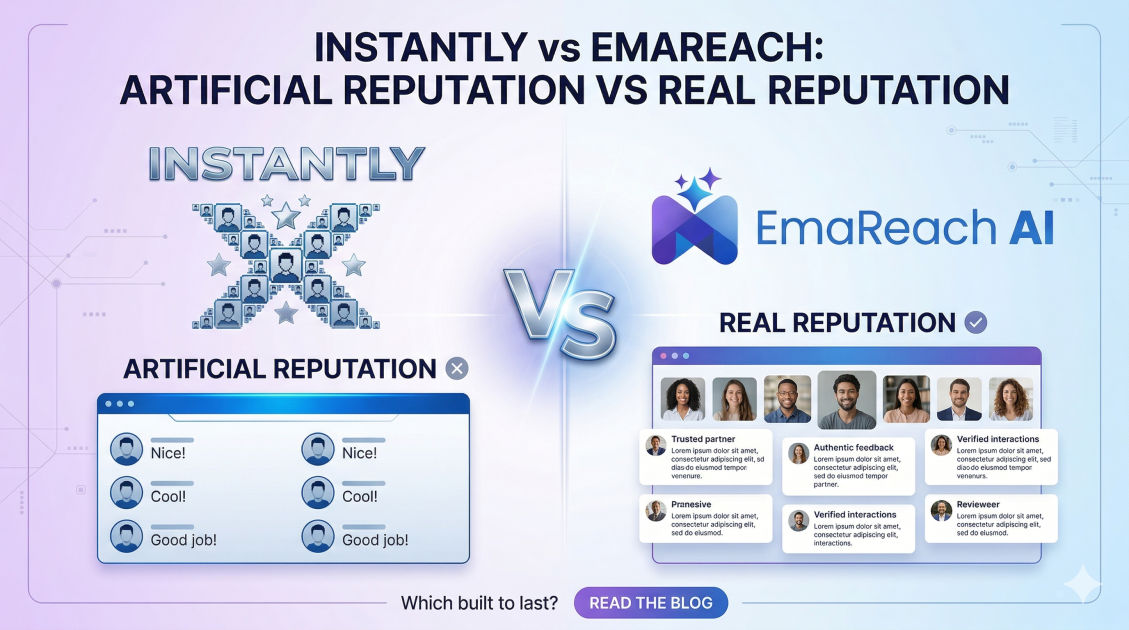
Instantly vs Emareach: Artificial Reputation vs Real Reputation
cold emailemail deliverabilityoutreach strategyemail warm-upAI outreachlead generationB2B marketing
Introduction: The New Frontier of Cold Outreach
In the rapidly evolving landscape of digital communication, the battle for the inbox has never been more intense. Businesses across the globe rely on cold email as a primary driver for growth, lead generation, and networking. However, as email service providers (ESPs) like Google and Microsoft deploy increasingly sophisticated filters, the old methods of 'spray and pray' are no longer just ineffective—they are dangerous to your domain's health.
Two major philosophies have emerged in the world of email outreach: the high-volume automation approach and the quality-centric, reputation-first approach. This debate is perfectly encapsulated in the comparison between Instantly and EmaReach. At its core, this is a discussion about Artificial Reputation versus Real Reputation. While both platforms aim to help you reach prospects, they do so using fundamentally different logic. One focuses on the mechanics of scale, while the other prioritizes the psychology of the inbox and the long-term integrity of your sending infrastructure.
Understanding Email Reputation
Before diving into the tools, it is crucial to understand what 'reputation' means in the context of email. Your sender reputation is a score assigned by ESPs based on your sending history. It is influenced by:
- Open Rates: How many people actually look at your mail.
- Engagement: Do people reply, forward, or move your email to folders?
- Bounce Rates: Are you sending to valid addresses?
- Spam Complaints: The ultimate reputation killer.
- Warm-up Patterns: How naturally your sending volume increases over time.
The Concept of Artificial Reputation
Artificial reputation is built through automated 'simulations.' Many platforms use massive networks of bot-controlled inboxes to interact with one another. They send emails back and forth, open them, and mark them as 'not spam.' On paper, this looks like engagement. However, because these patterns are often repetitive and generated by known data centers, ESPs are becoming better at identifying this 'fake' traffic. It is a temporary mask that hides poor sending practices rather than fixing the underlying quality of the outreach.
The Concept of Real Reputation
Real reputation is harder to earn but much harder to lose. It is built when actual human recipients interact with your content because it is relevant, personalized, and valuable. Real reputation is also supported by technical excellence—ensuring that your emails aren't just 'warmed up' by bots, but are structurally sound and intelligently paced to mimic genuine human business communication. This is where the distinction between Instantly and EmaReach becomes most apparent.
Instantly: The Volume Engine
Instantly has made a name for itself by offering unlimited sending accounts and a robust warm-up tool. It is designed for the user who wants to scale quickly. By connecting hundreds or even thousands of 'burner' domains, users can send a massive volume of emails daily.
The Mechanics of Instantly
Instantly relies heavily on its automated warm-up pool. When you join, your accounts start sending emails to other users in the pool. This creates a baseline of activity that signals to ESPs that the account is 'active.'
However, the challenge with this high-volume model is that it often treats the inbox as a numbers game. When you are sending tens of thousands of emails, the level of personalization often drops. Furthermore, because the warm-up is largely internal to the tool’s user base, it can sometimes create a 'closed loop' that ESPs eventually identify as non-human behavior. If the reputation is built solely on artificial interactions, the moment you send a real campaign to real humans who don't engage, that artificial shield can shatter.
EmaReach: The Deliverability Architect
EmaReach takes a different path. Instead of just focusing on how many emails you can send, EmaReach focuses on how many emails actually get read. The philosophy here is that a single email in the primary tab is worth a thousand in the spam folder.
Stop Landing in Spam: The EmaReach Difference
EmaReach is built on the principle of "Stop Landing in Spam. Cold Emails That Reach the Inbox." This isn't just a catchy slogan; it's a technical mandate. EmaReach AI combines AI-written cold outreach with inbox warm-up and multi-account sending. This ensures your emails land in the primary tab and get replies.
While Instantly provides the engine, EmaReach provides the navigation and the high-octane fuel. By using AI to craft messages that resonate with the recipient, EmaReach generates Real Reputation. When a recipient opens an email because the subject line is clever and the first sentence is relevant, that is a 'vote' of confidence in your domain that no bot can replicate.
Artificial vs. Real: The Technical Breakdown
To truly understand the difference, we must look at how these tools handle the 'Warm-up' and 'Sending' phases.
1. The Warm-up Phase
In the 'Artificial' model, warm-up is often a static process. You turn it on, and the tool sends a set number of emails. It’s predictable.
In the 'Real' model championed by EmaReach, the warm-up is more dynamic. It focuses on the quality of the interaction. By integrating AI-driven content into the warm-up process, the interactions look more like real business discussions. This is critical because Google’s AI is now looking for linguistic patterns. If your warm-up emails are gibberish or repetitive templates, they are flagged as 'low reputation' interactions. EmaReach ensures that the sending profile remains human-centric.
2. The Content Quality
Instantly allows for basic variables (First Name, Company), but at massive scale, these often feel clinical.
EmaReach utilizes advanced AI to write the outreach itself. This bridges the gap between cold calling and a warm introduction. When the content is high-quality, the 'Real Reputation' of the domain grows because the bounce rates stay low and the reply rates stay high. High reply rates are the 'Holy Grail' of deliverability; they tell the ESP that the recipient values the conversation.
The Risks of Relying on Artificial Reputation
There is a significant 'technical debt' associated with artificial reputation. If you build a business entirely on the back of bot-driven warm-up and high-volume, low-quality sending, you are building on sand.
- Domain Blacklisting: Once a domain is flagged for suspicious patterns, it is almost impossible to recover its reputation.
- Shadow Banning: Your emails might 'send' successfully according to your dashboard, but they land in the 'Promotions' or 'Spam' folders, unseen by your prospects.
- ESP Crackdowns: We have seen major shifts in how Gmail and Outlook handle bulk senders. They are moving away from allowing 'warm-up' services that don't provide real value to the ecosystem.
Why Real Reputation Wins Long-Term
Real reputation is an asset. When you use a platform like EmaReach, you are investing in the longevity of your brand's digital presence.
Multi-Account Sending Done Right
Both tools offer multi-account sending, but the execution differs. Artificial reputation models often suggest 'rotating' through accounts to hide volume. Real reputation models, like those used by EmaReach, use multi-account sending to distribute genuine human-like volume. By spreading carefully crafted, AI-optimized messages across multiple inboxes, you stay well under the 'spam trigger' thresholds of any single provider while maintaining a high aggregate output.
The AI Integration Powerhouse
EmaReach’s AI doesn’t just 'spin' text; it understands context. This is the key to moving from artificial to real reputation. If your outreach says, "I saw your recent post about X and thought Y," and it's actually accurate, the recipient is likely to engage. That engagement is the most powerful signal you can send to an ESP. This is why EmaReach AI combines AI-written cold outreach with inbox warm-up and multi-account sending—so your emails land in the primary tab and get replies.
Comparison: Scaling vs. Converting
| Feature | Instantly (Artificial Focus) | EmaReach (Real Focus) |
|---|---|---|
| Primary Goal | Maximum Volume | Maximum Deliverability & Replies |
| Warm-up Type | Bot-to-Bot Peer Network | AI-Enhanced Human Simulation |
| Content Strategy | Template-based Variables | AI-Generated Personalized Outreach |
| Inbox Placement | Variable (often Promotions/Spam) | Prioritized Primary Tab |
| Long-term Safety | High Risk of Domain Burn | Sustainable Domain Growth |
How to Transition from Artificial to Real Reputation
If you have been using high-volume tools and noticed your reply rates dropping, it is likely that your 'artificial' shield is wearing thin. Here is how to pivot toward a 'real' reputation strategy:
- Audit Your Content: Stop using generic templates. If a human can tell it’s a template in two seconds, an AI filter can do it in two milliseconds.
- Focus on Engagement: Shift your KPIs from 'Emails Sent' to 'Positive Reply Rate.'
- Use Intelligent Warm-up: Ensure your warm-up tool uses diverse, high-quality content that mimics real business language.
- Leverage EmaReach: By moving your campaigns to EmaReach, you integrate the writing, the sending, and the reputation management into one cohesive, AI-driven strategy. This removes the guesswork and the risk of 'burning' your primary domains.
The Psychology of the Recipient
We often talk about reputation in terms of servers and filters, but what about the reputation in the mind of the prospect?
Artificial reputation methods often lead to a 'cluttered' feel. Even if the email hits the inbox, if it feels like a bot wrote it, the recipient's mental 'spam filter' kicks in. They won't reply, and they might even report you.
Real reputation involves building trust from the first sentence. When you use EmaReach to craft emails that reach the inbox and look like they were written by a thoughtful colleague, you are building a brand reputation that goes beyond technical metrics. You are creating the foundation for a real business relationship.
Conclusion: The Choice is Clear
The era of tricking the algorithms is coming to an end. As email providers get smarter, the gap between artificial and real reputation will only widen. While Instantly provides a powerful tool for those who want to manage a high volume of accounts, EmaReach provides the sophisticated, AI-driven framework necessary to navigate the complexities of modern deliverability.
By prioritizing real engagement, AI-personalized content, and strategic inbox warm-up, EmaReach ensures that your outreach isn't just a shout into the void, but a meaningful conversation that lands exactly where it belongs: the primary tab. In the choice between the artificial and the real, the winner is always the one that builds lasting value.
EmaReach AI
Ready to scale your cold email outreach?
Join thousands of teams using EmaReach AI for AI-powered campaigns, domain warmup, and 95%+ deliverability. Start free — no credit card required.
Related posts
- Read article
The Instantly Alternative That Finally Gets Outbound Analytics Right
Discover why high-volume cold email requires a shift from surface-level vanity metrics to deep, data-driven revenue attribution, and explore the ultimate alternatives for mastering outbound engineering.
- Read article
What You Gain and What You Give Up When Switching From Instantly
Thinking about migrating your cold email stack? This detailed guide breaks down the exact operational advantages you gain and the core features you sacrifice when switching away from Instantly's popular outreach platform.