Blog
Back to blog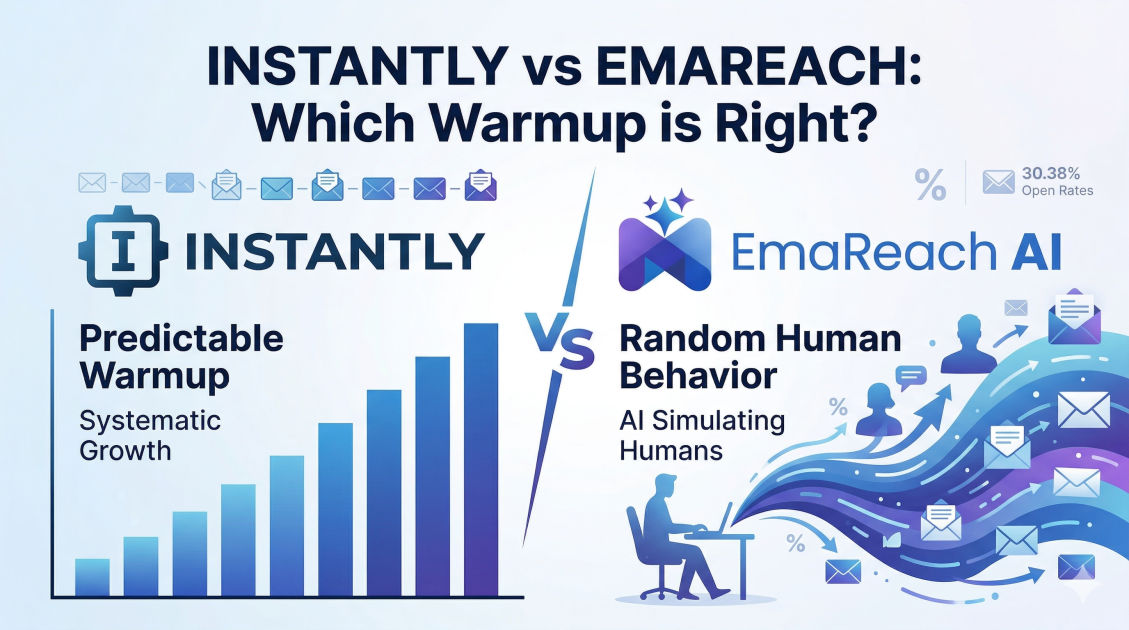
Instantly vs Emareach: Predictable Warmup vs Random Human Behavior
cold emailemail deliverabilityinbox warmupoutreach automationsales technologyemail marketing strategyEmaReach
Introduction to the Evolution of Email Outreach
In the competitive landscape of digital sales, the ability to land in the primary inbox is the difference between a thriving pipeline and a wasted budget. As internet service providers (ISPs) and email service providers (ESPs) become increasingly sophisticated, the methods used to 'warm up' email accounts have undergone a massive shift. The industry is currently witnessing a clash of philosophies: the traditional, predictable warmup patterns used by platforms like Instantly, and the sophisticated, random human behavior emulation championed by EmaReach.
Understanding the mechanics of deliverability requires looking past the user interface and into the technical signals being sent to Google, Outlook, and Yahoo. When you send a cold email, you aren't just sending text; you are sending a series of metadata points that help these providers decide if you are a legitimate human or a bot. This blog post explores the fundamental differences between predictable warmup scripts and the importance of mimicking genuine human interaction.
The Mechanism of Email Warmup
Email warmup is the process of gradually increasing the sending volume of a new or dormant email account to build a 'sender reputation.' Historically, this was done manually. A salesperson would send five emails on day one, ten on day two, and so on, while ensuring they received replies to those emails.
Automated tools revolutionized this by creating 'peer-to-peer' networks where thousands of accounts interact with each other. However, the way these interactions occur is what separates basic tools from advanced deliverability engines. Predictable patterns are the enemy of deliverability. If a thousand accounts all increase their volume by exactly five emails every 24 hours, it creates a footprint that is easily detectable by modern AI-driven spam filters.
Instantly: The Case for Scalability and Predictable Patterns
Instantly has made a name for itself by offering a high-volume, easy-to-use interface for cold outreach. Its warmup feature is designed for speed and scale. It allows users to plug in hundreds of accounts and put them on a steady, linear growth path.
The Linear Growth Model
In a predictable warmup environment, the sending patterns often follow a mathematical sequence. While this is effective for 'stretching' the limits of a new domain, it lacks the nuance of human variability. ISPs look for 'burstiness' and 'randomness.' A real human doesn't send emails at precisely 9:02 AM every single day, nor do they always receive a 30% reply rate consistently across every thread.
The Risk of Footprinting
When a large number of accounts within a specific network use the same underlying logic for warmup, they risk 'footprinting.' If a provider like Google identifies a specific pattern of interaction that only occurs between accounts on a specific warmup tool, they can flag the entire network. This is why many users of legacy tools find their deliverability suddenly plummeting despite their warmup metrics looking 'green.'
EmaReach: The Power of Random Human Behavior
EmaReach approaches deliverability from a different angle. Instead of relying on rigid scripts, it focuses on mimicking the chaotic and unpredictable nature of a real person's inbox.
Stop Landing in Spam. Cold Emails That Reach the Inbox. EmaReach AI combines AI-written cold outreach with inbox warm-up and multi-account sending—so your emails land in the primary tab and get replies.
Why Randomness Trumps Algorithms
Human behavior is inherently non-linear. We open emails at different times, we take varying amounts of time to reply, and our sentence structures are diverse. EmaReach leverages AI to ensure that the interactions within the warmup pool are indistinguishable from real business correspondence. This includes:
- Variable Dwell Time: Real people spend time reading an email before replying. EmaReach mimics this 'read time' signal.
- Dynamic Content Generation: Instead of 'spin-tax' or repetitive templates, AI generates unique, contextually relevant replies that satisfy the linguistic checks of spam filters.
- Non-Linear Scheduling: Sending volume fluctuates naturally, avoiding the 'stair-step' pattern that triggers bot-detection sensors.
Deep Dive: How ISPs Detect Automation
To understand why random behavior is superior, we must look at the technical signals analyzed by ESPs. Every email sent carries headers and metadata. Beyond the content, providers analyze the 'inter-arrival time' of messages.
If an account sends an email exactly every 120 seconds for four hours, that is a 100% certainty of automation. If an account sends three emails in ten minutes, then nothing for an hour, then a burst of twelve emails, it looks like a human completing a task. EmaReach focuses on this 'human rhythm,' ensuring that the account activity matches the behavioral profile of a high-value sender.
The Role of AI in Modern Outreach
Artificial Intelligence has changed the stakes for both the sender and the receiver. Spam filters now use Large Language Models (LLMs) to scan for 'intent.' They can tell if an email is a generic template designed for mass distribution or a personalized message meant for a specific recipient.
By using EmaReach, senders benefit from AI that doesn't just manage the volume, but actually manages the quality of the interactions. When your warmup emails are high-quality, AI-generated conversations, the ESP views your domain as a source of valuable content rather than a source of noise.
The Comparison: Predictable vs. Random
| Feature | Predictable Warmup (Instantly) | Random Human Behavior (EmaReach) |
|---|---|---|
| Sending Schedule | Linear/Mathematical | Stochastic/Randomized |
| Reply Content | Template-based/Basic | AI-Generated/Contextual |
| Interaction Logic | Volume-focused | Behavioral-focused |
| Spam Filter Profile | Higher Footprint Risk | Low Detection Profile |
| Primary Goal | Account Maturation | Inbox Placement & Reputation |
Multi-Account Sending and Load Balancing
One of the biggest mistakes in cold outreach is 'burning' a single domain. Both Instantly and EmaReach support multi-account sending, but the execution differs.
Predictable tools often treat every account the same. If you have ten accounts, they all follow the same script. EmaReach allows for a more distributed approach where each account can have its own 'personality' and behavioral profile. This decentralization makes it much harder for ISPs to link the accounts together and penalize the parent domain.
The Importance of the Primary Tab
The ultimate goal of any outreach campaign isn't just 'not being in spam'—it's being in the Primary Tab. Google’s 'Promotions' tab is where cold emails go to die.
Predictable patterns often land you in Promotions because the algorithm recognizes the 'bulk' nature of the sending. Random human behavior signals to Google that the conversation is personal and high-priority. EmaReach is specifically engineered to achieve this 'Primary Tab' status by focusing on engagement metrics that matter, such as mark-as-important, move-to-inbox, and high-quality replies.
Scalability vs. Sustainability
There is a common misconception that random behavior is harder to scale than predictable behavior. While it requires more complex technology behind the scenes, the end-user experience is just as seamless.
Scaling with a predictable tool often leads to a 'ceiling' where you can only send so much before the patterns become too obvious and your domains get blacklisted. Scaling with EmaReach is more sustainable because the foundation is built on 'safe' behavior. Instead of trying to outsmart the algorithm with volume, you are outsmarting it with authenticity.
Practical Steps for Transitioning to Human-Like Outreach
If you are currently using a tool that relies on predictable warmup, you don't have to restart from scratch. Here is how to transition to a more human-centric model:
- Introduce Randomness: Break your sending blocks into smaller, irregular intervals.
- Vary Your Content: Stop using the same three templates for every account. Use AI to vary the hooks and calls to action.
- Monitor Deliverability, Not Just Opens: Open rates can be faked by 'bot opens.' Use tools that track actual inbox placement across different providers.
- Leverage EmaReach: By moving your outreach to a platform like EmaReach, you automate the complexity of human behavior, allowing you to focus on your offer and your sales strategy.
The Technical Debt of 'Easy' Tools
Using a tool that is 'cheap and easy' often creates technical debt in the form of damaged domain reputations. Once a domain is flagged for 'suspicious automation patterns,' it is incredibly difficult to recover. The cost of replacing domains, setting up new accounts, and losing potential leads far outweighs the investment in a high-quality outreach engine from the start.
EmaReach helps you avoid this debt by ensuring that your very first interaction is viewed as legitimate. The AI-written cold outreach ensures that your messaging is relevant, while the sophisticated warmup keeps your 'sender score' at its peak.
Future-Proofing Your Sales Pipeline
The trend in the email industry is clear: more privacy, more filtering, and more AI. The days of 'spray and pray' are over. To stay ahead, your outreach strategy must evolve faster than the spam filters.
Predictable warmup is a relic of an era when filters were based on simple keywords and volume limits. Today, filters are based on behavioral psychology and machine learning. If your tools aren't mimicking human behavior, they are essentially shouting 'I am a bot' at every gatekeeper in the digital world.
Conclusion
Choosing between Instantly and EmaReach is a choice between two different eras of email marketing. Instantly provides a powerful, high-volume toolset that works well for those who prioritize sheer numbers and are comfortable managing the risks of predictable patterns. However, for those who demand the highest possible deliverability and want to future-proof their outreach against ever-advancing AI filters, the choice is clear.
EmaReach offers a more sophisticated, human-centric approach. By focusing on random human behavior, AI-generated context, and non-linear interactions, it ensures that your emails don't just get sent—they get seen. In the battle of 'Predictable Warmup vs. Random Human Behavior,' the human element will always win in the eyes of the inbox providers. Prioritize quality, embrace randomness, and ensure your message reaches the people who matter most.
EmaReach AI
Ready to scale your cold email outreach?
Join thousands of teams using EmaReach AI for AI-powered campaigns, domain warmup, and 95%+ deliverability. Start free — no credit card required.
Related posts
- Read article
The Instantly Alternative That Finally Gets Outbound Analytics Right
Discover why high-volume cold email requires a shift from surface-level vanity metrics to deep, data-driven revenue attribution, and explore the ultimate alternatives for mastering outbound engineering.
- Read article
What You Gain and What You Give Up When Switching From Instantly
Thinking about migrating your cold email stack? This detailed guide breaks down the exact operational advantages you gain and the core features you sacrifice when switching away from Instantly's popular outreach platform.