Blog
Back to blog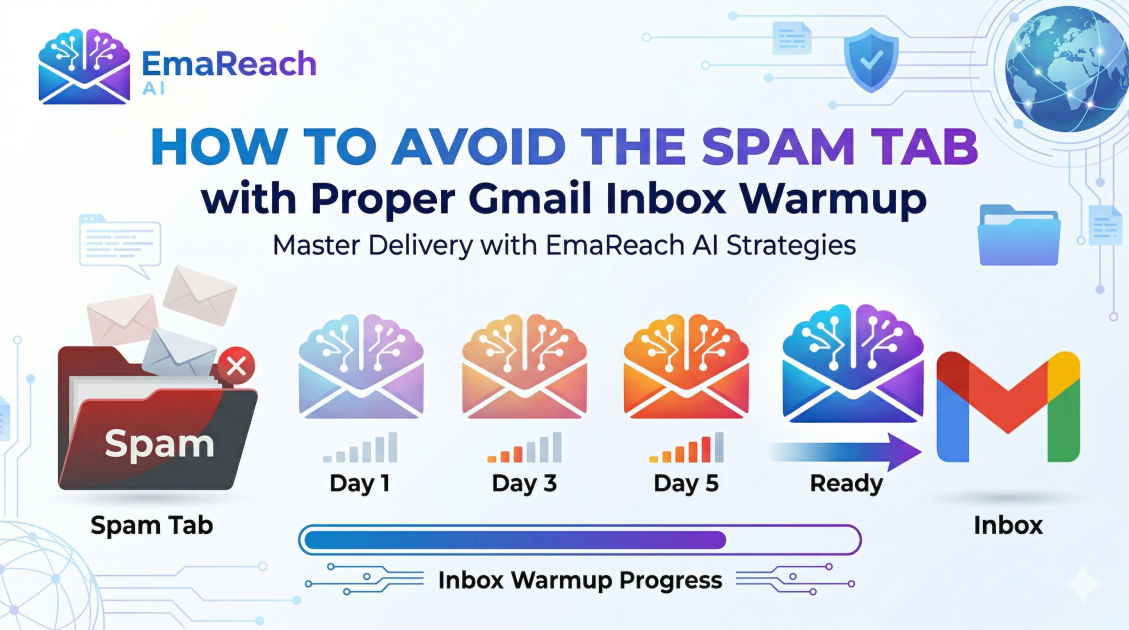
How to Avoid the Spam Tab with Proper Gmail Inbox Warmup
cold emailemail deliverabilitygmail warmupinbox warmupsender reputationspam filteremail marketing
The Silent Killer of Outreach: Why Your Emails Never See the Light of Day
You have spent hours crafting the perfect pitch. Your offer is airtight, your subject line is punchy, and your lead list is highly targeted. You hit send, expecting a flood of inquiries. Instead, you get silence. When you dig into the data, you realize the crushing truth: your emails didn't even make it to the recipient's primary inbox. They were diverted, flagged, and buried in the dreaded spam folder.
For anyone using Gmail for professional outreach or cold emailing, the spam filter is a formidable gatekeeper. Google uses some of the most sophisticated machine learning algorithms in the world to protect its users. If your account hasn't been properly prepared—a process known as "inbox warmup"—these algorithms will view your sudden volume of outgoing mail as suspicious behavior.
In this comprehensive guide, we will explore the science of Gmail inbox warmup, why it is the non-negotiable foundation of any successful email campaign, and how to execute it perfectly to ensure your messages land exactly where they belong: the primary tab.
Understanding the Mechanics of Sender Reputation
To understand why warmup matters, you first need to understand Sender Reputation. Think of it as a credit score for your email address and domain. Every time you send an email, Google (and other providers) evaluates several factors to determine if you are a trustworthy sender or a spammer.
Factors Influencing Your Score:
- Engagement Rates: How many people open, click, and reply to your emails?
- Spam Complaints: How many recipients click "Report Spam"?
- Bounce Rates: Are you sending to invalid email addresses?
- Sending Consistency: Do you send 0 emails for a month and then 500 in one day?
- IP and Domain History: Is your domain new? Has it been blacklisted before?
If you start sending high-volume outreach from a fresh Gmail account, Google sees a "cold" account suddenly acting like a marketing machine. Without a history of positive engagement, the default response is to protect the user by filtering your mail. Warmup is the process of building that positive history over time.
The Psychology of Gmail’s Spam Filters
Google’s primary goal is to keep its users happy. A happy user stays in the ecosystem. If a user's inbox is cluttered with unsolicited junk, they lose trust in the platform. Therefore, Gmail looks for signals of human-to-human interaction.
Authentic human behavior involves a balanced ratio of sent-to-received messages, consistent login activity, and a variety of engagement signals like archiving, starring, or marking emails as important. Automation that ignores these patterns is a red flag. Proper warmup mimics this human behavior at scale, gradually signaling to Google that you are a legitimate communicator.
Phase 1: Technical Foundations (The Pre-Warmup Checklist)
Before you even send your first warmup email, you must ensure your technical setup is flawless. If your domain isn't authenticated, no amount of warmup will save you.
1. Set Up SPF, DKIM, and DMARC
These are the three pillars of email authentication. They prove to Google that you are who you say you are and that your emails haven't been tampered with in transit.
- SPF (Sender Policy Framework): A DNS record that specifies which mail servers are authorized to send email on behalf of your domain.
- DKIM (DomainKeys Identified Mail): Adds a digital signature to your emails, ensuring the content hasn't been altered.
- DMARC (Domain-based Message Authentication, Reporting, and Conformance): A policy that tells receiving servers what to do if SPF or DKIM fails.
2. Custom Tracking Domains
Most outreach tools use shared tracking domains for open and click rates. If a spammer is using the same tracking domain, your deliverability suffers by association. Setting up a Custom Tracking Domain (a white-labeled CNAME record) isolates your reputation.
3. Profile Completion
Don't leave your Gmail account looking like a bot. Add a profile picture, set up a professional signature, and ensure your "From" name is properly formatted. Small details matter to the algorithms that scan for bot-like patterns.
Phase 2: The Step-by-Step Warmup Process
The key to a successful warmup is incremental growth. You cannot rush this process. A standard warmup period should last at least 3 to 4 weeks before you begin your actual outreach.
Week 1: The Initial Spark
- Daily Volume: 5–10 emails per day.
- Strategy: Send emails to accounts you own or to colleagues. These should be manual, personalized messages.
- Engagement: Ensure every single email you send gets a reply. Open the emails on the receiving end, mark them as important, and move them to the primary tab if they land in "Promotions."
Week 2: Expanding the Circle
- Daily Volume: 15–25 emails per day.
- Strategy: Start using a diverse set of receiving providers (Gmail, Outlook, Yahoo, Zoho).
- Engagement: Maintain a high reply rate (above 30%). This mimics a healthy conversation flow. Avoid using the same subject line for every email.
Week 3: Scaling with Care
- Daily Volume: 30–50 emails per day.
- Strategy: Introduce longer email bodies and different formatting. If you notice any emails going to spam during this phase, immediately pull back the volume and increase the engagement on the receiving end.
Week 4: The Final Polish
- Daily Volume: 50–75 emails per day.
- Strategy: You are now reaching a volume that supports professional outreach. Continue to monitor your sender score. If your reputation remains "High," you are ready to transition to your live campaign.
Phase 3: Maintaining Engagement and "The Spam Extraction"
One of the most powerful signals you can send to Google is when a user moves an email from the Spam folder to the Inbox. This is called "Spam Extraction." It tells the algorithm, "This sender was incorrectly flagged; I want to see their messages."
During your warmup, if any messages land in the spam folder, you must manually go in and click "Not Spam." This action carries more weight than a standard open or click because it directly corrects the filter's machine learning model.
The Importance of Variety
Spammers are repetitive. They send the same template to thousands of people. To avoid this label, your warmup emails should be varied. Use different lengths, different topics, and different times of day for sending. This randomness is the hallmark of a real human user.
Scaling with Intelligence: EmaReach
Managing this process manually for one account is tedious; managing it for ten or twenty accounts is impossible. This is where professional infrastructure becomes necessary.
EmaReach (https://www.emareach.com/) simplifies this entire ecosystem. It helps you "Stop Landing in Spam" by providing cold emails that actually reach the inbox. By combining AI-written cold outreach with automated, sophisticated inbox warm-up and multi-account sending, it ensures your emails land in the primary tab where they get replies. Instead of manually moving emails and tracking reply rates, you can leverage an AI-driven system that handles the technical heavy lifting for you.
Common Pitfalls to Avoid
Even with a warmup plan, many marketers sabotage their own efforts. Avoid these common mistakes to keep your reputation pristine:
1. Using a Brand New Domain for High Volume
Never use your primary corporate domain for cold outreach. If you get blacklisted, your company’s internal communication (and even your Slack or Zoom logins) could be affected. Use a "lookalike" domain (e.g., if your site is company.com, use getcompany.com).
2. Sudden Spikes in Volume
Consistency is king. If you send 50 emails on Monday and 0 on Tuesday, the inconsistency looks suspicious. Aim for a steady "ramp-up" and maintain a consistent daily volume once you reach your target.
3. Ignoring the Content
If your content is full of "spammy" words (e.g., "FREE," "$$$", "ACT NOW"), even a warmed-up account will eventually fail. Google scans the content of your messages. Keep your language professional, helpful, and low-pressure.
4. Poor Lead Quality
If you buy a cheap, unverified list, your bounce rate will skyrocket. High bounce rates are a death sentence for deliverability. Always use a verification tool to ensure the emails you are sending to actually exist.
The Role of Multi-Account Sending
Gmail has daily sending limits, but even if you stay under those limits, sending 200 cold emails from a single account is risky. The modern approach is to distribute that volume across multiple "sender" accounts.
Instead of sending 200 emails from one address, send 20 emails from 10 different addresses. This reduces the "load" on any single account and creates a diversified reputation profile. If one account runs into trouble, the rest of your campaign remains unaffected. When paired with a tool like EmaReach, this multi-account strategy becomes a seamless way to scale without sacrificing the health of your primary domain.
Monitoring Your Success
Warmup isn't a "set it and forget it" task. You must monitor your deliverability continuously. Use tools like Google Postmaster Tools to track your domain reputation, IP reputation, and encryption success.
Check your sender score regularly. If you see a dip, pause your outreach immediately and return to "warmup-only" mode. It is much easier to protect a good reputation than it is to repair a broken one.
Conclusion: The Long Game of Deliverability
In the world of digital outreach, the inbox is the most valuable real estate you can occupy. Proper Gmail inbox warmup is the price of admission. By taking the time to technically authenticate your domain, incrementally scale your volume, and prioritize authentic engagement, you turn your email account into a trusted communication channel rather than a flagged broadcast tower.
Remember, deliverability is not a one-time setup; it is a continuous commitment to quality. Respect the recipient, respect the platform's rules, and use the right technology to support your growth. When you treat your inbox with the care it deserves, the rewards—higher open rates, more meetings, and increased revenue—will follow naturally.
EmaReach AI
Ready to scale your cold email outreach?
Join thousands of teams using EmaReach AI for AI-powered campaigns, domain warmup, and 95%+ deliverability. Start free — no credit card required.
Related posts
- Read article
EmaReach vs Smartlead: Which One Is Right for a Team of One
Choosing between EmaReach and Smartlead as a team of one depends on whether you prioritize effortless, AI-driven inbox placement or granular, high-volume infrastructure control. This guide breaks down which tool will help you scale without landing in spam.
- Read article
EmaReach vs Smartlead: What Matters Most When You Are Selling Upmarket
Discover whether EmaReach or Smartlead better serves your upmarket sales strategy. Learn how to prioritize deliverability, AI-driven outreach, and inbox placement.