Blog
Back to blog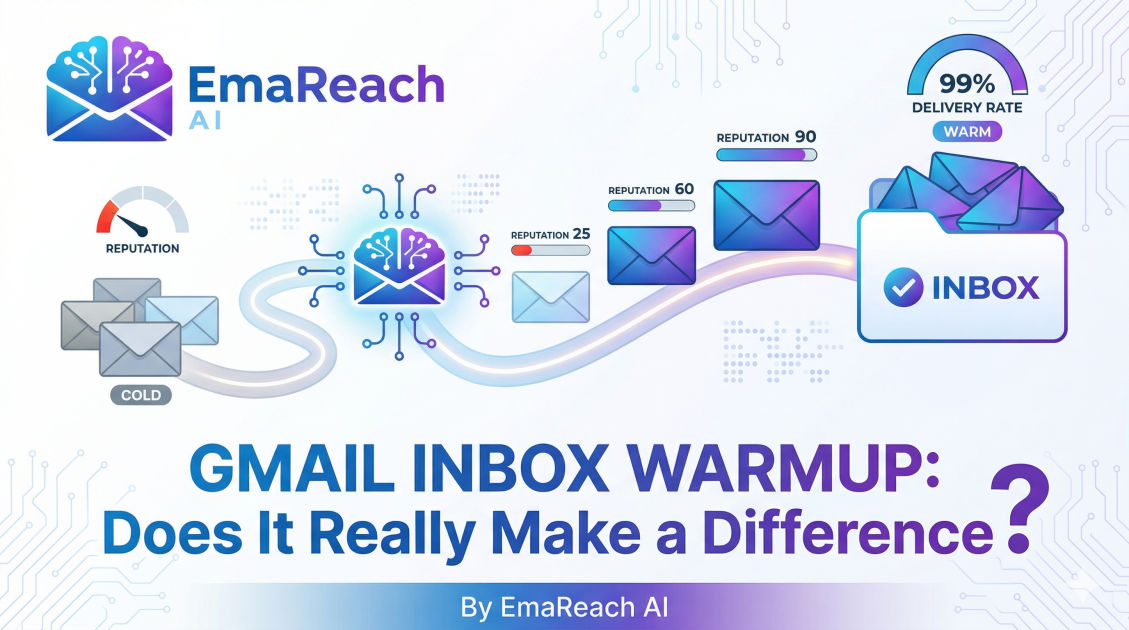
Gmail Inbox Warmup: Does It Really Make a Difference?
email deliverabilitygmail warmupcold outreachsender reputationemail marketinggoogle workspace
Introduction: The Hidden Barrier to Successful Email Outreach
In the world of digital communication, the success of an email campaign is often measured by open rates, click-through rates, and conversions. However, there is a fundamental metric that precedes all of these: deliverability. If your email never reaches the recipient's primary inbox, the most compelling copy and the most enticing offers are rendered useless. For Gmail users, particularly those using Google Workspace for professional outreach, the concept of 'Inbox Warmup' has become a cornerstone of deliverability strategy. But does it really make a difference, or is it just another digital marketing myth?
To understand the impact of inbox warmup, one must first understand how Google’s sophisticated spam filters operate. These filters are not static; they are dynamic, AI-driven systems that evaluate sender reputation in real-time. When a new email account suddenly begins sending high volumes of messages, it triggers red flags. Gmail’s algorithms interpret this behavior as typical of a spammer or a hijacked account. Inbox warmup is the process of building a positive sender reputation gradually, signaling to Google that you are a legitimate human user. This article explores the mechanics of warmup, its necessity in the modern landscape, and how it directly influences your ability to reach your audience.
The Mechanics of Gmail’s Reputation System
Google manages billions of emails daily. To protect its users from phishing and unwanted clutter, it assigns every sending IP and domain a 'reputation score.' This score is influenced by several key factors:
- Sending Consistency: Does the account send a steady stream of emails, or are there massive spikes followed by silence?
- Engagement Rates: Do recipients open the emails, click links, and reply? Or do they delete them without opening?
- Spam Complaints: How many users are clicking the 'Report Spam' button?
- Bounce Rates: Are you sending to invalid or non-existent email addresses?
- Authentication: Have you correctly set up SPF, DKIM, and DMARC records?
When you start with a fresh Gmail account, your reputation is neutral. In the eyes of an automated filter, neutral is often treated with the same suspicion as a poor reputation. If you immediately jump into sending hundreds of cold emails, the lack of historical data causes Gmail to play it safe by diverting your mail to the 'Spam' or 'Promotions' folder. Warmup acts as the historical record needed to prove your legitimacy.
Why 'Cold' Sending is a Recipe for Disaster
Imagine a stranger walking into a crowded room and shouting at the top of their lungs. Most people will ignore them or ask them to leave. Now imagine a person who enters, greets a few people, engages in small talk, and gradually increases their presence. The latter is far more likely to be listened to.
Sending from a 'cold' inbox is the digital equivalent of shouting in a room of strangers. Without a warmup period, your domain is at high risk for:
1. Blacklisting
If your initial sending volume is high and engagement is low, your domain can be added to global blacklists. Once blacklisted, it is incredibly difficult to recover, often requiring a total change of domain and email infrastructure.
2. Throttling
Gmail may not block you entirely but might 'throttle' your emails. This means they delay the delivery of your messages, sometimes for hours or days, which kills the timing of time-sensitive campaigns.
3. Permanent Spam Placement
Once the algorithm decides your emails belong in the spam folder, it takes a massive amount of positive engagement to reverse that decision. It is much easier to start correctly than it is to fix a broken reputation.
The Process of Effective Inbox Warmup
Inbox warmup is not just about sending emails to yourself; it is about simulating authentic human interaction. A comprehensive warmup strategy involves several layers of activity.
Incremental Volume Scaling
The most basic element is volume. You might start by sending 5 emails on day one, 10 on day two, and slowly scale up over several weeks until you reach your target daily volume. This gradual climb mimics the natural growth of a new business or a new hire's communication patterns.
The Power of Positive Engagement
Volume alone isn't enough. Google looks for 'positive signals.' This includes:
- Open Rates: High percentages of your warmup emails being opened.
- Reply Rates: This is the 'holy grail' of deliverability. When a recipient replies to your email, it tells Google that the communication is valuable and two-way.
- Marking as 'Not Spam': If a warmup email happens to land in the spam folder, having it manually moved to the primary inbox is a powerful signal to the algorithm that a mistake was made.
Multi-Account Strategies
For businesses performing large-scale outreach, warming up a single account isn't enough. To maintain high deliverability, it is often necessary to spread the volume across multiple accounts. This prevents any single account from exceeding 'safe' sending limits. Services like EmaReach specialize in this area. Stop Landing in Spam. Cold Emails That Reach the Inbox. EmaReach AI combines AI-written cold outreach with inbox warm-up and multi-account sending—so your emails land in the primary tab and get replies. This ensures that even as you scale, your reputation remains protected.
Manual vs. Automated Warmup: Which is Better?
Historically, marketers performed warmup manually. They would ask colleagues and friends to exchange emails with the new account. While effective, this is not scalable and is prone to human error.
Manual Warmup Pros and Cons
- Pros: Highly authentic, natural language patterns, zero cost (besides time).
- Cons: Extremely time-consuming, difficult to track, impossible to maintain at scale.
Automated Warmup Pros and Cons
Automated tools use a network of real email accounts to interact with your inbox. They send, open, and reply to messages automatically.
- Pros: Set-and-forget, provides consistent daily signals, generates necessary reply volume, provides data-driven insights into where your emails are landing.
- Cons: If not done correctly or if using 'low-quality' bot networks, it can potentially be detected by advanced filters.
In the current landscape, a hybrid approach or a high-quality automated service is generally the standard for professionals. The key is ensuring the automated interactions look as human as possible, using varied subject lines and body text.
Does It Really Make a Difference? The Data Speaks
When we look at the difference between warmed and unwarmed accounts, the data is stark. Accounts that undergo a 3-4 week warmup period consistently see:
- 80-95% Primary Inbox Placement: Compared to 20-30% for cold accounts.
- Higher Open Rates: Because the emails are actually seen by the recipient.
- Longer Account Lifespans: Warmed accounts are significantly less likely to be suspended by Google for 'suspicious activity.'
Furthermore, the 'Difference' isn't just about the first week. Warmup provides a safety net. During a live campaign, if you have a bad day where several people report your email as spam, a well-warmed account with a deep history of positive engagement can absorb that hit. A cold account will likely be neutralized immediately.
Essential Steps Before Starting Your Warmup
Before you send your first warmup email, your technical foundation must be rock-solid. Without these, no amount of warmup will save your deliverability.
1. SPF (Sender Policy Framework)
A DNS record that specifies which mail servers are authorized to send email on behalf of your domain.
2. DKIM (DomainKeys Identified Mail)
Adds a digital signature to your emails, allowing the receiver to verify that the email was indeed authorized by the owner of that domain.
3. DMARC (Domain-based Message Authentication, Reporting, and Conformance)
Ensures that your SPF and DKIM are functioning correctly and tells receiving servers what to do if the authentication fails.
4. Custom Tracking Domains
Most email tools use shared tracking pixels for clicks and opens. If another user on that shared pixel is a spammer, your reputation suffers. Using a custom tracking domain ensures your 'digital footprint' is unique to your brand.
Maintaining the Flame: Ongoing Warmup
One common misconception is that warmup is a one-time event. In reality, deliverability is a moving target. If you stop all 'human' interaction and only send cold outreach, your reputation will slowly degrade.
Professional deliverability experts recommend keeping warmup active even while running live campaigns. This 'maintenance mode' ensures that there is always a baseline of positive engagement (opens and replies) to offset the naturally lower engagement of cold outreach. This balance keeps the filters happy and ensures your primary emails stay out of the 'Promotions' graveyard.
Common Mistakes in Inbox Warmup
Despite the clear benefits, many marketers sabotage their own efforts by making these common errors:
- Rushing the Process: Trying to 'warm up' an account in three days. There are no shortcuts; Google's filters look for long-term patterns.
- Low-Quality Content: Using 'Lorem Ipsum' or repetitive strings of text in warmup emails. Advanced AI can detect these patterns.
- Ignoring the Inbox: Only sending emails but never receiving or replying to any. Communication is a two-way street.
- Inconsistent Volume: Sending 50 emails one day and 0 the next. Consistency is the hallmark of a real user.
Conclusion: The Verdict on Inbox Warmup
Does Gmail Inbox Warmup really make a difference? The answer is a resounding yes. In an era where Google’s AI is more aggressive than ever in protecting the user experience, inbox warmup is no longer an optional 'hack'—it is a mandatory requirement for anyone serious about email outreach.
It is the difference between your message being a welcomed communication or a hidden piece of digital noise. By investing the time to build a foundation of trust with Gmail’s algorithms, you ensure that your voice is heard, your investments in sales and marketing are protected, and your business can grow predictably through the power of the inbox. Whether you choose to do it manually or leverage sophisticated AI platforms, the goal remains the same: prove your legitimacy, protect your reputation, and reach your audience where they are actually looking.
EmaReach AI
Ready to scale your cold email outreach?
Join thousands of teams using EmaReach AI for AI-powered campaigns, domain warmup, and 95%+ deliverability. Start free — no credit card required.
Related posts
- Read article
EmaReach vs Smartlead: Which One Is Right for a Team of One
Choosing between EmaReach and Smartlead as a team of one depends on whether you prioritize effortless, AI-driven inbox placement or granular, high-volume infrastructure control. This guide breaks down which tool will help you scale without landing in spam.
- Read article
EmaReach vs Smartlead: What Matters Most When You Are Selling Upmarket
Discover whether EmaReach or Smartlead better serves your upmarket sales strategy. Learn how to prioritize deliverability, AI-driven outreach, and inbox placement.