Blog
Back to blog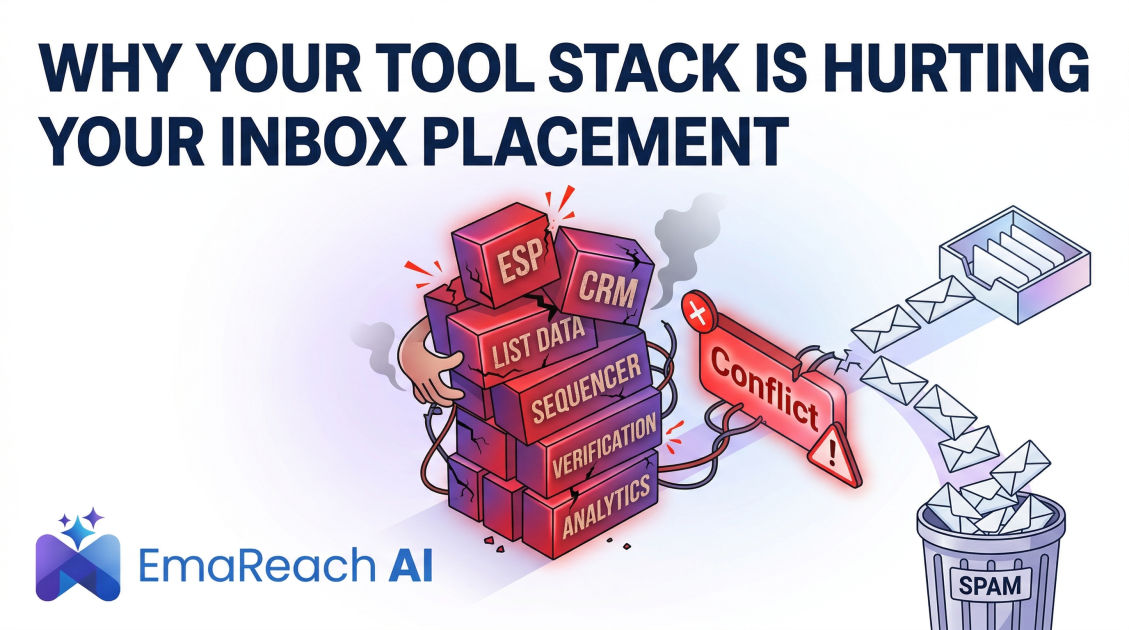
Why Your Tool Stack is Hurting Your Inbox Placement
email deliverabilitycold outreachmartechinbox placementemail automationSPF DKIMsender reputation
The Hidden Conflict Between Productivity and Deliverability
In the modern landscape of digital communication, the efficiency of an outreach strategy is often measured by the sophistication of its tool stack. Marketers and sales teams invest heavily in automation, CRM integrations, and multi-channel platforms to scale their operations. However, there is a growing, silent crisis occurring behind the scenes: the very tools designed to help you reach more people are often the primary reason your emails are failing to reach the inbox.
Inbox placement is no longer just about avoiding 'spammy' keywords. It is a complex ecosystem governed by sophisticated algorithms, machine learning, and sender reputation metrics. When your tool stack is poorly integrated or relies on outdated infrastructure, it sends negative signals to Internet Service Providers (ISPs). This guide explores the deep-seated technical and strategic reasons why your current software choices might be sabotaging your deliverability.
The Problem with Excessive Automation
Automation is a double-edged sword. While it allows for high-volume outreach, it often strips away the 'human' footprint that ISPs look for. When a tool sends a burst of five hundred emails at exactly 9:00 AM every Tuesday, it triggers red flags.
Patterns and Footprints
Algorithms used by Google and Microsoft are designed to detect non-human behavior. If your sending tool uses a rigid API that pushes content in predictable intervals, you are creating a digital footprint. Unlike a human who might take thirty seconds to send one email and three minutes for the next, automation tools often operate on a mathematical grid. This lack of variance is a primary driver for emails being rerouted to the promotions tab or the spam folder.
The Feedback Loop
Furthermore, many automation platforms do not have built-in safeguards to monitor real-time feedback from ESPs (Email Service Providers). If a tool continues to push emails after receiving a 'soft bounce' or a temporary block, it signals to the receiving server that the sender is an unmonitored bot rather than a responsible communicator.
Fragmented Infrastructure and DNS Conflict
Your tool stack often involves multiple third-party applications accessing your domain. You might have a CRM, a marketing automation platform, a cold outreach tool, and a customer support ticketing system—all sending emails on your behalf.
The SPF Limit Crisis
One of the most common technical failures in a bloated tool stack is exceeding the SPF (Sender Policy Framework) lookup limit. Most ISPs enforce a limit of 10 DNS lookups to prevent Denial of Service attacks. If your tool stack requires you to add records for five different platforms, you can easily hit this limit. Once exceeded, your SPF record becomes 'invalid' in the eyes of many receiving servers, leading to immediate authentication failure.
DKIM and DMARC Misalignment
When different tools use different methods to sign emails (DKIM), it can create a 'misalignment' with your DMARC policy. If your DMARC is set to 'reject' or 'quarantine' and a secondary tool in your stack isn't configured with the exact same domain alignment as your primary mail server, your legitimate emails will be discarded. This fragmentation is a direct byproduct of adding tools without a unified technical strategy.
The Solution: A Unified Approach with EmaReach
If you find that your current combination of software is causing more headaches than results, it is time to pivot to a platform designed with deliverability as its core philosophy. Stop Landing in Spam. Cold Emails That Reach the Inbox.
EmaReach AI combines AI-written cold outreach with inbox warm-up and multi-account sending—so your emails land in the primary tab and get replies. Instead of managing five different tools that fight for your domain's reputation, EmaReach provides a streamlined, intelligent environment that mimics human behavior and maintains technical health automatically.
By consolidating your outreach into a system that understands the nuances of ISP algorithms, you remove the 'noise' that fragmented tool stacks create. EmaReach ensures that your technical settings are always optimized, allowing you to focus on the message rather than the plumbing.
Data Hygiene and the 'Zombie' List Problem
Your tool stack might be hurting you simply by what it doesn't do. Many affordable or legacy tools lack sophisticated validation features. If your CRM is feeding an outreach tool 'dirty' data—invalid addresses, catch-all emails, or spam traps—your reputation will plummet.
The Cost of a High Bounce Rate
ISPs track your bounce rate across all the tools you use. If one tool in your stack is used for 'scraping' and another for 'sending', and the data transfer isn't seamless, you risk sending to dead accounts. A bounce rate higher than 2% is often enough to start damaging your sender score.
Internal Data Silos
When tools don't talk to each other, you might end up sending multiple emails to the same contact from different platforms, or failing to honor an unsubscribe request made in one tool while the other keeps firing. This not only leads to spam complaints—the 'kiss of death' for deliverability—but also signals a lack of professional oversight to the ISP.
Shared IP Reputation: The Hidden Danger of Cheap Tools
Many low-cost email tools utilize shared IP addresses. This means your inbox placement is at the mercy of every other user on that server. If a 'neighbor' on your shared IP sends a massive spam campaign, the IP gets blacklisted, and your perfectly crafted business emails go down with the ship.
The Importance of Reputation Isolation
Premium tool stacks prioritize IP health. They either offer dedicated IPs for high-volume senders or strictly vet their users to maintain a high 'neighborhood' score. If your current tool doesn't provide transparency regarding the IPs they use to route your mail, you are likely suffering from the poor habits of total strangers.
HTML Bloat and Hidden Tracking Pixels
Modern outreach tools love features. They offer fancy templates, multiple tracking pixels, and complex HTML structures. While these features look great in a dashboard, they are a nightmare for deliverability.
Code-to-Text Ratio
ISPs look at the ratio of actual text to underlying code. Heavy HTML templates often used by marketing platforms are frequently flagged as 'promotional' or 'commercial' by default. If your tool stack forces you into using heavy, unoptimized code, your emails are statistically less likely to hit the primary inbox compared to plain-text style emails.
Tracking Pixel Friction
While tracking opens is vital for ROI, the way a tool implements it matters. If your tool uses a generic, blacklisted domain for its tracking pixels, the presence of that pixel alone can trigger a spam filter. Sophisticated tools allow for custom tracking domains that match your sending domain, ensuring a cohesive and 'safe' appearance to the receiving server.
The Psychology of the Inbox: Content vs. Context
It isn't just about the 'pipes'; it's about what you put through them. However, your tool stack influences this more than you think. Tools that utilize 'spintax' or basic 'First_Name' tags often produce content that feels robotic.
AI-Driven Personalization
This is where advanced platforms change the game. Instead of basic placeholders, AI-driven tools can now analyze a prospect's LinkedIn profile or website to generate a unique opening line. This level of variance is not just good for conversion; it’s essential for deliverability. Unique content per email prevents 'content fingerprinting'—a technique where ISPs block messages because they see the exact same body text being sent to thousands of recipients.
How to Audit Your Current Tool Stack
If you suspect your software is the culprit behind your low open rates, follow this audit checklist:
- Check Your SPF/DKIM/DMARC: Use a domain health tool to ensure you haven't exceeded lookup limits.
- Monitor Your Sender Score: Use public reputation monitors to see if your sending IPs are on any major blacklists.
- Review Your Tracking Links: Send a test email to yourself and check if the tracking links are using a generic domain or your own.
- Test Plain Text vs. HTML: Run an A/B test. If your plain text emails have a significantly higher open rate, your tool’s templates are the problem.
- Evaluate Integration Points: Ensure your 'unsubscribe' data is syncing across every single tool in your stack instantly.
The Future of Deliverability
As ISPs become more aggressive in their quest to protect user inboxes, the margin for error decreases. The era of 'spraying and praying' with a disjointed collection of cheap tools is over. Success now requires a holistic view of the sending ecosystem.
By choosing tools that prioritize authentication, human-like sending patterns, and high-quality data hygiene, you aren't just improving your metrics; you are future-proofing your business communications. Your tool stack should be an engine for growth, not a barrier to entry.
Conclusion
Your inbox placement is the most critical KPI of your digital outreach. Without it, the most persuasive copy and the most valuable offers are invisible. If your current tool stack is creating technical friction, triggering spam filters with rigid automation, or damaging your reputation through poor infrastructure, it is time for a change. Consolidating your efforts into a high-performance, AI-optimized platform like EmaReach ensures that your message doesn't just get sent—it gets seen. Take control of your reputation today and stop letting your software stand in the way of your success.
EmaReach AI
Ready to scale your cold email outreach?
Join thousands of teams using EmaReach AI for AI-powered campaigns, domain warmup, and 95%+ deliverability. Start free — no credit card required.
Related posts
- Read article
What You Gain and What You Give Up When Switching From Instantly
Thinking about migrating your cold email stack? This detailed guide breaks down the exact operational advantages you gain and the core features you sacrifice when switching away from Instantly's popular outreach platform.
- Read article
The Instantly Alternative That Wins for Teams With Strict IT Policies
Discover why traditional cold email tools fail strict IT security audits and explore the ultimate enterprise-grade alternative built for secure, compliant, and high-performance outbound sales teams.