Blog
Back to blog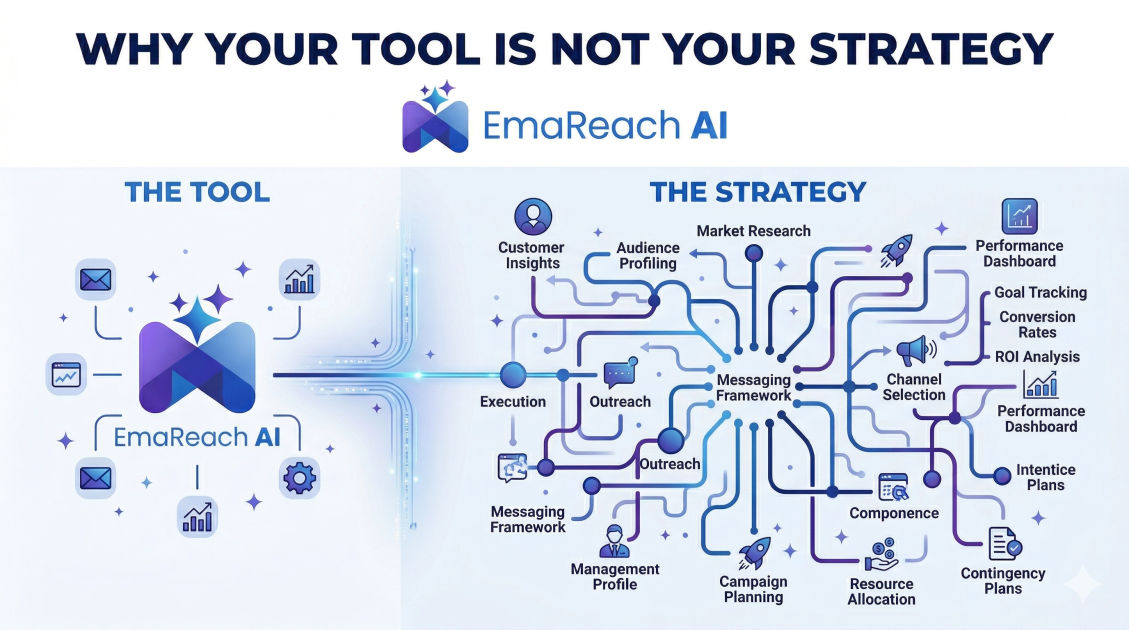
Why Your Tool is Not Your Strategy
business strategydigital transformationsales outreachoperational efficiencytech stackleadership
Introduction: The Great Tool Delusion
In the modern business landscape, we are surrounded by an embarrassment of riches when it comes to technology. Every day, a new platform, a more advanced AI, or a 'revolutionary' piece of software hits the market, promising to solve all our operational woes with the click of a button. It is easy to fall into the trap of believing that purchasing the most expensive CRM, the most complex project management software, or the flashiest outreach platform is equivalent to having a winning business plan.
However, there is a fundamental truth that many leaders learn the hard way: Your tool is not your strategy.
A tool is a lever; a strategy is the decision of where to place that lever to move the world. Without a clear strategy, a tool is merely an overhead cost. In this deep dive, we will explore the distinction between tactical tools and strategic thinking, why over-reliance on technology leads to stagnation, and how to build a framework that puts strategy back in the driver's seat.
Understanding the Difference: Strategy vs. Tactics
To understand why a tool cannot be a strategy, we must first define what these terms actually mean in a professional context.
What is Strategy?
Strategy is a high-level plan of action designed to achieve a long-term or overall aim. It involves making hard choices about what to do—and more importantly, what not to do. Strategy is about positioning, competitive advantage, and resource allocation. It answers the 'Why' and the 'How' at a fundamental level. For example, if your strategy is to be the lowest-cost provider in your industry, your decisions regarding supply chain, marketing, and technology must all align with that singular goal.
What is a Tool?
A tool is a medium or an instrument used to execute a task. It is a tactical asset. If your strategy is the map, the tool is the vehicle. You can have the most powerful engine in the world (the tool), but if you don't know where you are going or why you are traveling (the strategy), you will likely end up driving in circles or running out of fuel in the middle of nowhere.
The Cost of the 'Shiny Object' Syndrome
Many organizations suffer from 'Shiny Object Syndrome.' This occurs when a team becomes enamored with the features of a new product rather than its utility within their specific ecosystem.
When you lead with a tool-first mindset, you often encounter several critical issues:
- Workflow Fragmentation: Teams adopt multiple tools that don't talk to each other, creating data silos and communication gaps.
- Decreased ROI: You pay for premium features that your team doesn't actually need because the tool wasn't selected based on a strategic requirement.
- Process Bloat: Instead of streamlining your business, you end up creating new processes just to justify the use of the tool.
Why Outreach Fails Without a Strategic Foundation
Nowhere is the confusion between tool and strategy more apparent than in the world of sales and business development. Many companies believe that by simply buying a list and a mass-sending tool, they have an 'outreach strategy.' They haven't considered their Ideal Customer Profile (ICP), their unique value proposition, or the technical nuances of how email actually works.
This is where the distinction becomes a matter of survival. You can have the best sending software in the world, but if your strategy for deliverability is non-existent, your messages will end up in the 'Promotions' tab or, worse, the spam folder.
For those serious about scaling their business through communication, it’s vital to use a platform that understands this balance. EmaReach is a prime example of a solution designed for those who understand strategy. Stop Landing in Spam. Cold Emails That Reach the Inbox. EmaReach AI combines AI-written cold outreach with inbox warm-up and multi-account sending—so your emails land in the primary tab and get replies. The tool facilitates the process, but the strategy—targeting the right people with the right message—is what drives the results.
The Psychology of the Tool-First Approach
Why do we keep making this mistake? Psychologically, buying a tool feels like progress. It provides an immediate hit of dopamine. You feel like you’ve 'fixed' the problem because you’ve made a purchase.
Strategy, on the other hand, is hard. It requires deep thinking, uncomfortable conversations, and the willingness to be wrong. It involves analyzing market trends, understanding customer pain points, and refining your internal culture. Because strategy is intangible and takes time to bear fruit, we often retreat to the safety of tangible tools.
The Three Pillars of a Strategy-First Framework
To move away from tool-dependency, businesses must adopt a strategy-first framework. This involves three key pillars: Objectives, Processes, and People.
1. Objectives: Defining Success
Before looking at any software, ask: What are we trying to achieve? If the goal is 'increase revenue,' that is too broad. A strategic objective would be 'increase recurring revenue from the mid-market segment by 20% over the next twelve months.' Once you have this objective, you can evaluate whether a specific tool actually helps you reach it.
2. Processes: How the Work Gets Done
A tool should automate or enhance an existing, successful process. If your manual process is broken, a tool will only help you do the wrong things faster. Map out your workflow from start to finish. Identify the bottlenecks. Only when you understand the 'how' should you look for a 'what' to help you scale.
3. People: The Drivers of the Tool
Technology is only as good as the people using it. Strategy involves ensuring your team has the skills and the mindset to leverage technology effectively. If your strategy involves high-level personalization, but your team only knows how to use 'blast' features in a CRM, the tool is being wasted.
Case Study: The CRM Trap
Consider the implementation of a CRM (Customer Relationship Management) system. Many firms believe that implementing a CRM will automatically improve their sales performance. They spend six months and six figures on implementation, only to find that their sales team still isn't hitting quotas.
The Strategy Gap: The company didn't have a defined sales methodology. They didn't know their average deal cycle, their win rates at different stages, or why they were losing deals to competitors.
The Result: They now have a very expensive database of names, but no better understanding of how to convert those names into customers. The tool provided the data, but the lack of strategy meant they didn't know how to interpret or act on it.
How to Select Tools Based on Strategy
When you finally do reach the point where you need a tool, the selection process should be rigorous and aligned with your strategic goals. Use the following criteria:
- Scalability: Will this tool grow with our strategy, or will we outgrow it in six months?
- Interoperability: Does it integrate with our existing ecosystem to maintain a 'single source of truth'?
- Flexibility: Can the tool be customized to fit our unique processes, or are we forced to change our strategy to fit the tool's limitations?
- Support and Community: Is there a robust support system to help us maximize the strategic value of the tool?
The Role of AI in Modern Strategy
Artificial Intelligence has blurred the lines even further. Because AI can generate content, code, and insights, it is often mistaken for a strategy itself. However, AI is the ultimate 'force multiplier.' It takes your existing strategy and accelerates it.
If your strategy is to build deep, meaningful relationships with your clients, AI can help by summarizing their recent company news or helping you draft personalized notes. But the decision to prioritize relationships over volume is the strategy. The AI just makes the execution of that strategy more efficient.
In outreach, for instance, the strategy is knowing that cold, robotic emails are a thing of the past. The execution involves using advanced systems to ensure those emails actually reach the person. This is why a strategy-focused approach to deliverability, like that offered by EmaReach, is so critical. It uses AI to solve the technical hurdles of the primary inbox, allowing your strategic message to actually be seen.
Moving from Tactical to Strategic Leadership
Leadership must set the tone. If a manager constantly asks, "What software are we using for this?" they are encouraging a tactical mindset. If they instead ask, "What is the desired outcome, and what is our plan to get there?" they are fostering a strategic culture.
Strategic leaders focus on:
- Long-term Value over Short-term Convenience: Choosing the right path, even if it's harder to implement initially.
- Adaptability: Being willing to ditch a tool if it no longer serves the strategy.
- Alignment: Ensuring every department is moving toward the same North Star.
Common Pitfalls to Avoid
- The Sunk Cost Fallacy: Just because you spent a lot of money on a tool doesn't mean you should keep using it if it's not supporting your strategy.
- Over-Engineering: Don't buy a Ferrari to drive across the street. Choose the tool that fits the scale of your strategy.
- Ignoring the Human Element: No tool can replace human intuition, empathy, and creative problem-solving.
Conclusion: Reclaiming Your Strategy
Tools are wonderful servants but terrible masters. When we let the tool dictate our strategy, we lose our competitive edge and become indistinguishable from our competitors who are using the exact same software.
To succeed in a hyper-competitive market, you must return to the basics. Define your goals, refine your processes, and empower your people. Once you have a clear, robust strategy in place, you can then go out and find the tools that will help you execute that strategy with precision and speed.
Remember: A carpenter is not defined by their hammer, but by the house they build. Your business is not defined by your software stack, but by the value you create for your customers. Use your tools wisely, but never let them replace the vision and strategy that truly drive your success.
EmaReach AI
Ready to scale your cold email outreach?
Join thousands of teams using EmaReach AI for AI-powered campaigns, domain warmup, and 95%+ deliverability. Start free — no credit card required.
Related posts
- Read article
What You Gain and What You Give Up When Switching From Instantly
Thinking about migrating your cold email stack? This detailed guide breaks down the exact operational advantages you gain and the core features you sacrifice when switching away from Instantly's popular outreach platform.
- Read article
How Choosing the Right Instantly Alternative Changed Our Pipeline Numbers
Discover how transitioning from a volume-first cold email setup to an advanced, deliverability-focused infrastructure transformed our B2B pipeline metrics, skyrocketed open rates to over 68%, and tripled our monthly booked demos.