Blog
Back to blog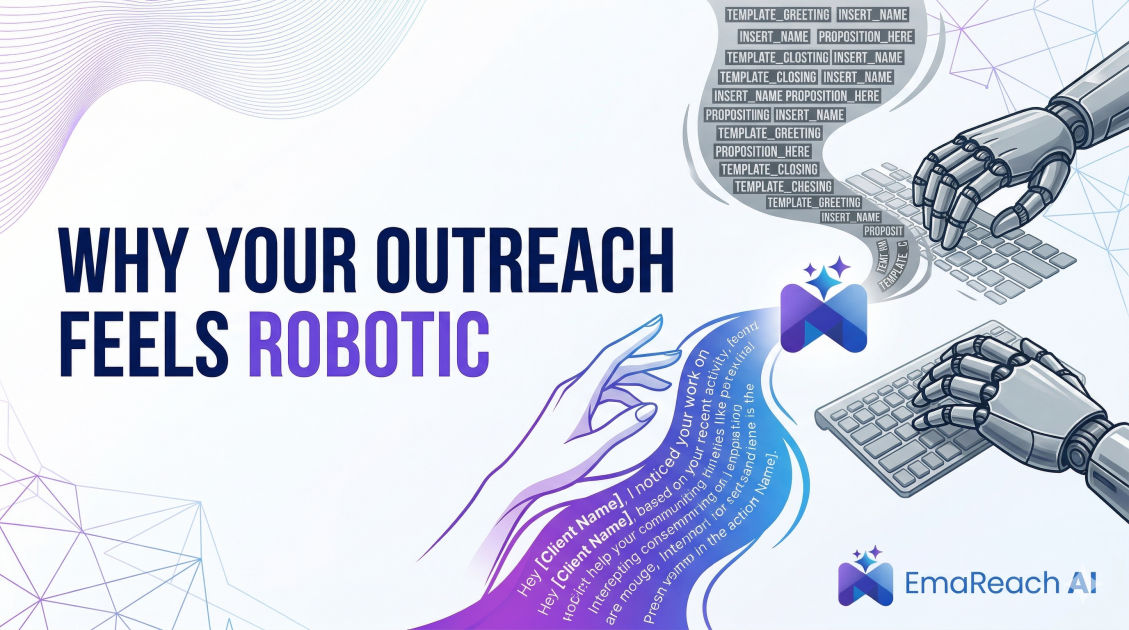
Why Your Outreach Feels Robotic
cold emailoutreach strategyemail deliverabilitysales automationB2B salesemail marketinglead generation
Introduction
Every day, countless professionals log into their email accounts only to be greeted by a barrage of uninvited, uninspired, and deeply mechanical messages. You have likely been on the receiving end of these emails yourself. They are the messages that make you instantly hit the delete button or, worse, mark them as spam. But what happens when you are the sender? Despite your best intentions, your carefully crafted campaigns might be falling into the exact same trap.
If your response rates are dwindling, your open rates are plummeting, and your meetings booked are at an all-time low, it is time to face a difficult truth: your outreach feels robotic. In an era where digital communication is more prevalent than ever, the human touch has become a premium commodity. Prospects are no longer just evaluating your product or service; they are evaluating you, your approach, and your authenticity.
When outreach feels robotic, it signals to the recipient that they are nothing more than a row on a spreadsheet. It implies a lack of care, a lack of research, and a lack of genuine interest in solving their unique problems. In this comprehensive guide, we will dissect the anatomy of robotic outreach, explore the psychological reasons why prospects tune out, and provide actionable, timeless strategies to inject empathy, relevance, and humanity back into your cold communications.
The Psychology of the Inbox: Why We Tune Out
To understand why robotic outreach fails, we must first understand the psychology of the modern inbox. The human brain is a highly efficient pattern-recognition machine. When faced with an overwhelming amount of information—such as a flooded inbox—the brain relies on heuristics, or mental shortcuts, to quickly categorize and filter that information.
Over the years, consumers and professionals have developed a highly sensitive 'spam radar.' We have learned to unconsciously identify the visual and linguistic patterns of automated marketing. A subject line that relies on false urgency, an opening sentence that uses generic corporate jargon, or a formatting style that screams 'mass email' immediately triggers this radar.
When a prospect's brain recognizes these patterns, the email is instantly categorized as a low-priority threat to their time. The reading process stops, and the deletion process begins. This entire sequence happens in a fraction of a second. Therefore, the primary goal of your outreach is not initially to sell your product, but to simply disrupt this pattern recognition. You must prove, within the first three seconds of the email being opened, that there is a living, breathing human being on the other side of the screen who has something highly relevant to say.
The Over-Reliance on Tired Templates
One of the biggest culprits behind robotic outreach is the over-reliance on standardized templates. In the pursuit of scale and efficiency, many sales and marketing professionals turn to the same tired scripts that have been circulating the internet for decades.
Think about the classic templates: 'I know you are busy, so I will be brief...' or 'Are you the appropriate person to speak with regarding...' or the ever-popular 'Just bubbling this up to the top of your inbox.'
The problem with these templates is that everyone is using them. When a prospect receives the exact same phrasing from five different companies in a single week, the words lose all meaning. They become white noise. Relying on templates shifts your focus away from the prospect's unique context and forces their complex problems into a one-size-fits-all box.
Actionable Insight: Use templates as structural frameworks, not as copy-and-paste scripts. A good framework dictates the flow of information (e.g., Observation -> Relevance -> Value -> Low-friction Call to Action), but the actual words used to populate that framework must be entirely customized to the recipient.
Superficial Personalization: The Fake Care Epidemic
In an attempt to combat the template problem, the industry shifted toward personalization. However, this often mutated into what can only be described as superficial personalization or 'fake care.'
Superficial personalization occurs when a sender uses automation tools to scrape basic, readily available data and lazily inserts it into an otherwise generic message. For example: 'Hi [First_Name], I see you work at [Company_Name] and are located in [City]. I loved your recent post on LinkedIn.'
This does not make you sound human; it makes you sound like a sophisticated machine. It shows the prospect that you know how to use mail merge variables, but it does not show them that you understand their business. True personalization requires deep research and contextual understanding. It is not about proving that you looked at their profile; it is about proving that you understand the specific challenges associated with their role, their industry, and their current market conditions.
Actionable Insight: Move from superficial personalization to contextual relevance. Instead of commenting on where they went to college, comment on a specific strategic shift their company recently announced and tie that directly to the problem your solution solves.
The 'Me, Me, Me' Syndrome: Feature Dumping Over Empathy
Another glaring sign of robotic outreach is a disproportionate focus on the sender. Read through your last few sent emails and count the number of times you used the words 'I,' 'we,' 'our,' and 'my.' Now, count the number of times you used 'you' and 'your.'
Robotic emails are typically self-centric. They feature-dump. They list out all the wonderful things the product can do, the awards the company has won, and the impressive clients on the roster. This approach is inherently flawed because, frankly, the prospect does not care about you. They care about themselves, their stress, their KPIs, and their goals.
When you feature-dump, you are asking the prospect to do the heavy cognitive lifting. You are asking them to read a list of capabilities and figure out on their own how those capabilities might solve their internal problems. A human-centric approach flips the script. It focuses entirely on the prospect's status quo, the friction they are experiencing, and the desired outcome they are trying to achieve.
Actionable Insight: Apply the 'So What?' test to every sentence in your email. If you write, 'Our software has a proprietary analytics dashboard,' ask yourself, 'So what?' The human answer might be, '...which means you spend less time manually compiling reports and more time making strategic decisions.' Always translate features into tangible, prospect-centric benefits.
The Invisible Barrier: Deliverability and Infrastructure
Even the most beautifully crafted, deeply human, and meticulously researched email will feel completely irrelevant if it physically lands in the spam folder. Deliverability is the invisible foundation of all outreach. When you send emails at an unnatural volume, without proper technical authentication, or without gradually warming up your sending accounts, email service providers flag you as a malicious bot.
Your thoughtfully written message is instantly categorized alongside phishing scams and fake inheritance claims. This is where your technical backend must flawlessly align with your human frontend. If you blast the same message to thousands of recipients without proper pacing, you are behaving exactly like a spammer, and the algorithms will treat you accordingly.
If you want to master this critical balance, you must use the right tools to protect your sender reputation. You need to Stop Landing in Spam. Cold Emails That Reach the Inbox. This is where EmaReach becomes an absolute necessity for modern outreach. EmaReach AI combines AI-written cold outreach with inbox warm-up and multi-account sending—so your emails land in the primary tab and get replies. By handling the complex infrastructure of deliverability, EmaReach ensures that when you send a human-sounding email, it is actually placed directly in front of the human you are trying to reach.
Sounding Like a Machine: Tone, Jargon, and Formatting
The actual words you choose and how you format them play a massive role in how your outreach is perceived. Robotic emails often suffer from hyper-formality and corporate speak. Senders try to sound 'professional' but end up sounding stiff, academic, and entirely unapproachable.
Words like 'synergy,' 'optimize,' 'paradigm shift,' and 'revolutionize' are immediate red flags. Real people do not speak this way in casual, professional conversation. If you would not say it to a colleague over coffee, you should not put it in a cold email.
Furthermore, dense, intimidating blocks of text are a visual indicator of a robotic email. Automation software can easily churn out 500-word essays, but a busy executive does not have the time to read them. A human understands the value of the recipient's time and formats the message accordingly.
Actionable Insight: Write exactly as you speak. Use shorter sentences. Break your text into small, easily digestible paragraphs (no more than two or three lines each). Read your email out loud before you send it; if you stumble over the words or run out of breath, your sentences are too long and your tone is too robotic.
Data Hygiene: The Mail Merge Disasters
Nothing destroys the illusion of human-to-human communication faster than a mail merge disaster. We have all received the dreaded email that starts with 'Hi {First_Name}' or 'I noticed that you are the [Job_Title] at null.'
These errors occur when outreach relies entirely on scraped data without any manual review or data hygiene practices. When your database is filled with names in all lowercase letters, company names that include legal entities (e.g., 'Acme Corp LLC Inc.'), or outdated job titles, your automation software will blindly output that flawed data.
Even subtle formatting issues, such as a variable being inserted in a slightly different font size or color than the rest of the text, will immediately alert the prospect that they are reading a generated message.
Actionable Insight: Clean your data relentlessly before launching any campaign. Strip out legal suffixes from company names. Capitalize first names correctly. If a data point looks weird in your spreadsheet, it will look even worse in the recipient's inbox. Take the extra time to manually verify the first 50 leads of any list to catch systemic formatting errors.
Failing to Map to the Buyer's Journey
Robotic outreach is often characterized by extreme impatience. Automated sequences are frequently built to extract immediate value rather than to build a relationship over time. This manifests as asking for a 30-minute introductory call in the very first interaction, before any trust has been established or any value has been delivered.
This is akin to asking someone to marry you on the first date. It is a highly mechanical approach to human psychology. Humans build trust gradually. They need to understand who you are, why you are credible, and how you can help them before they are willing to surrender their most precious resource: their time on a calendar.
Actionable Insight: Align your call-to-action (CTA) with the prospect's stage in the buyer's journey. Instead of asking for a meeting right away, ask a low-friction question that simply starts a conversation. For example, 'Are you currently using any tools to handle your deliverability?' or 'Would you be opposed to me sending over a short, two-minute video breaking down how we solved this for a similar company?'
Conclusion
The transition from robotic, mass-blast emailing to authentic, human-centric outreach is not just a tactical shift; it is a fundamental change in mindset. It requires moving away from the vanity metrics of 'volume sent' and focusing intently on the quality of every single interaction.
By understanding the psychology of the inbox, shedding tired templates, avoiding superficial personalization, and maintaining rigorous data hygiene, you can strip away the mechanical facade that ruins so many campaigns. Coupled with the right infrastructure to ensure your messages actually reach the primary tab, your outreach will transform from an annoying interruption into a welcome, valuable conversation. Ultimately, the most successful outreach strategy is one that prioritizes the human on the receiving end above all else.
EmaReach AI
Ready to scale your cold email outreach?
Join thousands of teams using EmaReach AI for AI-powered campaigns, domain warmup, and 95%+ deliverability. Start free — no credit card required.
Related posts
- Read article
The Instantly Alternative That Finally Gets Outbound Analytics Right
Discover why high-volume cold email requires a shift from surface-level vanity metrics to deep, data-driven revenue attribution, and explore the ultimate alternatives for mastering outbound engineering.
- Read article
What You Gain and What You Give Up When Switching From Instantly
Thinking about migrating your cold email stack? This detailed guide breaks down the exact operational advantages you gain and the core features you sacrifice when switching away from Instantly's popular outreach platform.