Blog
Back to blog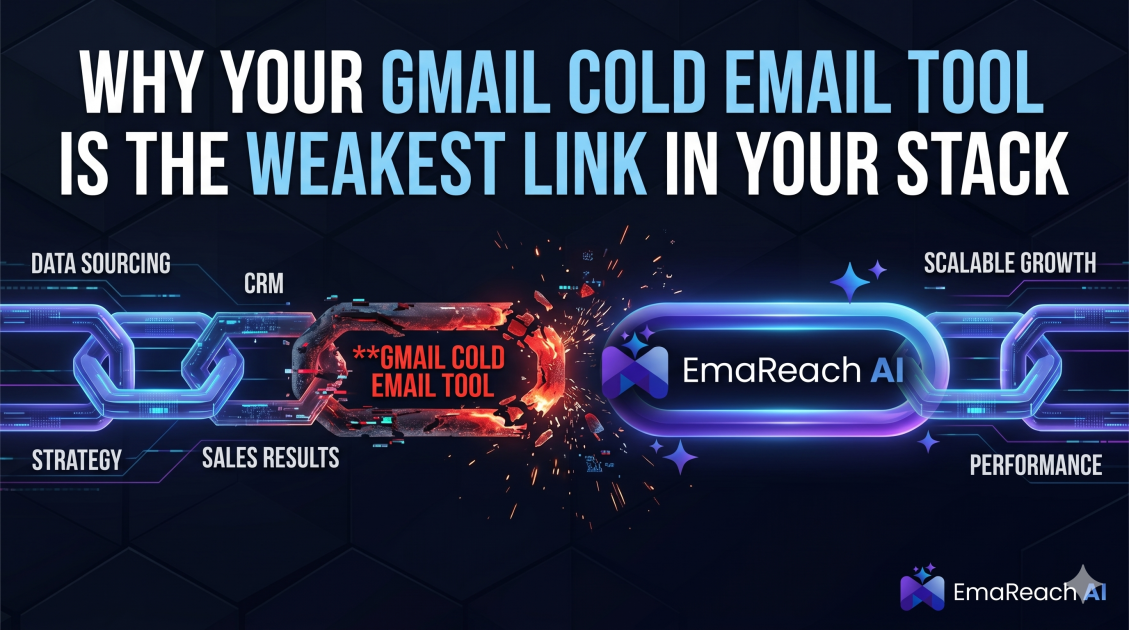
Why Your Gmail Cold Email Tool Is the Weakest Link in Your Stack
cold emailemail deliverabilityGmail marketingoutreach strategysales automationsender reputation
The Hidden Danger in Your Outreach Infrastructure
For years, the standard operating procedure for cold outreach was simple: buy a domain, set up a Google Workspace account, and plug it into a popular sending tool. This workflow served thousands of agencies and sales teams effectively. However, the landscape of email deliverability has undergone a seismic shift. Today, the very tools designed to simplify your outreach might be the primary reason your campaigns are failing. When you rely on a generic Gmail cold email tool, you aren't just sending emails; you are often broadcasting a signal to Google’s sophisticated filters that your content is unsolicited, automated, and unwelcome.
Your outreach stack is only as strong as its weakest link. While you might have spent weeks refining your offer and months building a high-quality lead list, the infrastructure you use to deliver those messages can render all that work invisible. If your tool is the weakest link, your emails don't just get ignored—they never even arrive.
The Fundamental Flaw of Legacy Gmail Tools
Most legacy cold email tools built for Gmail function as a simple automation layer over the Gmail API or SMTP. They are designed for convenience, not deliverability. The core issue is that these tools often lack the technical depth required to manage the nuanced relationship between a sending IP, domain reputation, and the specific behavioral triggers that Gmail’s AI monitors.
When a tool sends hundreds of emails in a perfectly timed sequence, it creates a pattern. Modern machine learning algorithms are exceptionally good at spotting these patterns. If your tool doesn't have sophisticated jittering, advanced rotation, and deep integration with your workspace's health, it’s effectively painting a target on your inbox. Once Gmail identifies an automation pattern, it doesn't just block the email; it flags the entire sender profile, making it nearly impossible to reach the primary tab again.
The "API Overhead" Problem
Many tools interact with Gmail via the API in a way that is inherently "noisy." Every time a tool performs an action—checking an inbox, sending a draft, moving a message—it leaves a digital footprint. When these actions are performed at scale without proper obfuscation, Google views the account as being controlled by a bot rather than a human. This distinction is the difference between an email landing in the 'Primary' tab and one disappearing into the 'Spam' folder or the 'Promotions' tab.
The Trap of Static Sending Patterns
Traditional tools often send emails in a linear fashion. You set a schedule (e.g., 9:00 AM to 5:00 PM) and a frequency (e.g., one email every 2 minutes). To a human, this looks organized. To a security filter, it looks like a script. Real human behavior is erratic; humans don't send emails every exactly 120 seconds for eight hours straight.
To break this cycle, you need more than just a scheduler; you need a system that understands the psychology of deliverability. This is where EmaReach (https://www.emareach.com/) changes the game. Stop Landing in Spam. Cold Emails That Reach the Inbox. EmaReach AI combines AI-written cold outreach with inbox warm-up and multi-account sending—so your emails land in the primary tab and get replies. By mimicking human irregularity and managing multiple accounts simultaneously, it removes the mechanical signatures that lead to blacklisting.
Why Your Current Tool Can't Solve the Reputation Crisis
Sender reputation is the credit score of the email world. It is built slowly and destroyed quickly. Most Gmail-based tools treat reputation as a static variable, but in reality, it is a living metric that fluctuates with every single send.
Lack of Integrated Warm-up
Many tools offer "warm-up" as an afterthought or an external add-on. A tool that isn't fundamentally integrated with a warm-up protocol is essentially sending your accounts into a war zone without armor. Without a continuous loop of positive engagement—emails being opened, replied to, and marked as important by other high-reputation accounts—your sending volume will inevitably outpace your reputation. This leads to a "reputation cliff" where deliverability drops from 90% to 5% overnight.
The Danger of Shared Infrastructure
Some tools route your emails through their own SMTP servers or shared IPs. If another user on that same infrastructure is sending low-quality spam, your reputation is tarnished by association. Even if you are using your own Google Workspace, the tool's unique header signatures can sometimes be enough for filters to group you with other "low-quality" senders using the same software.
The Death of the "Set It and Forget It" Mentality
One of the biggest selling points of many cold email tools is automation. But "set it and forget it" is a recipe for disaster in the modern era. High-performance outreach requires constant monitoring and adjustment. If your tool doesn't provide real-time feedback on your deliverability health, you are flying blind.
Weak tools focus on vanity metrics: open rates and click rates. While these are important, they are lagging indicators. By the time your open rate drops, the damage is already done. You need leading indicators—domain health checks, SPF/DKIM/DMARC monitoring, and blacklisting alerts. A tool that lacks these features is the weakest link because it fails to warn you before the ship sinks.
The Architecture of a Modern Outreach Stack
If the tool is the problem, what is the solution? A modern outreach stack must be built on three pillars: Intelligence, Infrastructure, and Integration.
1. Intelligent Personalization
Generic templates are a spam trigger. Even if your tool sends them perfectly, the content itself will get you caught. Modern tools must use AI to generate unique, contextually relevant messages for every lead. When every email you send is unique, it is much harder for filters to identify a mass-mailing campaign.
2. Multi-Account Management (Horizontal Scaling)
Instead of sending 200 emails from one account, a robust strategy involves sending 20 emails from 10 different accounts. This horizontal scaling reduces the risk on any single inbox. However, managing 10 accounts manually is impossible, and most basic tools aren't built to handle the synchronization required for this approach. You need a platform that manages these identities seamlessly, ensuring that warm-up and sending are balanced across the entire fleet.
3. Native Inbox Engagement
The most effective way to stay out of spam is to prove to Google that people want to talk to you. This means your tool shouldn't just send emails; it should manage the conversation. This includes automatically handling out-of-office replies, categorizing interested leads, and maintaining a healthy "inbox zero" state through the API. This positive signal tells Google that you are a high-value user, not a broadcast-only bot.
Transitioning Beyond Basic Automation
Moving away from a weak tool requires a shift in strategy. It’s no longer about how many emails you can send; it’s about how many you can get delivered. This is why professional outfits are moving toward platforms like EmaReach. By integrating the writing process with the sending infrastructure, EmaReach ensures that the "DNA" of your email—from the technical headers to the actual prose—is optimized for the primary tab.
When you use EmaReach (https://www.emareach.com/), you are replacing a simple "sender" with a deliverability engine. It understands that cold email is a trust-building exercise. If your infrastructure isn't trusted by the provider (Google), your message will never be trusted by the recipient.
The Cost of the Wrong Tool
The most expensive tool is the one that doesn't work. If you are paying $50 a month for a tool that lands your emails in spam, you aren't just losing $50. You are losing the value of your leads, the cost of your domains, the time of your sales team, and the potential revenue from those missed connections.
Consider the math: if you reach 1,000 leads and have a 1% meeting book rate, that’s 10 meetings. If your tool’s poor deliverability drops your reach to 200 (because 80% went to spam), you only get 2 meetings. The "cheap" or "simple" tool just cost you 8 potential clients. In this light, the tool is not just a utility—it is the gatekeeper of your ROI.
Technical Red Flags to Watch For
If you are evaluating your current stack, look for these signs that your tool is the weakest link:
- Fixed Intervals: The tool sends emails at exactly the same time gap every time.
- Manual DNS Setup Only: The tool doesn't automatically verify or monitor your SPF, DKIM, and DMARC records.
- No Multi-Inbox Support: You are forced to send high volumes from a single address.
- Lack of Content Spintax or AI Variation: The tool encourages sending the exact same copy to hundreds of people.
- Browser-Based Sending Only: Tools that rely on a browser extension can be easily throttled or detected by Google's client-side security.
The Future of Gmail Outreach
Google is in a perpetual arms race with spammers. As their AI becomes more adept at identifying automated outreach, the "gray area" that cold emailers inhabit becomes smaller. The only way to survive is to be better than the filters. This requires a tool that doesn't just automate tasks but understands the underlying environment.
The future belongs to "High-Fidelity Outreach." This means sending fewer, better emails from a highly optimized, multi-account infrastructure. It means using AI not just to write, but to monitor reputation and adjust sending behavior in real-time.
Conclusion
Your Gmail cold email tool is the bridge between your business and your future customers. If that bridge is poorly constructed, no one will ever cross it. By recognizing the limitations of basic automation and moving toward a sophisticated, deliverability-first approach, you protect your most valuable asset: your reputation.
Don't let a weak tool dictate the ceiling of your growth. Invest in infrastructure that treats deliverability as a science, not an afterthought. When your emails consistently hit the primary tab, every other part of your sales process—your copywriting, your offer, and your closing—finally has the chance to shine. The choice is clear: continue fighting the filters with outdated tools, or embrace a system built for the modern era of email. Reach for the inbox, and the results will follow.
EmaReach AI
Ready to scale your cold email outreach?
Join thousands of teams using EmaReach AI for AI-powered campaigns, domain warmup, and 95%+ deliverability. Start free — no credit card required.
Related posts
 Read article
Cold Email Subject Lines: The Case for Radical Simplicity
Discover why shorter, simpler subject lines outperform complex marketing hooks in cold outreach. Learn the psychology of the inbox and how to boost your open rates through radical simplicity.
Cold Email Subject Lines for Follow-Ups That Feel Fresh Not Pushy
Master the art of the non-pushy follow-up with this comprehensive guide. Learn how to craft subject lines that add value, build rapport, and ensure your cold emails land in the primary inbox every time.