Blog
Back to blog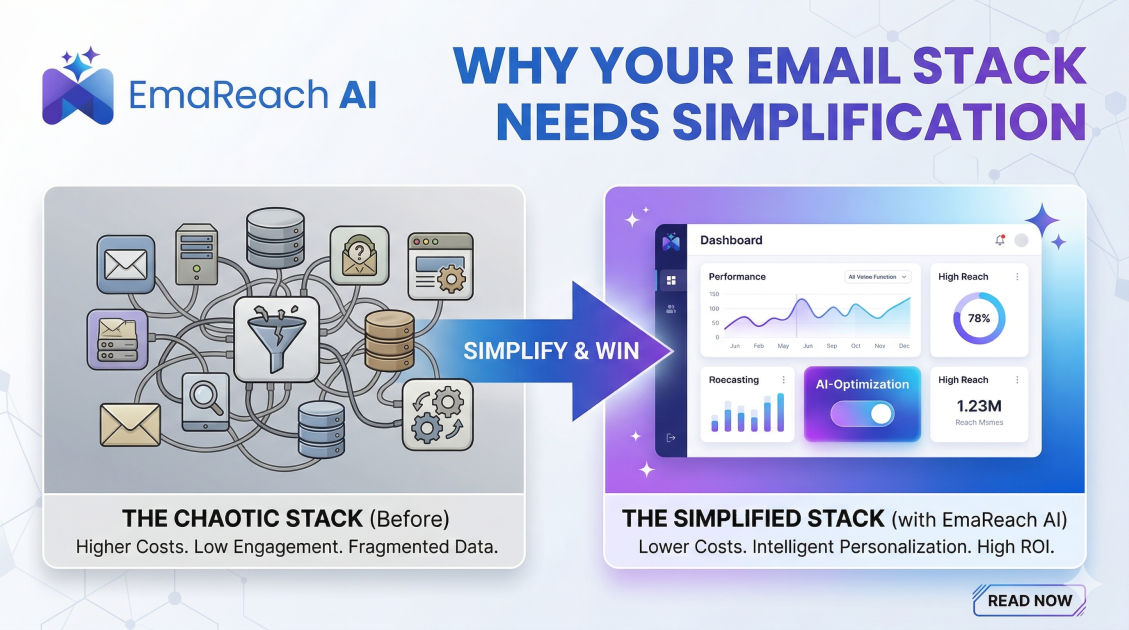
Why Your Email Stack Needs Simplification
cold emailoutreachemail deliverabilityproductivitymarketing toolssales automationemail marketing
Introduction
In the modern digital landscape, communication is the lifeblood of business growth. Whether you are running a marketing campaign, reaching out to potential leads, or simply keeping your existing customer base engaged, email remains the most direct and effective channel at your disposal. However, as strategies have evolved and become more sophisticated, so too has the technology we use to execute them. What began as a simple process of drafting a message and hitting send has now morphed into a complex web of interconnected applications, plugins, and platforms.
Today, it is not uncommon for a single organization to rely on half a dozen different tools just to manage their email operations. You might have one platform for list building, another for email verification, a separate application for inbox warm-up, a specialized tool for drafting AI-generated copy, yet another for sending the actual messages, and finally, a complex CRM to track all the resulting data. This phenomenon, often referred to as "tool sprawl" or the creation of a "franken-stack," is rapidly becoming one of the most significant bottlenecks in modern business operations.
While each of these tools is adopted with the best of intentions—usually to solve a specific, isolated problem or optimize a single metric—the cumulative effect is often the exact opposite of optimization. An overly complex email stack creates friction, inflates operational costs, damages sender reputation, and ultimately dilutes the effectiveness of your outreach efforts. In this comprehensive guide, we will explore the hidden dangers of a bloated email infrastructure and discuss why simplifying your email stack is not just a matter of convenience, but a critical strategic imperative for maximizing your reach and revenue.
The Anatomy of an Overcomplicated Email Stack
To understand why simplification is necessary, we must first examine how email stacks become bloated in the first place. Tool sprawl rarely happens overnight. It is usually the result of incremental additions, often driven by the desire to implement the latest growth hacks or adapt to changing industry trends. Over time, these incremental additions accumulate into a tangled web of software subscriptions.
The Typical Fragmented Workflow
A standard, yet highly fragmented, email outreach workflow often looks something like this:
- Lead Generation and Scraping: Utilizing specialized software to scrape contact information from various directories and professional networks.
- Data Cleaning and Verification: Exporting those leads into a separate tool designed to ping email servers and verify that the addresses are valid, reducing the risk of hard bounces.
- Domain Warm-up: Connecting new domains and email accounts to a dedicated warm-up service that artificially generates engagement to build a positive sender reputation with major inbox providers.
- Copywriting and Personalization: Leveraging standalone AI writing assistants or separate personalization engines to draft email copy and generate custom opening lines.
- Sending and Sequencing: Moving the data yet again into the core sending platform that handles the actual dispatching of emails and manages the follow-up sequences.
- Analytics and CRM Integration: Relying on third-party integration tools (like Zapier or Make) to push open rates, click-through rates, and reply data back into a central CRM.
At each stage of this workflow, data must be transferred, formatted, and synced. Every transfer point represents a potential point of failure. When an API breaks, when a CSV file is formatted incorrectly, or when a tool changes its pricing model, the entire operation grinds to a halt.
The Illusion of Best-in-Class
Many businesses justify this complexity by adhering to a "best-in-class" philosophy. The logic dictates that by selecting the absolute best tool for each highly specific micro-task, the overall outcome will be superior. However, this philosophy fails to account for the systemic friction created by integrating disparate systems. The marginal gains achieved by using a slightly better AI writer or a slightly faster verification tool are almost entirely wiped out by the time lost navigating between interfaces, troubleshooting broken integrations, and managing isolated data silos.
Symptom 1: Plunging Deliverability Rates
Perhaps the most severe consequence of a fragmented email stack is the damage it can inflict on your deliverability rates. Deliverability—the measure of whether your emails actually reach the primary inbox rather than being routed to the spam folder or blocked entirely—is the foundation of any successful email strategy. If your emails are not being seen, the quality of your copy and the size of your list are entirely irrelevant.
The Danger of Disconnected Systems
Inbox providers employ incredibly sophisticated algorithms to determine the legitimacy of an email. They monitor a wide array of signals, including sender reputation, volume consistency, engagement metrics, and technical authentication records (SPF, DKIM, DMARC). When you manage your email operations across multiple, disconnected tools, you inadvertently send mixed signals to these algorithms.
For example, if your warm-up tool is generating a specific pattern of engagement on one set of IP addresses, but your actual sending platform operates on entirely different IPs with varying volumes, inbox providers may view this inconsistency as suspicious behavior. Furthermore, managing technical authentication across multiple platforms increases the likelihood of configuration errors, which can result in immediate penalization.
The Consolidated Deliverability Solution
Simplifying your stack by consolidating your operations into a unified platform is one of the most effective ways to protect and enhance your deliverability. When your warm-up processes, sending infrastructure, and engagement tracking all live under one roof, the signals you send to inbox providers are coherent, consistent, and trustworthy.
If your current setup is hurting your sender reputation, it is crucial to seek out unified solutions that handle the entire lifecycle of an email. For businesses looking to optimize their outreach, you need to Stop Landing in Spam. Cold Emails That Reach the Inbox. EmaReach AI combines AI-written cold outreach with inbox warm-up and multi-account sending—so your emails land in the primary tab and get replies. By bringing AI generation, warm-up, and sending infrastructure into a single, cohesive engine, you eliminate the technical inconsistencies that trigger spam filters, ensuring your messages reach your target audience reliably.
Symptom 2: Operational Friction and Wasted Time
Beyond the technical implications, a bloated email stack exacts a heavy toll on human productivity. Time is a finite resource, and every minute spent wrestling with software is a minute not spent engaging with prospects, refining your strategy, or closing deals.
The Hidden Cost of Context Switching
Psychological research has repeatedly demonstrated the detrimental effects of context switching. Every time a professional has to move from one application to another—adjusting to a different user interface, logging in, and re-orienting themselves to a different workflow—they experience a cognitive penalty.
In a fragmented email stack, this context switching happens constantly. A sales representative might have to check their verification tool to see if a list is ready, switch to their AI tool to generate copy, switch back to their sending tool to build the campaign, and finally monitor their CRM to track the results. This constant toggling creates mental fatigue, reduces focus, and significantly slows down execution velocity.
Training and Onboarding Inefficiencies
Furthermore, an overly complex stack makes scaling your team incredibly difficult. When you hire a new employee, you are not just training them on your company's sales process; you are forcing them to learn the intricacies of six different software platforms. This drastically extends the onboarding period, delays their time-to-value, and increases the likelihood of human error as they navigate unfamiliar systems.
Simplification streamlines the operational workflow. By reducing the number of tools required to execute a campaign, you empower your team to focus on high-leverage activities rather than administrative software management.
Symptom 3: Fragmented Data and Blind Spots
Data is the compass that guides your email strategy. Without accurate, actionable data, you are flying blind, unable to determine what is working, what is failing, and where you need to pivot. Unfortunately, a bloated email stack is a recipe for data fragmentation.
The Problem with Siloed Information
When you use multiple tools, your data becomes siloed. Your verification tool knows your bounce rate, your sending tool knows your open rate, and your CRM knows your conversion rate. To get a holistic view of your campaign performance, you have to manually export data from multiple sources, merge it into a massive spreadsheet, and attempt to reconcile the discrepancies.
This manual reconciliation is not just tedious; it is highly prone to error. Discrepancies in how different tools define and track metrics can lead to inaccurate reporting, causing you to make strategic decisions based on flawed intelligence.
The Fragility of Third-Party Integrations
Many businesses attempt to solve this data fragmentation by stringing their tools together using third-party automation platforms. While these integrations can be helpful, they introduce another layer of complexity and fragility into the system.
APIs change, rate limits are exceeded, and data mapping errors occur. When an integration breaks silently, you may lose days or weeks of valuable engagement data before you even realize there is a problem. A simplified email stack, built around a unified platform with native, built-in tracking and reporting, eliminates these blind spots. It provides a single source of truth, allowing you to analyze your campaigns comprehensively and confidently in real-time.
The Financial Burden of Tool Sprawl
While the technical and operational costs of an overcomplicated stack are substantial, the direct financial burden cannot be ignored. Software subscriptions add up quickly, and a fragmented stack almost always results in wasted budget.
Paying for Overlapping Features
One of the most common financial inefficiencies in a bloated stack is paying for overlapping features. As software companies expand their product offerings, the lines between different categories blur.
For example, your dedicated sending platform might introduce a basic warm-up feature, but you are still paying a premium for a standalone warm-up tool. Your CRM might introduce built-in email sequencing, but you are still locked into a long-term contract with your dedicated outreach software. This redundancy means you are paying multiple times for the exact same functionality.
The Subscription Fatigue Phenomenon
Furthermore, managing multiple subscriptions creates administrative overhead. Tracking renewal dates, managing user licenses across different platforms, and reconciling invoices drain resources from your finance and operations teams.
By simplifying your stack and consolidating your tools, you can significantly reduce your software overhead. A single, comprehensive platform may appear more expensive at first glance, but when you calculate the total cost of ownership of a fragmented stack—including the hidden costs of wasted time and redundant features—the consolidated approach is almost always more cost-effective.
How to Audit and Simplify Your Email Operations
Recognizing the need for simplification is the first step; executing the transition requires a deliberate and strategic approach. You cannot simply turn off half of your software overnight without disrupting your operations. Instead, you need to conduct a thorough audit and systematically prune the excess.
Step 1: Map Your Current Workflow
The first step is to create a visual map of your entire email workflow, from lead generation to final conversion. Document every single step in the process, and list the specific software tool used at each stage.
Pay close attention to how data moves between these tools. Are you relying on manual CSV exports? Are you using complex automated workflows? Identifying these integration points will highlight the areas of greatest friction and vulnerability.
Step 2: Identify Core Capabilities vs. Nice-to-Haves
Once you have mapped your workflow, evaluate each tool based on its actual impact on your bottom line. Ask yourself: What is the absolute core capability we need to execute our strategy?
Often, you will find that you are paying for advanced, enterprise-level tools when you only actually utilize 10% of their features. Be ruthless in your assessment. Differentiate between features that are strictly necessary for your success and features that are merely "nice to have" but ultimately distract from your core objectives.
Step 3: Seek Out Unified Platforms
With a clear understanding of your core requirements, begin evaluating unified platforms that can replace multiple tools in your current stack. Look for solutions that offer native integration between critical functions, such as AI generation, deliverability optimization, and campaign management.
When evaluating these platforms, prioritize ease of use, the quality of their sender infrastructure, and the transparency of their reporting. The goal is to find a platform that reduces your cognitive load and technical overhead, allowing you to focus entirely on the quality of your messaging and the strategy of your campaigns.
Step 4: Execute a Phased Migration
Finally, implement your simplification strategy in phases. Do not attempt a hard cutover. Begin by migrating one core workflow or one specific campaign to your new, simplified setup. Monitor the results closely, paying particular attention to your deliverability metrics and your team's operational velocity. Once you have validated the new workflow, gradually deprecate your legacy tools and fully transition your operations.
Conclusion
The complexity of your technology stack should never outpace the sophistication of your strategy. In the pursuit of optimization, it is easy to fall into the trap of tool sprawl, adopting an endless array of point solutions that ultimately slow you down, obscure your data, and damage your sender reputation. Simplification is not about doing less; it is about doing things better. By critically auditing your operations, eliminating redundancies, and embracing unified platforms that manage the entire lifecycle of an email, you can reclaim lost productivity, protect your deliverability, and build an outreach engine that consistently drives meaningful business growth. True optimization lies in removing the barriers between your message and your audience, and a streamlined, simplified email stack is the key to unlocking that direct connection.
EmaReach AI
Ready to scale your cold email outreach?
Join thousands of teams using EmaReach AI for AI-powered campaigns, domain warmup, and 95%+ deliverability. Start free — no credit card required.
Related posts
- Read article
The Instantly Alternative That Finally Gets Outbound Analytics Right
Discover why high-volume cold email requires a shift from surface-level vanity metrics to deep, data-driven revenue attribution, and explore the ultimate alternatives for mastering outbound engineering.
- Read article
What You Gain and What You Give Up When Switching From Instantly
Thinking about migrating your cold email stack? This detailed guide breaks down the exact operational advantages you gain and the core features you sacrifice when switching away from Instantly's popular outreach platform.