Blog
Back to blog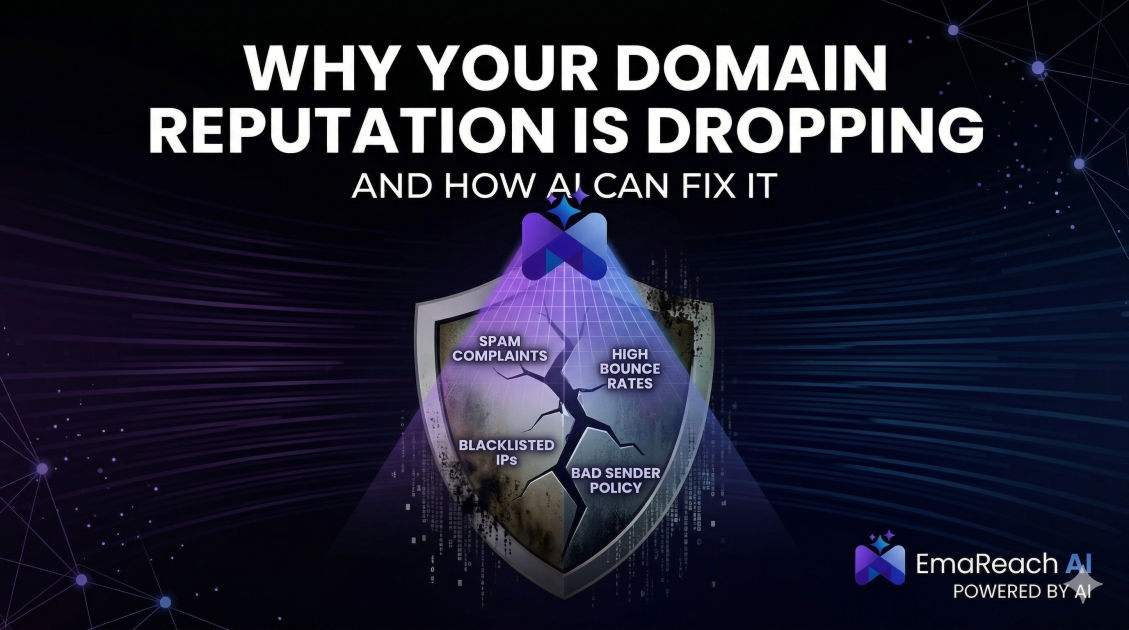
Why Your Domain Reputation Is Dropping
domain reputationemail deliverabilitycold emailinbox placementemail marketingSPF DKIM DMARCoutreach strategy
Understanding the Invisible Score: What is Domain Reputation?
In the world of digital communication, your domain reputation is the invisible credit score that determines whether your emails reach the inbox or vanish into the black hole of the spam folder. Unlike a traditional credit score, however, domain reputation is dynamic, constantly shifting based on your sending habits, technical configurations, and how recipients interact with your content.
When your domain reputation begins to drop, the consequences are immediate and painful. Open rates plummet, click-through rates disappear, and your return on investment (ROI) from email marketing or cold outreach hits rock bottom. But why does this happen? To fix a failing reputation, you must first understand the multifaceted factors that Mail Transfer Agents (MTAs) and Inbox Service Providers (ISPs) use to judge you.
The Technical Foundation: SPF, DKIM, and DMARC Failures
One of the most common reasons for a sudden drop in domain reputation is a technical misconfiguration. ISPs like Google, Outlook, and Yahoo use authentication protocols to verify that an email is actually coming from the person it claims to be from. If these are missing or incorrectly set up, you look like a phisher.
Sender Policy Framework (SPF)
SPF is a DNS record that lists the IP addresses and domains authorized to send emails on your behalf. If you add a new email service provider but forget to update your SPF record, your emails will fail authentication. This triggers a red flag for receiving servers, leading to a quick degradation of your reputation.
DomainKeys Identified Mail (DKIM)
DKIM adds a digital signature to your emails. This signature proves that the content of the email hasn't been tampered with during transit. Missing DKIM signatures make your domain look suspicious and untrustworthy.
Domain-based Message Authentication, Reporting, and Conformance (DMARC)
DMARC ties SPF and DKIM together. It provides instructions to the receiving server on what to do if an email fails authentication (e.g., 'do nothing', 'quarantine', or 'reject'). A lack of a DMARC policy makes your domain vulnerable to spoofing, which can destroy your reputation if attackers start using your domain for malicious purposes.
High Bounce Rates: The Silent Reputation Killer
Every time you send an email to an address that no longer exists, you generate a 'hard bounce.' A high bounce rate (typically anything over 2%) signals to ISPs that you are practicing poor list hygiene or, worse, using a purchased or scraped list of poor quality.
ISPs view high bounce rates as a sign of a 'spray and pray' sender. They assume you don't know your audience and are simply blasting messages to anyone. To maintain a healthy reputation, you must verify your email lists regularly and remove invalid addresses immediately. Continuing to hit dead mailboxes is a fast track to the blocklist.
Spam Complaints: The Ultimate Red Flag
Nothing damages a domain reputation faster than a recipient clicking the 'Report Spam' button. This is a direct signal from a user to their provider that your content is unwanted. While a few complaints are inevitable as you scale, a spike in complaint rates is devastating.
Recipients report emails as spam for several reasons:
- They never signed up for your list (illegal or unethical sourcing).
- The content is irrelevant to their needs.
- You are sending emails too frequently.
- The 'Unsubscribe' link is hard to find or broken.
If you find your reputation dropping, examine your complaint metrics. If they are rising, it’s time to rethink your targeting and the value you provide in each message.
Poor Engagement Metrics
Modern ISPs have moved beyond simple 'spam or not spam' filters. They now use complex machine learning algorithms to track engagement. They look at:
- Open Rates: Are people interested enough to click?
- Replies: Is there a two-way conversation happening?
- Mark as Not Spam: Do users rescue your mail from the junk folder?
- Folders: Are you being moved to the 'Primary' tab or 'Promotions'?
If your emails are consistently ignored, deleted without being opened, or left to rot in the inbox, ISPs will eventually decide that your content is low-value. They will preemptively start placing your emails in the spam folder to 'protect' their users.
The Danger of Sending Volume Spikes
Consistency is key to a stable domain reputation. If your domain typically sends 100 emails a day and suddenly jumps to 10,000 in a single afternoon, ISPs will treat this as a 'snowshoe spamming' attempt. These sudden surges are characteristic of compromised accounts or aggressive spammers.
To prevent this, you must 'warm up' your domain and IP address. This involves gradually increasing your sending volume over several weeks, allowing ISPs to get used to your traffic patterns. If you are starting a new outreach campaign, you cannot rush this process without risking a permanent stain on your reputation.
Solving the Deliverability Puzzle with EmaReach
Maintaining a pristine domain reputation manually is an exhausting uphill battle. This is where specialized technology becomes essential. Stop Landing in Spam. Cold Emails That Reach the Inbox. EmaReach AI combines AI-written cold outreach with inbox warm-up and multi-account sending—so your emails land in the primary tab and get replies.
By distributing your sending volume across multiple accounts and using automated warm-up sequences, EmaReach ensures that your primary domain remains protected while maximizing your reach. It handles the technical heavy lifting so you can focus on closing deals rather than troubleshooting DNS records.
Content Triggers: Words and Formatting to Avoid
While content is no longer the only factor in deliverability, it still plays a role. Using 'spammy' language can trigger automated filters before a human ever sees your message. Avoid excessive use of:
- ALL CAPS: This feels like shouting.
- Excessive Symbols: Using too many exclamation points (!!!) or dollar signs ($$$).
- Trigger Phrases: Words like 'Free,' 'Earn Money Fast,' 'Act Now,' or 'Guaranteed' can flag your email.
- Poor HTML-to-Text Ratio: Too many images and not enough text can make an email look like a malicious advertisement.
Blacklists: The Final Warning
There are hundreds of public and private blacklists (like Spamhaus, SORBS, or Barracuda) that track IP addresses and domains associated with spam. If your domain reputation drops low enough, you will eventually end up on one of these lists.
Once you are blacklisted, many ISPs will simply reject your mail outright. Removing yourself from a blacklist can be a bureaucratic nightmare, requiring you to prove that you have fixed the underlying issues that led to the listing in the first place. Monitoring these lists is a vital part of domain health management.
Inconsistent Sending Patterns
Beyond just volume spikes, inconsistent timing can also hurt you. If you send a massive blast on Monday and then nothing for three weeks, you fail to establish a 'normal' behavior profile. ISPs prefer predictable, human-like sending patterns. Automated scheduling and drip campaigns help create the steady cadence that reputation algorithms favor.
The Impact of Shared IP Reputations
If you are using a shared IP address from a major email marketing provider, you are at the mercy of the other senders on that same IP. If a neighbor on your shared server starts blasting spam, the IP's reputation drops, and your emails may be penalized by association. For high-volume senders, moving to a dedicated IP or using a sophisticated multi-account infrastructure is often the only way to gain full control over their deliverability destiny.
Why Your 'From' Name and Subject Line Matter
Reputation is built on trust. If your 'From' name is deceptive or your subject lines are clickbait that doesn't match the content inside, you will see an increase in deletions and spam reports. Transparency is your best friend. Ensure your brand is recognizable and your subject lines are honest. Building a long-term relationship with your recipients is far more valuable than a high open rate on a single deceptive email.
The Role of Inbox Placement Testing
Many senders assume their reputation is fine because they aren't getting 'undeliverable' notifications. However, a 'shadow ban' is more common. This is when your emails are 'delivered' but go straight to the spam folder or the promotions tab where they are never seen.
Regularly performing seed list testing—where you send emails to a controlled group of addresses across different providers—will give you a clear picture of where you are actually landing. If you see you are hitting the inbox at Gmail but the spam folder at Outlook, you have a specific reputation issue to diagnose.
Summary of Best Practices for Domain Health
To ensure your domain reputation doesn't continue to drop, implement these core strategies:
- Authenticate everything: SPF, DKIM, and DMARC are non-negotiable.
- Clean your lists: Use verification tools to remove bounces before they happen.
- Monitor engagement: If people aren't opening, change your strategy.
- Scale slowly: Never jump from 0 to 1,000 emails overnight.
- Provide value: Content that is genuinely useful is rarely reported as spam.
- Use the right tools: Leverage platforms like EmaReach to automate the complex parts of deliverability and warm-up.
Conclusion
A dropping domain reputation is a symptom of underlying issues in your email ecosystem. Whether it is a technical oversight in your DNS records, a lack of list hygiene, or aggressive sending patterns, these problems must be addressed holistically. By prioritizing the recipient's experience and adhering to the technical standards set by ISPs, you can rebuild your reputation and ensure your messages always find their way to the inbox. Remember, reputation is hard to build but very easy to lose; constant vigilance is the price of high deliverability.
EmaReach AI
Ready to scale your cold email outreach?
Join thousands of teams using EmaReach AI for AI-powered campaigns, domain warmup, and 95%+ deliverability. Start free — no credit card required.
Related posts
- Read article
The Instantly Alternative That Works Better for Trigger-Based Campaigns
Discover why Instantly falls short for advanced, signal-driven outbound and explore the ultimate API-first alternatives optimized for high-converting, trigger-based cold email campaigns.
- Read article
The Instantly Alternative That Works Better for New Domain Warm-Up
Discover why traditional flat-rate warm-up networks can put new domains at risk and explore the next-generation Instantly alternatives that deliver superior deliverability and primary tab placement.