Blog
Back to blog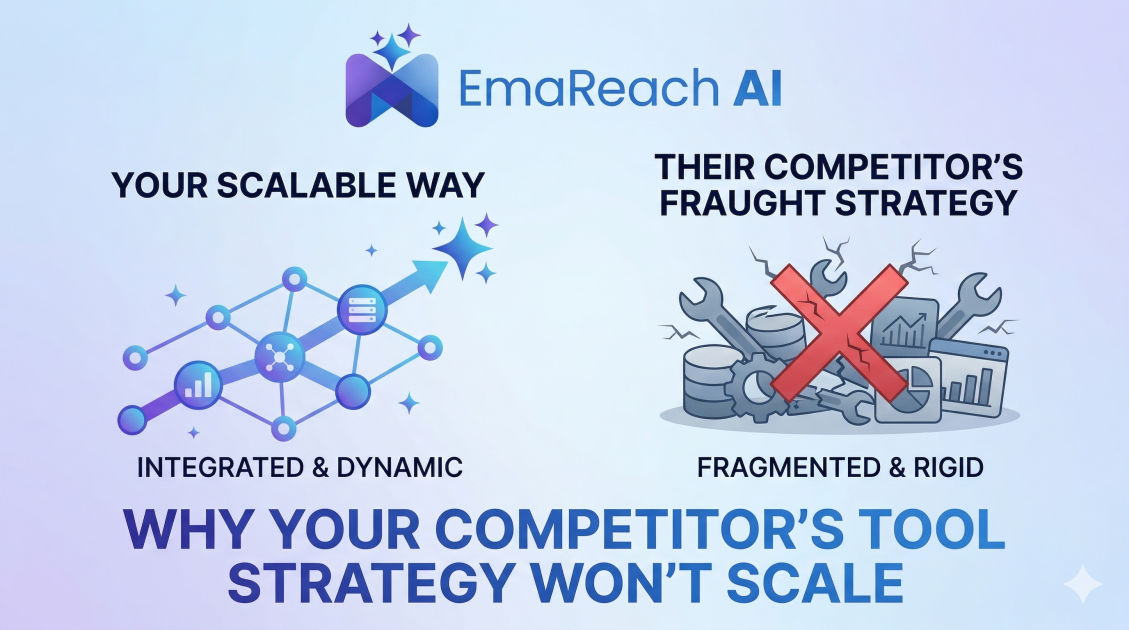
Why Your Competitor’s Tool Strategy Won’t Scale
business strategyscalingtech stackoutreachdigital transformationoperational efficiencycold email
Introduction
In the hyper-competitive landscape of modern business, it is incredibly tempting to look over your shoulder. When a competitor experiences a sudden surge in growth, the first question leadership teams usually ask is: "What tools are they using?" This leads to a frantic race to mirror their tech stack, adopting the same CRM, the same automation platforms, and the same analytical engines.
However, there is a fundamental flaw in this mimicry. A tool strategy built on imitation is inherently reactive and lacks the structural integrity required for long-term scaling. While your competitor may be seeing short-term gains, their reliance on a specific configuration of software often hides deep-seated inefficiencies and technical debt. If you simply copy their blueprint, you aren't just inheriting their successes—you are inheriting their ceiling.
True scaling isn't about having the "best" tools; it’s about how those tools integrate into a unique operational philosophy. This article explores why the "follow the leader" approach to technology fails and how you can build a resilient, scalable strategy that leaves the competition behind.
The Fallacy of the "Silver Bullet" Tool
Many organizations operate under the delusion that a specific piece of software will solve their scaling woes. They see a competitor using a high-end marketing automation suite and assume that the tool itself is the engine of growth. In reality, tools are force multipliers. If your underlying processes are inefficient or broken, a powerful tool will only help you fail faster.
Tools vs. Systems
A tool is a single instrument; a system is the harmony of people, processes, and technology. Competitors often get lucky by finding a tool that fits their current size perfectly. However, because they haven't built a modular system, they find themselves trapped. When they try to double their output, the tool—which was never integrated into a broader strategy—becomes a bottleneck. By copying them, you are locking yourself into a rigid structure that cannot flex under the pressure of growth.
The Cost of Feature Bloat
Often, competitors choose tools based on a laundry list of features rather than actual utility. This leads to a bloated tech stack where 80% of the functionality goes unused, yet 100% of the cost and complexity remain. Scaling requires lean operations. A competitor’s strategy that involves juggling fifteen different disconnected platforms is a house of cards waiting to tumble.
Why Outreach Strategies Often Break at Scale
One of the most visible areas where tool-dependency fails is in sales and marketing outreach. We see it constantly: a company buys a popular seat-based email tool, loads it with thousands of leads, and hits 'send.' For a few weeks, it works. Then, the wheels come off.
The Deliverability Trap
Most off-the-shelf outreach tools used by your competitors are not built for the nuances of modern email infrastructure. They focus on the interface and the templates, but they ignore the technical plumbing. When these companies try to scale from 100 emails a day to 10,000, their domain reputation plummets. They end up in the spam folder, and their "strategy" vanishes.
To avoid this, you need a solution that understands the mechanics of the inbox. This is where EmaReach (https://www.emareach.com/) changes the game. Stop Landing in Spam. Cold Emails That Reach the Inbox. Unlike the rigid tool strategies of your competitors, EmaReach AI combines AI-written cold outreach with inbox warm-up and multi-account sending. This ensures that as you scale, your emails land in the primary tab and get replies, rather than being flagged by filters that catch those using basic, unoptimized tool stacks.
Personalization at Scale
Competitors often fail to scale because their tools rely on "static" personalization—simple tags like [First_Name]. As volume increases, these emails feel increasingly robotic. A scalable strategy requires dynamic, AI-driven content that maintains a human touch even when sending to thousands of prospects. If you copy a competitor who is manually tweaking every lead, you'll run out of hours in the day long before you hit your revenue targets.
The Integration Debt Crisis
Scaling is the process of increasing throughput without a linear increase in costs. Your competitor’s tool strategy likely involves "Frankenstein-ing" different apps together using basic triggers. While this works at a small scale, it creates massive "Integration Debt."
Data Silos
When tools don't talk to each other natively, data becomes trapped. Your competitor might have great lead data in their CRM, but if that data doesn't flow seamlessly to their customer success tool or their billing software, manual intervention is required. Manual intervention is the enemy of scaling.
Fragile Automations
Simple automations (if this, then that) are notoriously fragile. If one tool updates its API or changes its data structure, the entire chain breaks. A company that relies on a dozen different third-party connectors to keep their business running is one update away from a total operational standstill. Scalable companies build on platforms with robust, native integrations or develop their own proprietary middleware to ensure stability.
The Human Element: Training and Adoption
Tools don't run businesses; people do. A major reason why a competitor’s tech stack won't scale is the "Adoption Gap."
Complexity Overload
If a tool is too complex, employees will find workarounds. They’ll use spreadsheets instead of the CRM; they’ll use personal email instead of the tracked outreach platform. As a team grows from 5 to 50, these "shadow IT" habits become ingrained. You might copy the competitor’s software, but you can’t copy the tribal knowledge required to make it work—or the lack thereof that is quietly sabotaging them.
The Burden of Maintenance
Every tool added to a stack requires an owner. Someone has to manage permissions, update workflows, and troubleshoot errors. Competitors often scale their tool count faster than their headcount, leading to burned-out operations managers and a tech stack that is perpetually out of date. A truly scalable strategy prioritizes tools that reduce the administrative burden, not increase it.
Technical Limitations of Legacy Platforms
Sometimes, the reason a strategy won't scale is simply hardware or architecture. Many popular "industry standard" tools are built on legacy frameworks. They might be slow to load, have limits on the number of records they can handle, or lack the API rate limits necessary for high-volume data processing.
Rate Limiting and Throttling
As you grow, you will need to move data faster. Many mid-tier tools have strict API limits. Your competitor might be hitting those limits already, causing delays in their reporting and execution. If you follow their lead, you’ll hit the same wall. Scalable strategies involve choosing "API-first" tools designed to handle enterprise-level loads from day one.
Security and Compliance
Scaling often means moving into more regulated markets or working with larger enterprise clients. Many "growth-hacker" tools used by smaller competitors lack the SOC2 compliance, data encryption, or GDPR rigor required for high-level play. Adopting a tool that can’t pass a security audit means you'll have to rip and replace your entire infrastructure just as you’re about to land your biggest contract.
Building a Scalable Strategy: The Alternative
If copying the competition is a dead end, how do you build a strategy that actually scales? It starts with a shift in mindset from "tool-first" to "outcome-first."
1. Define the Process Before the Platform
Never buy a tool to define a process. Map out your workflow on a whiteboard first. If you can't run the process manually (even at a small scale), a tool won't fix it. Once the process is optimized, look for technology that automates the most tedious parts of that specific workflow.
2. Prioritize Interoperability
When evaluating a new tool, the first question should be: "How does this get data in and out?" Favor tools with open APIs and deep, native integrations with your core stack. The goal is a "Single Source of Truth" where data flows automatically without human intervention.
3. Focus on Deliverability and Reputation
In the realm of growth and outreach, your technical reputation is your most valuable asset. This is why platforms like EmaReach are essential for those looking to move beyond the limitations of standard tools. By automating the warm-up process and using AI to ensure relevance, you protect your domain's health. This allows you to scale your outreach volume without the fear of being blacklisted—a hurdle that stops most competitors in their tracks.
4. Build for the Team You Want, Not the Team You Have
Choose tools that are intuitive enough for a new hire to learn in a day, but powerful enough to handle ten times your current volume. Avoid "niche" tools that require specialized consultants to maintain unless they provide a massive competitive advantage.
Conclusion
Watching your competitors can provide valuable market insights, but using their tool strategy as your roadmap is a recipe for stagnation. Most companies are "muddling through" with a patchwork of software that is barely holding together. By copying them, you are merely capping your own potential at their level of inefficiency.
To truly scale, you must build a bespoke ecosystem that prioritizes process over platforms, data fluidity over feature lists, and long-term deliverability over short-term hacks. Whether it’s choosing a robust CRM or utilizing a sophisticated outreach partner like EmaReach to ensure your communications actually land, your focus must remain on the foundation. Tools are replaceable; a scalable strategy is your most enduring competitive advantage.
EmaReach AI
Ready to scale your cold email outreach?
Join thousands of teams using EmaReach AI for AI-powered campaigns, domain warmup, and 95%+ deliverability. Start free — no credit card required.
Related posts
- Read article
What Makes the Right Instantly Alternative Worth the Migration Effort
Discover why upgrading your cold email infrastructure to the right Instantly alternative can dramatically improve your deliverability, scale your personalization, and future-proof your sales pipeline against strict spam filters.
- Read article
The Instantly Alternative That Wins for Teams With Strict IT Policies
Discover why traditional cold email tools fail strict IT security audits and explore the ultimate enterprise-grade alternative built for secure, compliant, and high-performance outbound sales teams.