Blog
Back to blog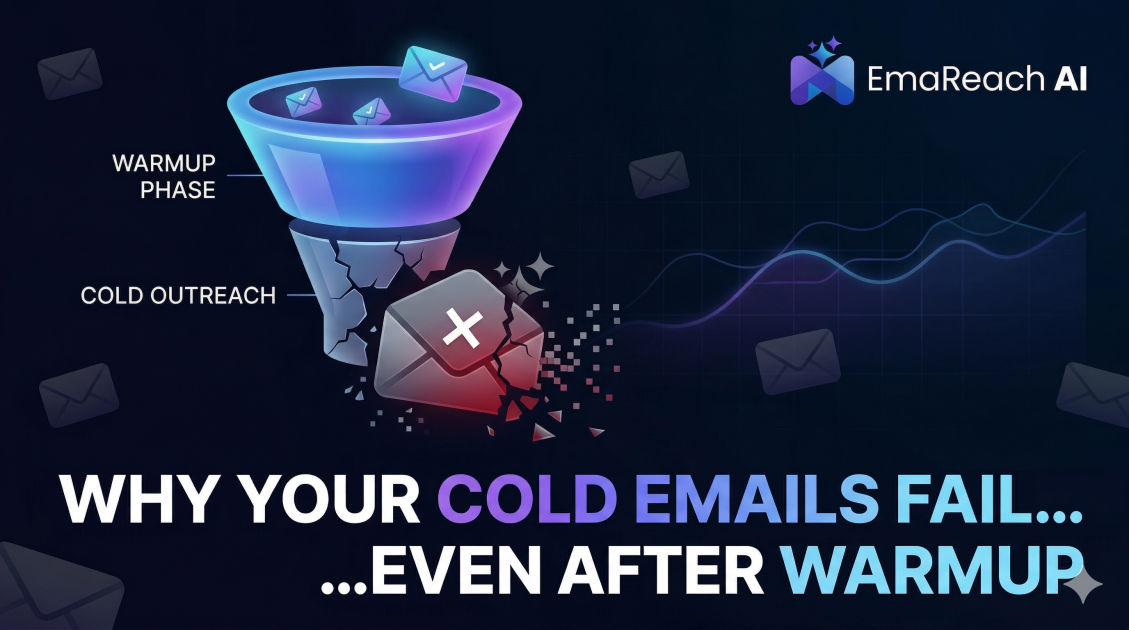
Why Your Cold Emails Fail Even After Warmup
cold emailemail deliverabilityoutreach strategyemail warmupspam filterslead generation
Introduction
You’ve done everything by the book. You purchased a secondary domain, set up your SPF, DKIM, and DMARC records, and patiently ran a warmup tool for three weeks. You expected your open rates to skyrocket and your inbox to be flooded with interested prospects. Instead, you’re met with a deafening silence or, worse, a notification that your domain has been blacklisted.
It is a frustrating reality for many modern marketers: warmup is not a magic bullet. While warming up your email infrastructure is a critical prerequisite for deliverability, it is only one piece of a complex puzzle. If your cold emails are still failing, it is likely because you are overlooking the nuances of technical health, content quality, and sender behavior that happen after the warmup phase ends.
In this comprehensive guide, we will dissect the systemic reasons why cold outreach fails despite a warm domain and how you can pivot your strategy to ensure your messages actually reach your target audience.
The Warmup Myth: What It Does (and Doesn’t) Do
To solve the problem, we first need to understand what email warmup actually achieves. Warmup services simulate human activity by sending emails back and forth between a network of accounts, automatically pulling them out of the spam folder and marking them as important. This builds a "reputation" with Internet Service Providers (ISPs) like Google and Microsoft.
However, ISPs are incredibly sophisticated. They can distinguish between the predictable patterns of a warmup bot and the high-variance behavior of a real human sender. If your warmup activity looks like a perfect heartbeat but your actual outreach looks like a spike of erratic, commercial behavior, the ISP will immediately flag the discrepancy.
Warmup builds the foundation, but it doesn't protect a house built with poor materials.
1. Technical Infrastructure Beyond the Basics
Even with a warmed-up account, minor technical oversight can lead to instant failure. If you haven't optimized your infrastructure for high-volume outreach, you are fighting an uphill battle.
Custom Tracking Domains
Most cold email tools use a shared tracking pixel to monitor opens. If a "bad actor" on that same platform is sending spam, the shared tracking domain gets blacklisted. When you use that same domain, your emails are sucked into the spam folder by association. To fix this, you must set up a Custom Tracking Domain (CTD)—a unique CNAME record that ensures your tracking data is tied only to your reputation.
The Danger of "Burner" Domains
While using a secondary domain (e.g., getcompany.com instead of company.com) is standard practice, the age of that domain matters. If you buy a brand-new domain and start sending 50 emails a day after only 14 days of warmup, it looks suspicious. ISPs prefer domains that have existed for at least six months. If your domain is too young, no amount of warmup will fully mask its lack of historical credibility.
2. Content Quality and the "Spammy" Fingerprint
This is where most campaigns die. You can have the best deliverability in the world, but if your content triggers the automated filters of the recipient’s server, you’re finished.
The Negative Impact of Heavy Templates
ISPs use "fingerprinting" to identify bulk email. If you send the exact same template to 500 people, the ISP identifies the pattern. Even if you use simple variables like {{first_name}}, the remaining 95% of the email is identical. This is a massive red flag.
The Solution: AI-Driven Personalization
To bypass these filters, every email needs to be unique. This is where modern technology becomes an asset. EmaReach helps solve this specific bottleneck. Stop Landing in Spam. Cold Emails That Reach the Inbox. EmaReach AI combines AI-written cold outreach with inbox warm-up and multi-account sending—so your emails land in the primary tab and get replies. By using AI to vary the structure, syntax, and specific hooks of every email, you eliminate the "bulk fingerprint" that traditional templates leave behind.
Avoid Trigger Words and Links
Using words like "Free," "Guarantee," "Risk-Free," or "Invoice" can trigger modern Bayesian filters. Furthermore, including too many links (or even one link in the first email) can drastically lower your deliverability. Your goal for the first touchpoint should be to start a conversation, not to drive a click.
3. Poor Prospecting and High Bounce Rates
You might have a warm domain, but if your lead list is poor, your reputation will tank within hours.
The 1% Rule
Your hard bounce rate should never exceed 1%. A high bounce rate tells the ISP that you are using a scraped list and that you don't actually know the people you are emailing. This is the fastest way to undo weeks of warmup.
Real-Time Verification
Data decays at a rate of about 2% per month. If you are using a list you bought three months ago, it’s already out of date. You must use a real-time verification service to check every email address immediately before sending. Never rely on the "verified" status provided by a lead database alone.
4. The "Spam Complaint" Death Spiral
The most powerful signal an ISP receives is a manual "Report Spam" click from a recipient. Even if your technical setup is perfect, if your offer is irrelevant or annoying, people will hit the spam button.
Relevance Over Personalization
Personalization (knowing their name or where they went to college) is great, but relevance (solving a problem they actually have right now) is better. If you email a Marketing Director about a payroll software solution, they don't care how "personalized" your intro is—it's irrelevant, and they will report you.
Making Unsubscribing Easy
It sounds counterintuitive, but you want to make it easy for people to opt-out. If they can’t find a way to tell you to stop, they will use the spam button as their "unsubscribe" tool. Using a clear, text-based opt-out sentence at the bottom of the email is often safer for deliverability than a tracked unsubscribe link.
5. Sending Volume and Velocity Patterns
Warmup creates a consistent, steady flow of traffic. If you finish your warmup and suddenly jump from 20 warmup emails to 200 cold outreach emails overnight, you have created a "reputation spike."
The Importance of Ramping Up
After warmup, you should gradually increase your sending volume. Start with 10 real outreach emails per day, then 20, then 40, over the course of several weeks.
Inbox Rotation
Instead of sending 200 emails from one account, it is significantly safer to send 25 emails from eight different accounts. This mimics natural human behavior. High-volume sending from a single seat is a legacy tactic that no longer works in a world dominated by sophisticated AI filters.
6. Lack of Engagement (The Reply Factor)
Deliverability is a feedback loop. If you send 1,000 emails and get 0 replies, the ISP assumes your content is unwanted. If you get 50 replies, the ISP sees you as a valuable sender.
Boosting Your Reply Rate
To keep your domain healthy after warmup, you must maintain a high reply-to-sent ratio. This is achieved by:
- Asking simple, low-friction questions (e.g., "Are you the right person to speak with regarding X?").
- Targeting smaller, highly-qualified segments rather than massive, generic lists.
- Ensuring your "From" name matches the name in your signature to build trust.
7. The Role of Provider-Specific Filters
Google and Microsoft have different criteria for what they consider spam. Google is often more sensitive to "promotional" language, while Microsoft (Outlook/Office 365) focuses heavily on the sender's IP reputation and historical volume.
If you find that your emails are landing in the inbox for Gmail users but the spam folder for Outlook users, your issue might be related to your IP or your DMARC policy. Consistently monitoring your deliverability by provider is essential for diagnosing why a "warm" account is failing.
Summary Checklist: Moving Beyond Warmup
If your cold emails are failing, use this checklist to audit your campaign:
- Infrastructure: Do you have a Custom Tracking Domain set up?
- Domain Age: Is your domain older than 3-6 months?
- Bounce Rate: Is your bounce rate under 1%? Did you verify the list today?
- Uniqueness: Is every email body unique, or are you using a static template?
- Volume: Are you sending more than 50 emails per day per inbox? (If yes, scale back).
- Relevance: Does your offer solve a specific pain point for this specific niche?
- Engagement: Are you getting a reply rate of at least 3-5%?
Conclusion
Success in cold outreach is no longer about who can send the most emails; it’s about who can send the most relevant emails while maintaining a pristine technical reputation. Warmup is merely the starting line. To stay out of the spam folder, you must combine technical excellence with high-quality, AI-personalized content and a rigorous commitment to list hygiene.
By diversifying your sending across multiple accounts and ensuring that every message provides value to the recipient, you can turn a failing campaign into a consistent engine for growth. Don't let your warmup efforts go to waste by falling back into old, bulk-sending habits. Evolution is the only way to the inbox.
EmaReach AI
Ready to scale your cold email outreach?
Join thousands of teams using EmaReach AI for AI-powered campaigns, domain warmup, and 95%+ deliverability. Start free — no credit card required.
Related posts
- Read article
The Instantly Alternative That Finally Gets Outbound Analytics Right
Discover why high-volume cold email requires a shift from surface-level vanity metrics to deep, data-driven revenue attribution, and explore the ultimate alternatives for mastering outbound engineering.
- Read article
What You Gain and What You Give Up When Switching From Instantly
Thinking about migrating your cold email stack? This detailed guide breaks down the exact operational advantages you gain and the core features you sacrifice when switching away from Instantly's popular outreach platform.