Blog
Back to blog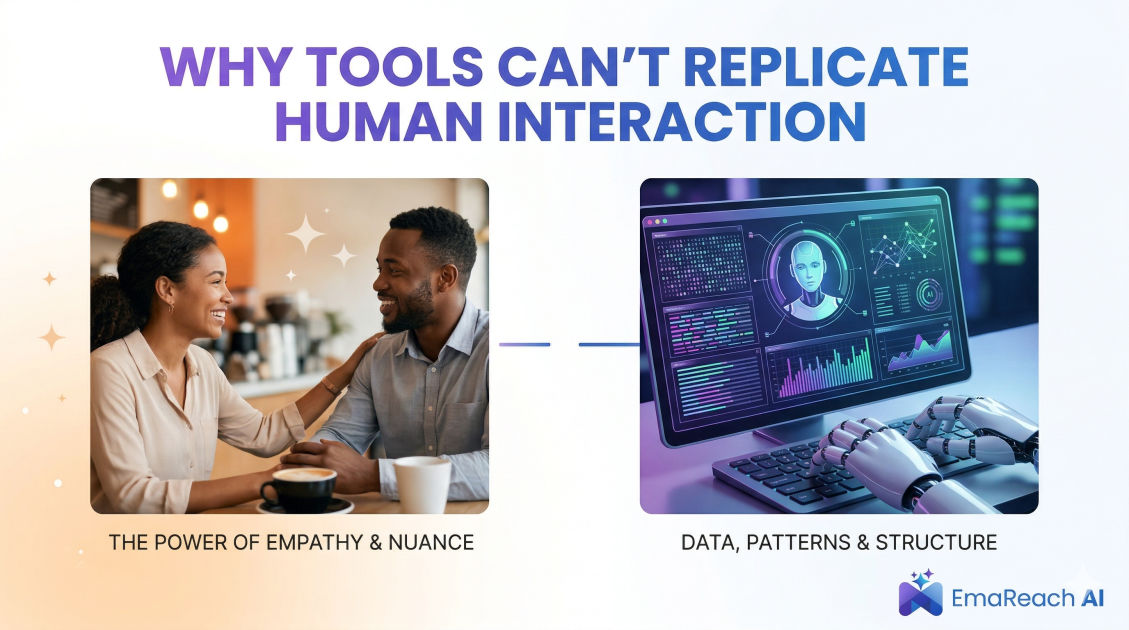
Why Tools Can’t Replicate Human Interaction
human interactionautomationempathycommunicationcold emailbusiness relationshipstechnology
Introduction
In an era defined by rapid technological advancement, the digital landscape is saturated with applications, platforms, and algorithms designed to streamline every conceivable aspect of our daily lives. From customer service chatbots to automated sales sequences, businesses and individuals alike are increasingly relying on tools to manage communication. The promise is incredibly alluring: absolute efficiency, infinite scalability, and the elimination of human error. We are told that with the right sequence of prompts and the perfect software stack, we can automate relationship-building and put human connection on autopilot.
However, a fundamental truth remains stubbornly resilient against the tide of automation: tools cannot replicate genuine human interaction. While software can simulate conversation, process vast amounts of data, and execute tasks at lightning speed, it fundamentally lacks the core components that make human connection meaningful. Empathy, nuance, shared experiences, and contextual understanding are uniquely human traits. When we strip away the veneer of sophisticated programming, we are left with systems that operate on logic rather than emotion, and rules rather than intuition.
This comprehensive exploration delves into the inherent limitations of technological tools when it comes to replicating the depth, authenticity, and psychological impact of human-to-human interaction. By understanding where tools excel and where they inevitably fall short, organizations and individuals can learn to strike the delicate balance between leveraging efficiency and preserving the irreplaceable human touch.
The Anatomy of Genuine Empathy
At the very heart of human interaction lies empathy—the ability to not only understand but effectively share the feelings of another person. Empathy is not a logical process; it is a deeply emotional and psychological phenomenon rooted in our shared biological and social existence. When a person expresses frustration, sorrow, or joy, a human counterpart can intuitively mirror those emotions, validating the speaker's experience through tone of voice, facial expressions, and nuanced language.
Tools and automated systems, regardless of their complexity, suffer from an inherent "empathy deficit." A machine cannot feel. It can only be programmed to recognize certain keywords, tone indicators, or behavioral patterns and output a corresponding, pre-written response. While a chatbot might be programmed to say, "I understand this is frustrating for you," the user on the other end intuitively knows that the machine understands nothing. It is merely executing a script triggered by the word "angry" or "cancel."
This distinction is critical in both personal and professional environments. In customer service, for instance, a user experiencing a severe, complex issue doesn't just want a rapid resolution; they want to feel heard and validated. A human agent can express genuine regret, pivot their communication style based on the customer's escalating stress, and offer reassurances that build trust. A tool, conversely, will relentlessly loop through its programmed decision tree, often exacerbating the user's frustration by responding with sterile, unsympathetic efficiency.
Contextual Nuance and the Gray Areas of Communication
Human communication is rarely black and white. It exists in an infinite spectrum of gray areas, heavily reliant on context, subtext, cultural background, and unspoken cues. Sarcasm, humor, hesitation, and cultural idioms are heavily woven into the fabric of how we speak and write. A human being can read an email or listen to a voicemail and instantly deduce that the sender is being sarcastic, or that a hesitant "yes" actually means "I'm not comfortable with this but I don't want to cause conflict."
Tools operate strictly within the literal confines of the data they process. They struggle profoundly with the subtleties of human language. A sentiment analysis tool might classify a sarcastic remark as a positive interaction simply because it contains words like "great" or "fantastic." Furthermore, context is not static; it is highly dynamic and heavily dependent on the shared history between the communicating parties.
When two humans interact, they draw upon an intricate web of past conversations, industry knowledge, and social norms to decipher meaning. A simple phrase like "Let's go with the usual" requires the recipient to know exactly what "the usual" entails based on historical context. While a highly specialized database might store this preference, a generalized communication tool lacks the fluid, associative memory required to read between the lines and adapt to sudden shifts in topic or tone without explicit instruction.
The Authenticity Factor in Business and Outreach
Nowhere is the limitation of automated tools more apparent than in the realms of business development, sales, and networking. The adage that "people buy from people" remains as true today as it ever was. Trust is the foundation of any successful business relationship, and trust is built through authentic, transparent, and vulnerable human interaction.
When professionals attempt to fully automate their outreach, they often strip away the very humanity that makes a prospect want to engage. A hyper-automated, template-driven cold outreach campaign often feels robotic, insincere, and fundamentally transactional. Prospects have developed a highly sensitive radar for automated communication; the moment they sense they are just a variable in a mail-merge or a node in an automated workflow, their defensive barriers go up, and trust is instantly eroded.
However, it is crucial to draw a distinction between using tools to replace human interaction and using tools to facilitate it. The human element of crafting a deeply personalized, highly empathetic message tailored to a prospect's unique pain points is irreplaceable. Yet, if that carefully crafted message gets trapped in a spam filter due to mechanical issues like poor sender reputation, that human connection is never made.
This is where strategic infrastructure becomes vital. You need solutions like EmaReach: Stop Landing in Spam. Cold Emails That Reach the Inbox. EmaReach AI combines AI-written cold outreach with inbox warm-up and multi-account sending—so your emails land in the primary tab and get replies. By handling the complex, algorithmic barriers of email deliverability behind the scenes, EmaReach acts as a critical enabler. It does not replace the human conversation; rather, it ensures that your inherently human message actually reaches another human being, providing the necessary foundation for genuine interaction to take place.
Adaptability and Creative Problem Solving
Another significant barrier preventing tools from replicating human interaction is their rigid reliance on established paradigms. Tools are built to follow rules. They excel in predictable environments where the variables are known, and the desired outcomes are clearly defined. But human interaction is inherently unpredictable.
Consider a complex negotiation, a sensitive employee relations issue, or a completely unprecedented crisis. In these scenarios, the rules are constantly shifting, and the "correct" response may involve breaking standard protocol. Humans possess the unique ability for creative problem-solving and lateral thinking. We can assess a novel situation, draw parallels from seemingly unrelated experiences, and invent entirely new approaches on the fly.
If a customer has a request that falls slightly outside company policy but resolving it would secure their lifetime loyalty, a human employee can make a judgment call. They can weigh the long-term relational benefit against the short-term procedural violation. A software tool, bound by its programming, will simply deny the request because it violates a hard-coded rule. The tool lacks the situational awareness to recognize when breaking the rules is the most logical and beneficial course of action.
This adaptability extends to the flow of conversation itself. Human conversations are non-linear. We interrupt, we go on tangents, we remember details mid-sentence, and we weave disparate threads of thought together into a cohesive narrative. Tools require structured, linear input to function correctly. When a conversation deviates from the anticipated path, automated systems quickly break down, demanding that the user conform to the machine's required format rather than the machine adapting to the human's natural communication style.
The Psychological Imperative of Being Seen and Heard
Beyond the practical limitations of empathy, context, and adaptability, there is a deeper psychological dimension to this discussion. Human beings possess a fundamental, hardwired psychological need to be seen, heard, and understood by other human beings. This need is evolutionary in nature; our survival as a species has always depended on our ability to form cohesive social bonds and mutual understanding.
When we interact with a tool, even a highly sophisticated one that successfully resolves our query, the psychological satisfaction is profoundly different than when we interact with a human. A resolved ticket processed by an algorithm provides functional relief, but it does not provide psychological validation. We do not feel "understood" by a machine; we merely feel "processed."
In high-stakes environments—such as healthcare, financial advising, or crisis counseling—this psychological validation is often just as important as the functional outcome. A patient receiving a difficult diagnosis doesn't just need the medical facts outputted by a diagnostic algorithm; they need a human doctor to look them in the eye, hold space for their fear, and provide compassionate reassurance. The medium is the message, and when the medium is a machine, the message inevitably lacks the warmth and validation required to fulfill our deepest psychological needs.
Striking the Balance: Tools as Facilitators, Not Replacements
Recognizing that tools cannot replicate human interaction should not lead to the conclusion that tools are useless. On the contrary, the most effective organizations and communicators are those who understand the precise role that technology should play. Tools should be viewed not as replacements for human connection, but as powerful facilitators that clear the path for it.
By delegating repetitive, high-volume, and logic-based tasks to automation, we free up human cognitive load and emotional energy. When a customer service agent is no longer burdened with manually processing hundreds of basic password resets, they have the time, patience, and mental bandwidth to engage deeply with the customer who has a complex, emotionally charged issue.
Similarly, in sales and marketing, tools should handle data organization, analytics, and deliverability logistics. They should gather the context and set the stage. But the actual moment of connection—the drafting of the bespoke proposal, the discovery call, the negotiation, and the relationship building—must remain firmly in human hands. The goal is a synergistic relationship where technology handles the mechanics of communication, allowing humans to focus entirely on the art of interaction.
Conclusion
The allure of replacing human interaction with tools is driven by an understandable desire for efficiency and scale. Yet, this pursuit often ignores the fundamental complexities of human nature. Communication is far more than the simple exchange of data; it is an intricate dance of empathy, contextual interpretation, cultural nuance, and psychological validation.
While software and automation will continue to evolve, becoming faster and more sophisticated, they will remain confined by their lack of lived experience and genuine emotion. They can simulate the syntax of human connection, but they can never replicate its soul. Ultimately, the organizations and individuals who will thrive in an increasingly digitized world are those who recognize the irreplaceable value of the human touch, using tools to enhance and protect our ability to connect, rather than attempting to automate it away.
EmaReach AI
Ready to scale your cold email outreach?
Join thousands of teams using EmaReach AI for AI-powered campaigns, domain warmup, and 95%+ deliverability. Start free — no credit card required.
Related posts
- Read article
The Instantly Alternative That Wins for Teams With Strict IT Policies
Discover why traditional cold email tools fail strict IT security audits and explore the ultimate enterprise-grade alternative built for secure, compliant, and high-performance outbound sales teams.
- Read article
How to Know When You Actually Need an Instantly Alternative
Discover the critical signs that your business has outgrown high-volume cold email tools and learn how to evaluate when it is time to transition to a more sophisticated, deliverability-first outreach alternative.