Blog
Back to blog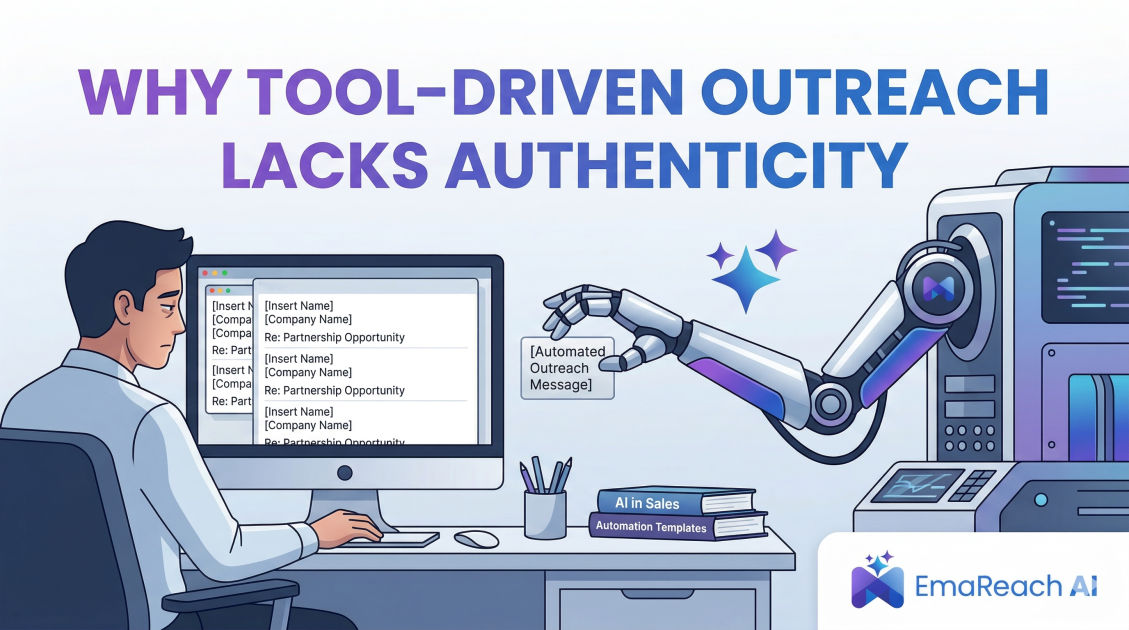
Why Tool-Driven Outreach Lacks Authenticity
cold emailoutreach strategydeliverabilitysales automationb2b marketingauthenticitylead generation
Introduction
In the modern landscape of digital communication, professionals are inundated with an overwhelming volume of daily emails, direct messages, and connection requests. The natural response to this digital saturation from sales professionals, marketers, and founders has been to scale their efforts. To reach more people in less time, organizations have heavily adopted automated tools, promising endless leads and conversations at the click of a button. However, this relentless pursuit of scale has created a critical problem: a severe crisis of authenticity.
While automation offers undeniable efficiency, heavily tool-driven outreach inherently strips away the human element required to build genuine relationships. When the primary objective becomes hitting arbitrary volume metrics rather than fostering meaningful connections, the quality of communication inevitably deteriorates. Prospects and potential partners are highly sophisticated; they can immediately recognize when they are simply a row in a massive spreadsheet or a variable in a mail-merge campaign. This article explores the deep-seated reasons why purely tool-driven outreach fails to resonate, the hidden costs of over-automating your communication, and how organizations can restore genuine authenticity to their relationship-building strategies.
The Mechanization of Human Connection
At the core of all successful business relationships is mutual trust and understanding. When outreach is entirely delegated to software, this foundational element is the first casualty. Tool-driven outreach relies heavily on templates, predetermined cadences, and scraped data, effectively mechanizing what should be an organic human interaction.
The Transactional Nature of Automation
Automation tools are inherently binary and transactional. They operate on rigid if-then logic: if an email is opened, send template B; if an email is ignored, wait three days and send template C. This structural rigidity forces human communication into an artificial pipeline. Real human interaction is fluid, dynamic, and responsive to subtle emotional and contextual cues. A tool cannot detect the nuance in a prospect's brief reply, nor can it adjust its tone to match the specific cultural or industry-specific climate of the recipient's current situation.
By treating communication as an assembly line, the sender implicitly signals to the recipient that their individual value is minimal. The underlying message is not "I want to solve your specific problem," but rather, "You match my basic targeting criteria, and I am playing a numbers game." This immediately triggers defensive filters in the recipient's mind, relegating the message to the mental (or literal) trash bin.
The Loss of Contextual Nuance
One of the most glaring flaws in tool-driven outreach is the inability to grasp deep context. A tool might successfully scrape a recipient's job title and company name, inserting them seamlessly into a subject line. However, it completely misses the broader context of that individual's daily life. It doesn't know that their company just underwent a massive restructuring, or that their industry is facing a specific regulatory challenge, or that they recently posted a thoughtful article about a nuanced problem.
Authentic outreach requires synthesizing disparate pieces of information to form a holistic understanding of the person on the other side of the screen. Tools can gather data, but they cannot generate the empathy required to contextualize that data meaningfully. Without this contextual nuance, outreach remains superficial, failing to strike the chords that prompt a genuine, enthusiastic response.
The Anatomy of an Inauthentic Message
To understand why tool-driven outreach lacks authenticity, we must dissect the common elements that betray an automated approach. These are the telltale signs that immediately break the illusion of a one-to-one conversation.
The Generic Hook
The most common symptom of automation is the generic opening line. Phrases like "I hope this email finds you well" or "I saw you work in marketing at [Company]" are devoid of actual observation. They are placeholders designed to apply to thousands of people simultaneously. An authentic message begins with a highly specific observation that proves the sender has taken the time to investigate the recipient as an individual.
False Flattery
Many automated templates attempt to manufacture authenticity through unwarranted praise. Statements like "I am incredibly impressed by your trajectory at [Company]" or "Your recent work is groundbreaking," when not followed by specific, detailed references, sound hollow and manipulative. People have highly attuned radar for insincerity. False flattery is immediately recognizable as a manipulative tactic rather than a genuine compliment, instantly eroding trust.
The Misaligned Ask
Because tool-driven outreach operates at scale, the "ask" or call-to-action is often a blunt instrument. Requesting a "15-minute call to explore synergies" from a complete stranger who has zero prior context about you or your offering is presumptuous. It fails to respect the recipient's time and assumes a level of relationship that has not yet been earned. Authentic outreach scales the "ask" to match the level of trust established, often starting with a simple, low-friction exchange of value rather than an immediate demand for calendar time.
Deliverability: The Hidden Cost of Inauthentic Automation
The consequences of tool-driven outreach extend far beyond poor conversion rates; they fundamentally threaten an organization's ability to communicate at all. When emails sound robotic, lack personalization, and offer little value, recipients do not merely ignore them—they mark them as spam.
Email service providers (ESPs) employ sophisticated algorithms that monitor engagement metrics. If a high volume of your outgoing mail is deleted without being opened, or worse, flagged as spam, your domain reputation plummets. Over time, your emails will automatically be routed to the junk folder, rendering even your best messages invisible. Blunt automation prioritizes volume, but in the modern email ecosystem, sending thousands of ignored emails is actively detrimental to your infrastructure.
This is where the mechanical side of outreach requires intelligent, strategic intervention. If your strategy focuses on crafting authentic, human messages, you still need a robust technical foundation to ensure those messages are actually delivered. EmaReach is designed to solve this exact problem. Stop Landing in Spam. Cold Emails That Reach the Inbox. EmaReach AI combines AI-written cold outreach with inbox warm-up and multi-account sending—so your emails land in the primary tab and get replies. By handling the complex technical background of deliverability, it frees you to focus entirely on the authentic, human strategy of your communication.
Defining True Authenticity in Outreach
If tool-driven templates represent the absence of authenticity, what does genuine authenticity actually look like in practice? It is not merely about using a conversational tone or throwing in an emoji. True authenticity is rooted in deep respect for the recipient.
Cognitive Empathy
Authentic outreach demonstrates cognitive empathy—the ability to intellectually understand another person's perspective and challenges. It involves stating the recipient's unarticulated problems more clearly than they can state them themselves. When you achieve this, the recipient instantly feels understood. You transform from a vendor pushing a product into a peer offering a tailored solution.
Vulnerability and Honesty
Automated templates often project a facade of absolute perfection and guaranteed results, which triggers skepticism. Authentic communication embraces a degree of vulnerability. Admitting that your solution might not be a perfect fit for everyone, or transparently stating the reason for your outreach without hiding behind artificial pretenses, builds massive credibility. Honesty cuts through the noise of corporate hyperbole.
Value-First Methodology
Rather than asking for time or money upfront, authentic outreach leads with value. This could be an insight derived from observing their business model, a relevant resource that addresses a specific pain point, or an introduction that could benefit them. The goal is to prove your worth before ever making a request, shifting the dynamic from extraction to contribution.
Building a Hybrid Strategy: Combining Efficiency with Humanity
The solution is not to abandon tools entirely. Refusing to use technology in outreach is as foolish as relying on it exclusively. The key is to redefine the role of the tool. Tools should not be the driver of the vehicle; they should be the engine that powers the human driver.
The 80/20 Rule of Personalization
A highly effective approach is the 80/20 rule. Eighty percent of your message—the core value proposition, the description of your offering, the foundational structure—can be standardized or subtly assisted by technology. However, the first twenty percent—the hook, the contextual framing, the reason why you are contacting this specific person on this specific day—must be painstakingly human.
Leveraging Tools for Research, Not Just Sending
Instead of using tools solely to blast out emails, use them to gather deep intelligence. Utilize social listening tools, industry alerts, and financial databases to identify trigger events. Did a target company just acquire a new competitor? Did they expand into a new region? Did their leadership team change? Use tools to surface these insights, and then use your human intellect to craft a message that connects your value proposition to that specific, timely event.
Actionable Steps to Humanize Your Campaigns
Transitioning from a purely tool-driven approach to an authentic outreach strategy requires a fundamental shift in daily operations and mindset. Here are actionable methodologies to implement this shift.
Implement Tiered Outreach
Not all prospects require the same level of personalization. Implement a tiered system:
- Tier 1: Your highest-value targets. These receive 100% manual, deeply researched, custom-crafted messages. No automation is used in the messaging itself.
- Tier 2: Strong-fit prospects. These receive messages built on robust, segment-specific templates with significant manual customization in the opening lines and contextual references.
- Tier 3: Broader market matches. These can leverage higher automation, but the messaging must be hyper-relevant to their specific micro-niche, avoiding broad, generic claims.
Write Like You Speak
Read your outreach copy out loud. If it sounds like a corporate press release or a legal document, rewrite it. Authentic communication is conversational. Use shorter sentences. Avoid complex jargon unless it is specifically tailored to prove industry expertise. Use contractions. The goal is to sound like an intelligent, helpful peer writing an email to a colleague, not a faceless corporation broadcasting to the masses.
Focus on Quality Over Quantity
The most profound shift required is metric realignment. Organizations must stop rewarding the sheer volume of emails sent. If an SDR sends 1,000 generic emails and gets zero positive replies, they have failed, regardless of their activity metrics. Conversely, if an SDR sends 20 highly researched, deeply authentic emails and books 4 qualified meetings, they have succeeded brilliantly. Measure the quality of replies, the conversion rate from reply to meeting, and the ultimate lifetime value of the relationships built.
The Psychological Toll on the Sender
An often-overlooked consequence of purely tool-driven outreach is the psychological impact on the sales and marketing professionals executing it. Constantly pushing buttons to send generic spam into the void, only to receive silence or angry rejections, leads to severe burnout. It creates a disconnect between the professional and the actual market they are trying to serve.
When professionals are empowered to do deep research, understand their prospects, and write meaningful messages, they reclaim a sense of craftsmanship. They are no longer machine operators; they are strategic consultants. This shift not only improves the quality of the outreach but drastically improves job satisfaction and retention within the team.
Conclusion
The allure of tool-driven outreach is entirely understandable; efficiency and scale are powerful business drivers. However, when the mechanisms of scale overshadow the fundamental human requirement for authentic connection, the entire strategy collapses upon itself. Generic, automated blasts erode brand trust, destroy domain deliverability, and ultimately fail to generate meaningful business relationships. By recognizing the limitations of automation and intentionally infusing empathy, context, and honest value back into our communication, we can transcend the noise of the inbox. Tools will always be a necessary part of the infrastructure, but genuine authenticity will always remain the definitive competitive advantage.
EmaReach AI
Ready to scale your cold email outreach?
Join thousands of teams using EmaReach AI for AI-powered campaigns, domain warmup, and 95%+ deliverability. Start free — no credit card required.
Related posts
- Read article
The Instantly Alternative That Finally Gets Outbound Analytics Right
Discover why high-volume cold email requires a shift from surface-level vanity metrics to deep, data-driven revenue attribution, and explore the ultimate alternatives for mastering outbound engineering.
- Read article
What You Gain and What You Give Up When Switching From Instantly
Thinking about migrating your cold email stack? This detailed guide breaks down the exact operational advantages you gain and the core features you sacrifice when switching away from Instantly's popular outreach platform.