Blog
Back to blog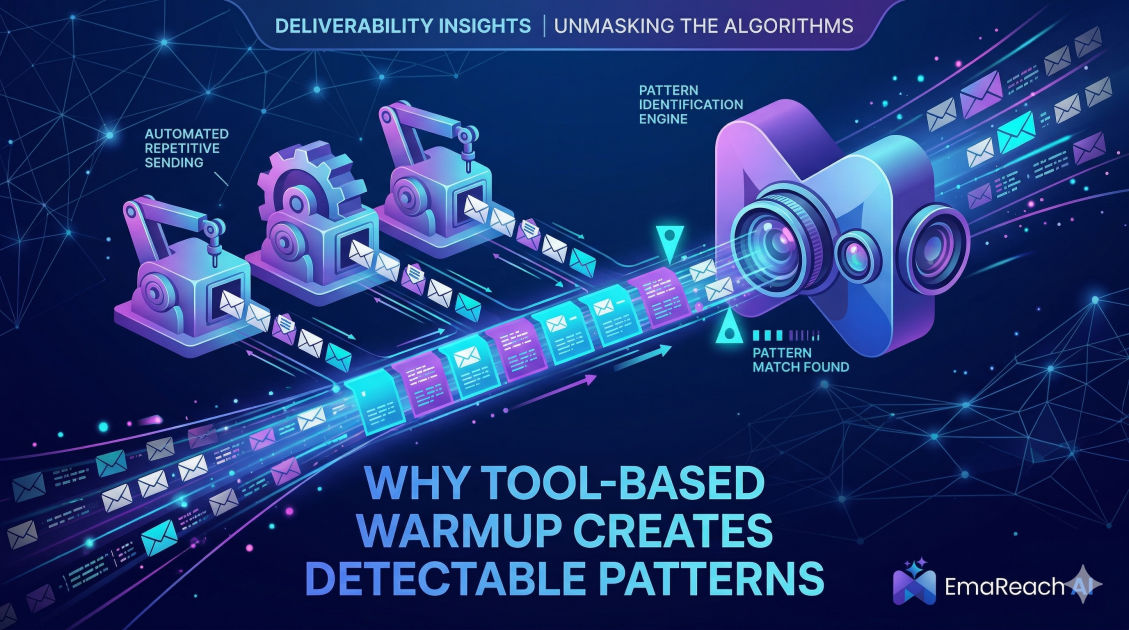
Why Tool-Based Warmup Creates Detectable Patterns
email deliverabilitycold emailinbox warmupspam filtersemail marketingoutreach strategy
Introduction: The Hidden Mechanics of Email Deliverability
In the world of outbound sales and digital marketing, the concept of 'email warmup' has shifted from a best practice to a perceived necessity. However, as the ecosystem matures, a critical flaw has emerged: the predictability of the tools used to achieve it. Traditional tool-based warmup relies on automated loops that, while effective in the short term, often leave behind a breadcrumb trail of digital signatures that modern Spam Filters are increasingly adept at identifying.
Understanding why these patterns emerge requires a deep dive into the intersection of machine learning, behavioral heuristics, and the technical infrastructure of major Email Service Providers (ESPs). When you automate human behavior, you inevitably trade nuance for scale, and it is in that missing nuance where detectable patterns are born.
The Fundamental Logic of Email Warmup
Before analyzing why tools fail, we must define what they are attempting to mimic. Email warmup is the process of gradually increasing the volume of mail sent from a new IP address or domain to build a reputation with ESPs like Google and Microsoft. The goal is to prove that the sender is a legitimate human being engaging in meaningful correspondence rather than a bot blasting unsolicited spam.
Historically, this was done manually. A user would send a few emails to friends or colleagues, who would then open, reply, and perhaps mark the email as 'important.' Tools entered the market to automate this cycle, creating networks of thousands of accounts that interact with one another to 'trick' the ESP's algorithms into granting high deliverability scores.
The Anatomy of a Detectable Pattern
Detection doesn't usually happen because of a single email; it happens because of a sequence of events that defy the laws of natural human probability. Here is why tool-based warmup creates detectable patterns.
1. The Reciprocity Loop (The 'Circle of Trust')
Most warmup tools operate on a peer-to-peer network. Account A sends an email to Account B, and Account B replies. While this seems organic, ESPs have global visibility. They can see that Account A only ever interacts with a specific cluster of other accounts that are also exhibiting identical high-activity behaviors.
In a natural setting, a human sends emails to a diverse range of domains and individuals who have varying levels of activity. In an automated warmup pool, the interactions are too 'perfect.' Every email is opened, every email is replied to, and every email is moved out of the spam folder. This 100% engagement rate is a statistical anomaly that screams 'automation' to a sophisticated AI filter.
2. Linguistic Uniformity and 'Gibberish' Scaling
To avoid being caught by content filters, many tools generate 'nonsense' text or use repetitive templates to fill the body of warmup emails. They might use AI-generated sentences that are grammatically correct but contextually void.
Modern ESPs use Natural Language Processing (NLP) to analyze the intent of an email. If a domain is sending thousands of emails that discuss unrelated topics with no coherent thread of business or personal utility, the 'reputation' being built is fragile. The pattern of sending low-value, high-frequency text is a hallmark of tool-based systems.
3. The Temporal Fingerprint
Humans are inconsistent. They sleep, they take lunch breaks, and they don't send emails at exactly 3:02 PM every single day. Many legacy warmup tools send emails on a fixed schedule or within a specific 'window' that lacks the chaotic distribution of human life.
Even tools that attempt to 'randomize' sending times often do so within a narrow Gaussian distribution that is easily identified by a mathematical analysis of the mail server logs. When an ESP sees a burst of activity followed by total silence, repeated across a network of accounts, the pattern becomes undeniable.
The Technical Red Flags: Headers and Metadata
Beyond the behavior of the user, the 'tool' itself often leaves technical footprints. Every email contains metadata in its header. If a warmup tool uses a specific API or a cloud-based infrastructure to trigger sends, the ESP can trace the origin.
- X-Mailer Headers: Some tools forget to strip or spoof the software used to send the mail.
- IP Clustering: If thousands of 'warmup' accounts are sending from the same range of data center IPs, the entire network can be flagged simultaneously.
- Inconsistent User-Agents: If an account is 'logged in' via a browser in one session and then sends mail via a backend API script in the next, the inconsistency flags the account as being under automated control.
Why Your Current Warmup Might Be Hurting You
If you are using a basic tool-based warmup, you might actually be 'burning' your domain before you even start your outreach. When an ESP identifies a domain as part of a warmup pool, it doesn't just ignore the warmup emails; it puts a 'shadow' flag on the domain.
Once you transition from warmup to actual cold outreach, the filters are already tuned to your domain. The moment you send a real pitch, the filter recognizes the shift in behavior—moving from the 'safe' pool of automated replies to a 'cold' list of prospects—and drops your message straight into the spam folder.
The Evolution of Deliverability: Moving Beyond Simple Warmup
To succeed in modern outreach, you need a solution that bridges the gap between automation and authentic human behavior. This is where EmaReach (https://www.emareach.com/) changes the game.
Stop Landing in Spam. Cold Emails That Reach the Inbox. EmaReach AI combines AI-written cold outreach with inbox warm-up and multi-account sending—so your emails land in the primary tab and get replies. Instead of relying on detectable, repetitive patterns, EmaReach focuses on the 'Primary Tab' philosophy. By utilizing advanced AI to generate content that mimics real business communication and managing the warmup process through a lens of human-centric heuristics, it bypasses the common pitfalls of standard tools.
The Impact of 'Engagement Velocity' vs. 'Engagement Quality'
Standard tools focus on velocity—how many emails can we send and receive? Modern deliverability focuses on quality. Does the recipient actually read the email? Do they click links? Do they forward it?
When a warmup tool merely sends and archives, it misses the depth of engagement that ESPs now track. If an email is 'replied to' within 0.5 seconds of being received (a common occurrence in automated pools), the ESP knows it wasn't a human reading the text. Genuine engagement has a 'dwell time'—a period where the user is actually interacting with the interface.
The 'Spam Folder Rescue' Trap
One of the most touted features of warmup tools is their ability to move emails from the spam folder to the inbox. While this is helpful, doing it at a massive scale across a single domain in a short period looks like a coordinated 'raid' on the spam filter.
When thousands of accounts suddenly decide that a specific sender's 'gibberish' email is 'not spam,' the ESP's security team receives an alert. This creates a detectable pattern of manipulation rather than a genuine recovery of reputation.
Structural Differences in High-Level Outreach
To avoid detection, one must diversify. The most successful outreach campaigns today do not rely on a single 'warmup' switch. They rely on a multi-faceted approach:
- Multi-Account Distribution: Spreading the volume across dozens of 'sender' accounts so no single account reaches a threshold of suspicion.
- Contextual Warmup: Sending emails that actually relate to the industry or niche the sender is in, rather than generic text.
- Humanized Interactivity: Varying the time-to-reply and the length of the reply threads to simulate real business conversations.
By integrating these elements, a system becomes much harder for an algorithm to 'fingerprint.'
Conclusion: The End of the 'Set It and Forget It' Era
The era of using a cheap, basic warmup tool to safeguard your domain is coming to a close. As Email Service Providers lean more heavily on AI to protect their users' inboxes, the patterns created by simple automation become more visible. To stay ahead, senders must move toward sophisticated platforms that understand the nuance of human interaction.
If you want to ensure your outreach survives the next generation of filter updates, you must eliminate the detectable patterns of the past. Choosing a robust, AI-driven partner like EmaReach ensures that your warmup and your outreach work in harmony, protecting your reputation and ensuring your voice is actually heard by your prospects.
Investing in deliverability is no longer about finding a shortcut; it’s about building a foundation that looks, acts, and feels entirely human.
EmaReach AI
Ready to scale your cold email outreach?
Join thousands of teams using EmaReach AI for AI-powered campaigns, domain warmup, and 95%+ deliverability. Start free — no credit card required.
Related posts
- Read article
The Instantly Alternative That Works Better for Trigger-Based Campaigns
Discover why Instantly falls short for advanced, signal-driven outbound and explore the ultimate API-first alternatives optimized for high-converting, trigger-based cold email campaigns.
- Read article
What the Cold Email Community Actually Says About Instantly Alternatives
Discover what growth marketers, agency owners, and outbound practitioners across major cold email communities are saying about the top alternatives to Instantly. This comprehensive, research-driven guide breaks down the real-world pros, cons, and technical features of tools like Smartlead, EmaReach, Saleshandy, and Lemlist based on community consensus.