Blog
Back to blog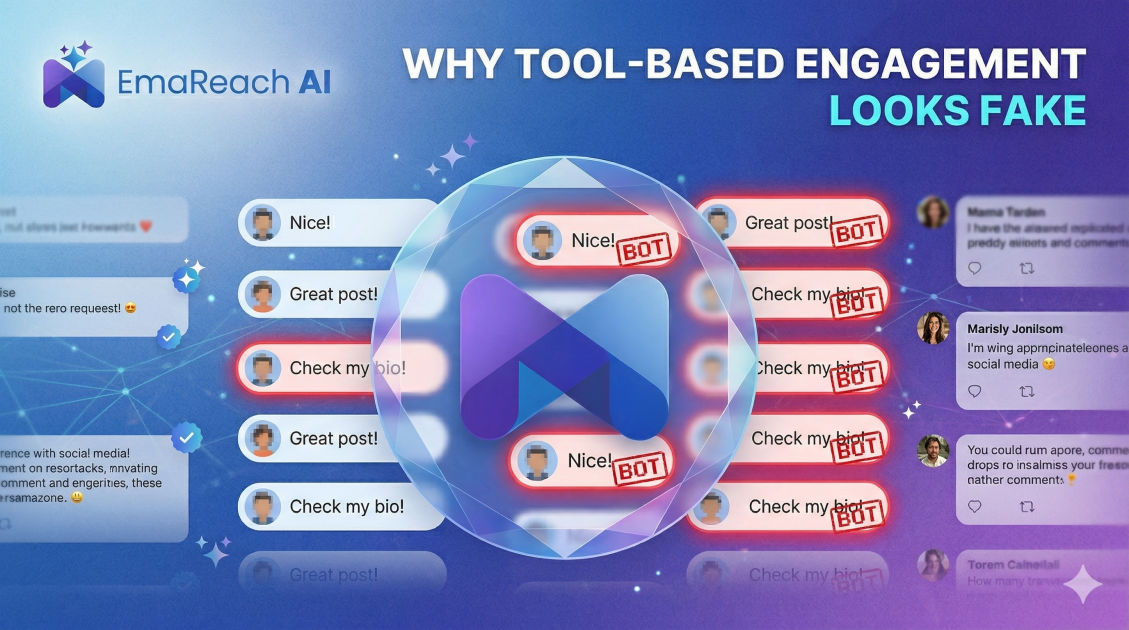
Why Tool-Based Engagement Looks Fake
digital marketingautomationcold outreachauthenticityemail deliverabilitysocial media strategy
The Paradox of the Automated Era
In the digital landscape, engagement is the currency of success. Whether you are a brand seeking to build a community, a sales professional looking for leads, or a creator wanting to connect with an audience, the goal is always the same: meaningful interaction. However, as the volume of digital noise increases, many have turned to technology to scale their efforts. This has given rise to a phenomenon known as tool-based engagement—the use of automation, AI-driven bots, and programmatic scripts to simulate human interaction.
While the intent behind these tools is efficiency, the result is often the opposite. Tool-based engagement frequently looks, feels, and smells "fake." This lack of authenticity can be devastating to a brand's reputation. When people realize they are interacting with a machine rather than a human, the trust that is foundational to any professional relationship evaporates. To understand why this happens, we must dissect the subtle cues that signal a lack of human touch.
The "Uncanny Valley" of Digital Interaction
In robotics and 3D animation, the "uncanny valley" is a term used to describe the feeling of unease when a humanoid object looks almost, but not quite, like a human. A similar effect exists in digital engagement. When a tool attempts to mimic human conversation but fails to capture the nuance, it creates a jarring experience for the recipient.
Lack of Contextual Awareness
One of the primary reasons tool-based engagement feels fake is its inability to grasp context. A human can read a social media post or an email and understand the underlying emotion, the sarcasm, or the specific industry jargon used. An automated tool often operates on a keyword-matching basis.
For example, if a user posts about a frustrating experience with a software bug, an automated bot might see the keyword "software" and reply with: "Great post! We love software too! Check out our new app!" This complete disconnect from the actual sentiment of the post is a glaring red flag that the engagement is artificial.
Uniformity and Predictability
Humans are unpredictable. We have varying writing styles, we make occasional typos, and we use diverse sentence structures. Automated tools, conversely, are built on templates. Even when they use randomized variables, the underlying logic is often discernible. When an influencer or a potential client receives five comments or emails in a single day that all follow the exact same syntactic structure—"Hey [Name], I really loved your post about [Topic]! Keep it up!"—the illusion of person-to-person connection is shattered.
The Problem with Algorithmic Timing
Timing is an essential component of authentic engagement. In a natural setting, people respond when they are available, when they feel inspired, or when they have a moment of downtime. Tool-based engagement often follows a rigid or overly optimized schedule that feels "too perfect."
The Instant Response Trap
There is a specific type of artificiality that comes from responding too quickly. If a user posts a 2,000-word article on a professional networking site and receives a detailed, complimentary comment three seconds later, it is mathematically impossible for a human to have read the content and formulated a response. This "instant engagement" signals to everyone watching that a bot is monitoring the account. It doesn't look like support; it looks like spam.
The 24/7 Machine
Authentic human engagement has a rhythm that mirrors human life. There are peaks during business hours and lulls during the middle of the night or on weekends. When an account engages at a consistent, high-volume rate 24 hours a day, 7 days a week, it becomes obvious that a machine is at the helm. While global brands have teams across time zones, the specific patterns of automated tools—such as liking exactly 10 posts every hour—are easily spotted by both users and platform algorithms.
When Scalability Kills Personalization
Every professional is taught that personalization is the key to successful outreach. However, tool-based engagement often uses a shallow version of personalization that actually highlights the automation rather than hiding it.
The "First Name" Fallacy
Simply inserting a first name into a template is no longer enough to convince someone that an interaction is genuine. In fact, when a tool pulls data from a messy database, it often leads to embarrassing errors. We have all received messages addressed to "Hi [First_Name]" or, worse, messages addressed to our company name instead of our actual name. Even when the data is correct, if the rest of the message is a generic pitch, the use of the first name feels like a cynical trick rather than a warm greeting.
The Challenge of Cold Outreach
This issue is particularly prevalent in the world of cold outreach and email marketing. Most tools simply blast out messages, leading to low engagement and high spam reports. However, there is a way to bridge the gap between automation and authenticity. For those who need to scale their outreach without losing the human touch, a more sophisticated approach is required.
Stop Landing in Spam. Cold Emails That Reach the Inbox. EmaReach (https://www.emareach.com/) provides a solution to this specific problem. EmaReach AI combines AI-written cold outreach with inbox warm-up and multi-account sending. Unlike standard automated tools that look fake and trigger spam filters, this system ensures your emails land in the primary tab and get replies by mimicking the behavior and quality of high-level human communication.
The Absence of Shared History and Empathy
True engagement is built on empathy and, eventually, shared history. Tools have no memory of the "small talk" from a previous conversation unless it is manually logged in a CRM, and even then, they cannot use that information to build rapport naturally.
The Empathy Gap
Empathy involves understanding the other person's perspective. When a human engages, they might say, "I saw you moved to Chicago; I bet you're freezing right now!" A tool struggles with these tangential, humanizing observations. Because tools are focused on a specific goal—clicks, likes, or scheduled calls—they often skip the "human" parts of the conversation. This rush to the finish line makes the interaction feel transactional and cold.
The Feedback Loop
Authentic engagement is a two-way street. It involves listening as much as speaking. Tool-based systems are primarily "broadcast" systems. They push information out but are notoriously bad at handling complex replies or follow-up questions that deviate from the script. When a user replies to an automated comment with a nuanced question and receives either no response or a repeating of the original pitch, the "fakeness" is confirmed.
The Role of Platform Algorithms in Detecting Fakes
It isn't just humans who find tool-based engagement off-putting; the platforms themselves are actively fighting it. Social media networks and email providers have invested billions in identifying bot-like behavior.
Pattern Recognition
Algorithms are designed to find patterns. If an account's activity consists entirely of "Great post!" comments followed by a link, the platform will quickly shadowban or restrict that account. This creates a vicious cycle: the user buys a tool to increase engagement, the tool performs repetitive actions, the platform suppresses the account, and the user's actual reach drops even lower than it was before they started.
Deliverability Issues
In the realm of email, tool-based engagement often leads to disastrous deliverability. When thousands of identical emails are sent from a single IP address or domain, email service providers (ESPs) identify them as bulk automated mail. This is why many automated campaigns fail—they never even reach the recipient's eyes. To combat this, one must use sophisticated systems like EmaReach that focus on "warming up" accounts and using AI to vary the content, making each message appear unique and human-authored.
How to Use Tools Without Looking Fake
Does this mean all tools are bad? Certainly not. The key is to use tools as an augmenter of human effort, not a replacement for it. To maintain authenticity while leveraging technology, consider the following strategies:
- Use Tools for Research, Not Just Execution: Use AI to summarize a prospect's recent activity or to find relevant news about their company. Use that data to write a truly personal message yourself.
- The 80/20 Rule: Automate the 80% of administrative tasks (like finding email addresses or scheduling) but keep the 20% of actual communication (writing the core message, responding to comments) strictly human.
- Variable Content: If you must use automation for outreach, ensure that your templates have hundreds of variations. Use tools that can rewrite sentences and swap out synonyms so that no two messages are identical.
- Human-in-the-Loop: Never let an automated tool post or send without a final human review. A quick five-second check can prevent a PR disaster caused by a tone-deaf automated response.
The Future of Digital Connection
As AI continues to evolve, the line between human and machine interaction will become even thinner. However, our innate human ability to detect inauthenticity will also sharpen. We are becoming "digitally literate" in a way that allows us to spot a bot within seconds of an interaction.
The irony of the digital age is that as it becomes easier to automate everything, the value of a genuine, unscripted, human moment skyrockets. If your engagement strategy relies solely on tools, you aren't building a community; you are building a database of people who feel ignored.
To succeed in a world of automation, you must double down on the things machines can't do: show vulnerability, use humor appropriately, and demonstrate a genuine interest in others without expecting an immediate return. Tools should be the wind in your sails, not the captain of your ship.
Conclusion
Tool-based engagement looks fake because it lacks the variability, context, and empathy that define human interaction. While the temptation to scale engagement through automation is high, the cost—a total loss of trust and brand equity—is often too high to pay. By focusing on quality over quantity and using technology to support rather than replace human connection, you can build a digital presence that is both efficient and profoundly authentic. Remember that at the other end of every screen is a person looking for a real connection. Don't give them a script; give them yourself.
EmaReach AI
Ready to scale your cold email outreach?
Join thousands of teams using EmaReach AI for AI-powered campaigns, domain warmup, and 95%+ deliverability. Start free — no credit card required.
Related posts
- Read article
What You Gain and What You Give Up When Switching From Instantly
Thinking about migrating your cold email stack? This detailed guide breaks down the exact operational advantages you gain and the core features you sacrifice when switching away from Instantly's popular outreach platform.
- Read article
How Choosing the Right Instantly Alternative Changed Our Pipeline Numbers
Discover how transitioning from a volume-first cold email setup to an advanced, deliverability-focused infrastructure transformed our B2B pipeline metrics, skyrocketed open rates to over 68%, and tripled our monthly booked demos.