Blog
Back to blog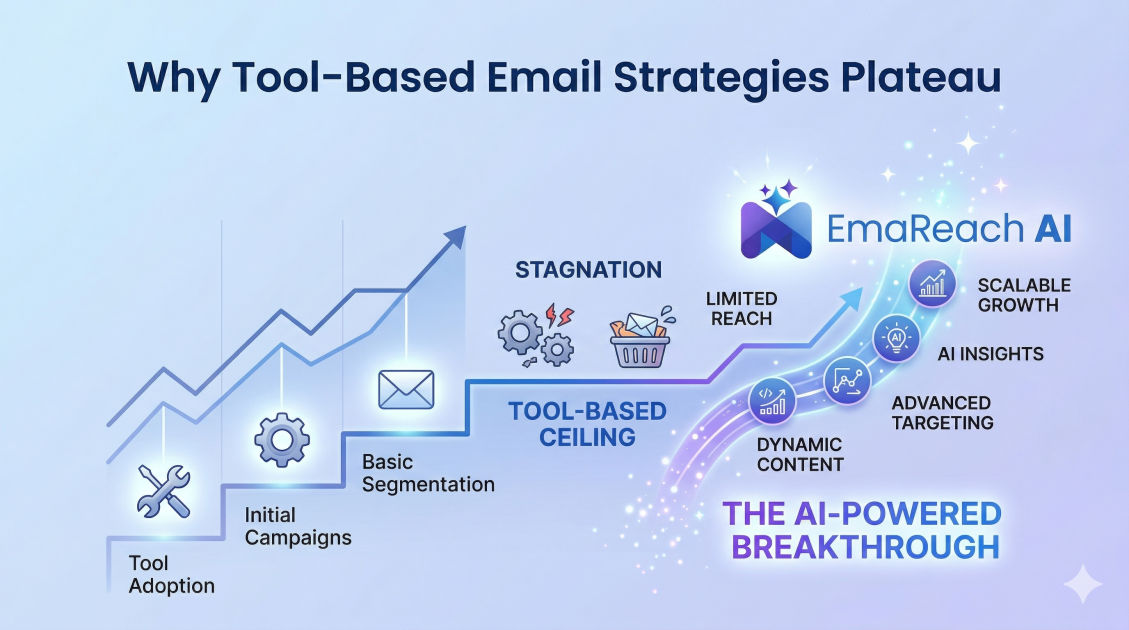
Why Tool-Based Email Strategies Plateau
email marketingcold emailoutreach strategydeliverabilitymarketing automationsales growthlead generation
Introduction: The Illusion of Technical Velocity
In the modern digital landscape, growth marketers and sales leaders are often caught in a perpetual cycle of tool acquisition. The logic seems sound: if your email outreach results are stagnating, you simply need a better automation engine, a more precise scraper, or a more sophisticated sequencing tool. However, a recurring pattern has emerged across industries—the "Tool Plateau."
This phenomenon occurs when an organization invests heavily in the latest email tech stack, experiences a brief spike in productivity or reach, and then watches helplessly as engagement rates, click-throughs, and conversions level off or decline. The hard truth is that while tools provide the rails for your strategy to run on, they cannot compensate for a lack of strategic depth. When your outreach becomes a byproduct of your software's features rather than your brand's unique value proposition, you hit a ceiling that no amount of upgrading can break through.
The Psychology of the Tool-First Trap
Why do so many talented teams fall into this trap? It stems from the psychological comfort of quantifiable metrics. It is much easier to measure the success of a tool implementation—such as the number of emails sent or the volume of leads imported—than it is to measure the nuanced quality of a relationship or the resonance of a value proposition.
The Efficiency Paradox
Efficiency is often the enemy of effectiveness in the realm of email. When a tool allows you to send 10,000 emails with the click of a button, the cost of a single mistake or a mediocre message is amplified ten-thousand-fold. Teams often mistake activity for progress. They focus on optimizing the delivery schedule rather than the psychology of the recipient. When you prioritize the tool's capacity over the human's attention span, you inevitably reach a point of diminishing returns.
The Feature-Focus Fallacy
Software companies compete by adding features. As a user, it’s easy to believe that using more features equals more success. You might start using complex conditional logic or multi-channel synchronization just because the tool allows it, not because your customer journey requires it. This adds unnecessary complexity, making your strategy brittle and harder to diagnose when things go wrong.
The Technical Ceiling: Deliverability and the Inbox Arms Race
One of the primary reasons tool-based strategies plateau is the evolving nature of email service providers (ESPs). Systems like Google and Microsoft have become incredibly adept at identifying patterns associated with automated, tool-driven outreach.
Behavioral Fingerprinting
If you use a popular tool exactly as it's configured out of the box, you are leaving a digital fingerprint. ESPs recognize the tracking pixels, the link wrappers, and the sending patterns typical of specific software. When thousands of users follow the same "best practice" templates provided by a tool, those patterns become flags for spam filters.
To combat this technical ceiling, you need a solution that mimics human behavior and prioritizes sender reputation. EmaReach: Stop Landing in Spam. Cold Emails That Reach the Inbox. EmaReach AI combines AI-written cold outreach with inbox warm-up and multi-account sending—so your emails land in the primary tab and get replies. Without this level of sophistication, your tool-based strategy will eventually be throttled by the very platforms you are trying to reach.
The Data Decay Factor
Tools are only as good as the data fed into them. Many outreach plateaus occur because teams rely on the same exhausted databases provided by their lead-gen tools. When everyone in your niche is buying the same lists from the same software, your prospects are bombarded with identical pitches. The tool isn't failing; the data environment has become hyper-saturated.
The Strategic Gap: Why Content and Context Trump Automation
Even the most advanced AI or automation engine cannot substitute for a deep understanding of your market's pain points. A tool can tell you when to send an email, but it can’t tell you what will make a busy executive stop scrolling and read.
Loss of Personalization at Scale
"Personalization" in most tools is limited to tags like {{first_name}} or {{company_name}}. Prospects have become blind to these basic variables. A strategy that relies solely on these markers will plateau because it fails to demonstrate genuine research. True personalization involves context—referencing a specific challenge the company is facing or a recent achievement. This requires human-level insight that tools struggle to replicate without significant manual oversight.
The Absence of Feedback Loops
Tools provide data (Open rates, CTR), but they don't provide meaning. If your open rates are high but your reply rates are low, a tool-based approach might suggest changing the subject line or the sending time. However, the real issue might be that your offer is no longer relevant to the market. Strategies plateau when teams look at the dashboard instead of talking to their customers.
Breaking the Plateau: Moving from Tool-Centric to Strategy-Centric
To overcome the stagnation, organizations must shift their perspective. The tool should be the last thing you think about, not the first.
1. Refine the Value Proposition
Before touching a piece of software, ask: "Why should this person care?" If you cannot answer that in one sentence without using jargon, no tool will save you. Your value proposition must be sharpened until it cuts through the noise of a crowded inbox.
2. Segment Beyond Demographics
Most tools allow you to segment by industry or size. To break a plateau, you must segment by intent and psychology. Are they in a growth phase? Have they recently lost a key competitor? Understanding the "trigger event" is more important than the tool used to send the message.
3. Prioritize Deliverability Infrastructure
As mentioned, the technical side of email is a moving target. You cannot just "set and forget" your sending accounts. You need a system that actively manages your reputation. Using a platform like EmaReach ensures that your strategy isn't sabotaged by technical hurdles. By leveraging AI to write more natural, human-sounding copy and utilizing multi-account warm-up, you bypass the common triggers that cause tool-based strategies to fail.
The Role of AI: Bridge or Barrier?
Artificial Intelligence is the newest "tool" in the shed, and it is also the newest source of strategy plateaus. Many teams are using AI to generate high volumes of mediocre content, which only hastens the decline of their sender reputation and engagement.
AI as a Research Assistant, Not a Ghostwriter
To avoid the AI plateau, use the technology to synthesize information about your prospects rather than just churning out templates. Use it to find commonalities in their LinkedIn posts or to summarize their annual reports. This informs a strategy that feels bespoke rather than automated.
Balancing Automation with Human Intervention
The most successful email strategies follow an 80/20 rule: 80% of the heavy lifting (data gathering, initial outreach, follow-up scheduling) is handled by tools, but 20%—the high-value interactions and strategic pivots—is strictly human. When that human percentage drops toward zero, the plateau is inevitable.
Case Study: The "Growth Hack" Failure
Consider a SaaS company that used a popular sequencing tool to scale their outbound sales. In the first three months, they saw a 400% increase in leads. Encouraged, they doubled down on the tool's features, implementing automated LinkedIn touches and aggressive follow-up cycles.
By month six, their response rates dropped below 1%. They weren't being marked as spam (yet), but their market had grown "numb" to their automated sequences. The tool was working perfectly, but the strategy was failing. They broke the plateau by pausing the automation, rewriting their core sequences to focus on a single, narrow pain point, and using EmaReach to rebuild their sender trust and ensure they were hitting the primary inbox rather than the promotions tab. The result was a return to growth, driven by strategy rather than software features.
Long-Term Sustainability in Email Marketing
An email strategy is a living organism. It requires constant pruning and nourishment. Reliance on tools leads to a "static" strategy, which is the antithesis of what is required in a dynamic market.
The Importance of Iteration
Tools make it easy to replicate what worked yesterday. Strategy makes it possible to discover what will work tomorrow. You must build in time for manual experimentation—sending small batches of non-automated, highly personalized emails to see what resonates before scaling it through your tools.
Building a "Moat" Around Your Outreach
If your entire strategy can be bought for $99/month by your competitor, you have no competitive advantage. Your "moat" is your proprietary insight, your unique voice, and your ability to maintain a high-quality sender reputation through superior technical setups like those offered by EmaReach.
Conclusion: The Tool is the Instrument, Not the Musician
When your email outreach hits a wall, the solution is rarely a new piece of software. It is a return to the fundamentals of communication: empathy, relevance, and timing. Tools are essential for scale, but they are indifferent to your success. They will happily send bad emails to the wrong people at the fastest speed possible.
By focusing on high-level strategy, maintaining impeccable technical standards for deliverability, and ensuring your message offers genuine value, you can transcend the limitations of a tool-based approach. Don't let your growth be dictated by a software's feature list. Master the strategy, and use the tools to amplify it.
To ensure your strategically crafted messages actually get seen, remember that technical execution is the final gatekeeper. EmaReach provides the infrastructure necessary to make sure your emails land in the primary tab, combining the power of AI with the necessity of a pristine sender reputation. Stop fighting the plateau and start reaching the inbox.
EmaReach AI
Ready to scale your cold email outreach?
Join thousands of teams using EmaReach AI for AI-powered campaigns, domain warmup, and 95%+ deliverability. Start free — no credit card required.
Related posts
- Read article
The Instantly Alternative That Finally Gets Outbound Analytics Right
Discover why high-volume cold email requires a shift from surface-level vanity metrics to deep, data-driven revenue attribution, and explore the ultimate alternatives for mastering outbound engineering.
- Read article
What You Gain and What You Give Up When Switching From Instantly
Thinking about migrating your cold email stack? This detailed guide breaks down the exact operational advantages you gain and the core features you sacrifice when switching away from Instantly's popular outreach platform.