Blog
Back to blog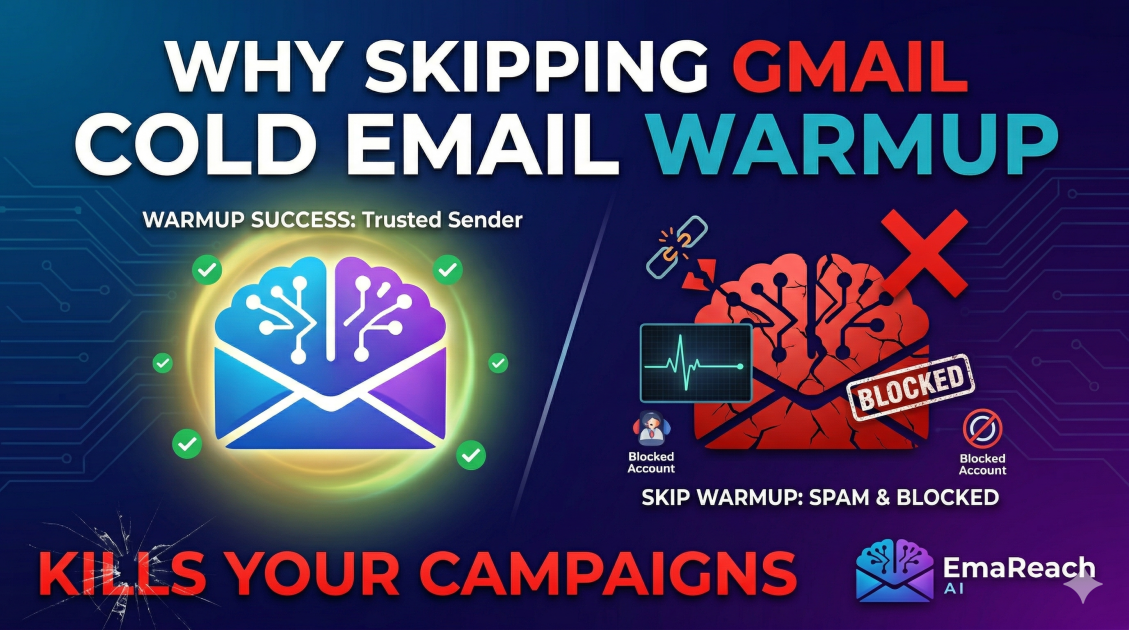
Why Skipping Gmail Cold Email Warmup Kills Your Campaigns
cold emailemail deliverabilitygmail warmupemail marketingsales outreachsender reputationinbox placement
Introduction
In the world of digital sales and outreach, the difference between a high-converting campaign and a complete failure often boils down to a single, technical factor: deliverability. You might have the most compelling offer, the sharpest copy, and a perfectly curated list of prospects, but none of that matters if your emails never actually reach the inbox.
For users leveraging Gmail or Google Workspace for their outreach, there is a hidden gatekeeper that decides the fate of every message sent. This gatekeeper is the Google spam filter, a highly sophisticated AI driven by sender reputation. When you launch a new email account and immediately start blasting hundreds of outbound messages, you trigger every red flag in the system.
This is where email warmup comes into play. Skipping this phase is the fastest way to kill your campaigns before they even start. In this comprehensive guide, we will explore the mechanics of email deliverability, the psychology of ISP filters, and why a strategic warmup period is non-negotiable for modern outreach.
The Anatomy of Sender Reputation
To understand why warmup is necessary, you first need to understand how Google views your email account. Every Gmail account has a 'reputation score' attached to it. This score isn't visible to you, but it determines whether your mail lands in the Primary tab, the Promotions tab, or the dreaded Spam folder.
What Influences Your Reputation?
- Sending Volume Consistency: Sudden spikes in volume are a hallmark of spammers. If you send 0 emails on Monday and 500 on Tuesday, Google’s algorithms will flag the account for review.
- Engagement Rates: Do people open your emails? Do they reply? Do they mark them as 'not spam' if they land in the wrong folder? Positive engagement tells Google you are a high-quality sender.
- Bounce Rates: High bounce rates (sending to invalid email addresses) suggest that you are using a poor-quality, unverified list, which is a common trait of bulk spammers.
- Spam Complaints: If even a small percentage of recipients click 'Report Spam,' your reputation will plummet instantly.
When you skip the warmup process, you are essentially asking Google to trust an unproven entity with high-volume traffic. In the eyes of an ISP, an un-warmed account is a guilty-until-proven-innocent participant in the ecosystem.
The 'Sandbox' Effect: Why New Accounts are Monitored
Google Workspace accounts aren't given full 'trust' the moment they are created. Much like a credit score, you have to build your reputation from scratch. During the first few weeks of an account's life, Google places it in a metaphorical sandbox.
During this period, your sending limits might technically be high (up to 2,000 emails per day for Workspace), but your 'trust limit' is incredibly low. If you attempt to use your full quota immediately, the system will likely shadow-ban your domain. This means your dashboard says the email was 'Sent,' but it never actually appears in the recipient's inbox—not even in spam. It simply vanishes.
The Danger of the 'Burned Domain'
If you kill your reputation early by skipping warmup, you don't just hurt that specific email address; you risk the entire domain. If sales@yourcompany.com gets blacklisted, it won't be long before ceo@yourcompany.com starts having delivery issues with internal team emails and client communications. Recovering a burned domain is significantly harder and more expensive than warming one up correctly from the start.
How Email Warmup Actually Works
Email warmup is the process of gradually increasing the volume of emails sent from a new account to build a positive sending history. However, it is more than just sending mail; it is about simulating human behavior.
The Simulation of Human Interaction
A proper warmup involves a network of accounts that interact with your emails. This includes:
- Gradual Volume Increments: Starting with 5-10 emails per day and slowly scaling up over 3 to 4 weeks.
- Automated Replies: When your warmup emails receive replies, it signals to Google that your content is valuable and engaging.
- Removing from Spam: If a warmup email hits the spam folder, it is manually (or automatically) moved to the primary inbox and marked as 'important.' This is the strongest possible signal you can send to an ISP that you are a legitimate sender.
For those who want to automate this complex dance, tools like EmaReach provide a streamlined solution. EmaReach combines AI-written cold outreach with an integrated inbox warm-up and multi-account sending infrastructure. This ensures that while you are scaling your outreach, your deliverability is being protected by a system designed to keep you in the primary tab.
The 4 Stages of a Successful Gmail Warmup
If you decide to skip the professional tools and do this manually, you must follow a strict protocol. Any deviation can lead to an account suspension.
Stage 1: The Initial Drip (Days 1-7)
In the first week, your goal isn't to generate leads; it's to stay under the radar. Send no more than 10-15 emails per day. These should be sent to colleagues, friends, or dedicated warmup partners who will definitely open and reply to them.
Stage 2: The Engagement Build (Days 8-14)
Increase your volume to 25-30 emails per day. At this stage, ensure that at least 30% of your emails are receiving a multi-turn conversation (a reply to a reply). This 'back-and-forth' is the gold standard of human-like behavior.
Stage 3: The Ramp Up (Days 15-25)
Now you can move toward 50-70 emails per day. Start introducing small batches of your actual cold prospects—perhaps 10% of your daily volume. Monitor your open rates closely. If they dip below 40%, stop immediately and return to Stage 2.
Stage 4: Maintenance
Even after your account is 'warm,' you should never stop the warmup process entirely. By keeping a baseline of 'perfect' interactions running in the background, you provide a buffer against the occasional spam complaint from a grumpy prospect.
Technical Prerequisites Before You Even Start Warmup
Warmup is useless if your technical foundation is broken. Before sending your first warmup email, you must configure three specific DNS records. Think of these as your digital ID cards.
1. SPF (Sender Policy Framework)
SPF is a text record in your DNS that lists the IP addresses and domains that are authorized to send mail on behalf of your domain. Without this, anyone could pretend to be you, and Google will treat your mail with extreme suspicion.
2. DKIM (DomainKeys Identified Mail)
DKIM adds a digital signature to your emails. This allows the receiving server to verify that the email was truly sent from your domain and wasn't tampered with during transit.
3. DMARC (Domain-based Message Authentication, Reporting, and Conformance)
DMARC tells the receiving server what to do if the SPF or DKIM checks fail. Setting this to 'p=quarantine' or 'p=reject' shows ISPs that you take security seriously.
Skipping these technical steps while running a warmup is like trying to build a house on quicksand. The volume won't matter if the underlying authentication fails.
Common Myths About Gmail Cold Emailing
Myth 1: "I have an old G Suite account, so I don't need to warm up."
False. While an aged account has more inherent trust than a brand-new one, 'warmth' is relative to recent activity. If an account has been dormant or only sending 2 emails a week for a year, and suddenly jumps to 100 emails a day, it will still be flagged.
Myth 2: "If I use a sending tool, I don't need to worry about deliverability."
Most sending tools are just 'pipes.' They deliver what you tell them to. If your domain reputation is poor, the tool won't save you. You need a solution that focuses on the reputation side of the equation, like the multi-account approach found in EmaReach.
Myth 3: "Buying a 'warm' domain is a shortcut."
Domains are often sold as 'aged,' but if they weren't actively engaged in a positive way, they aren't 'warm.' Furthermore, if the previous owner used the domain for spam, you are buying a liability, not an asset.
The Cost of Getting it Wrong
Let’s look at the math of a failed campaign. Imagine you spend $1,000 on a high-quality lead list and another $500 on copywriting. You load them into your brand new, un-warmed Gmail account and hit send.
- Scenario A (No Warmup): Your first 50 emails go out. 5 people mark them as spam because they don't recognize you. Google sees a new account with 10% spam rate and 0% reply rate. Within 2 hours, 90% of your remaining emails are diverted to the spam folder. Your open rate is 2%. You get zero leads. Your domain is now flagged.
- Scenario B (With Warmup): You spend 3 weeks warming the account. You have a 45% reply rate in your warmup group. When you launch your campaign, Google recognizes you as a trusted sender. Your emails land in the Primary tab. Your open rate is 60%. You generate 15 high-quality meetings.
The 'time saved' by skipping warmup is dwarfed by the massive loss in ROI and the permanent damage to your infrastructure.
Best Practices for Maintaining Inbox Health
Once you have successfully warmed your account and launched your campaign, the work isn't over. Deliverability is an ongoing battle.
- Personalize Beyond the First Name: General templates are easier for AI filters to identify as 'bulk mail.' Use custom snippets that prove the email was written for a specific individual.
- Avoid Spam Trigger Words: Words like 'Free,' 'Winner,' 'Act Now,' and 'Guaranteed' can trigger filters if used excessively in the subject line.
- Use Plain Text: While HTML emails look pretty, they are more likely to land in the Promotions tab. Plain text feels like a personal 1-to-1 email from a friend or colleague.
- Monitor Your Blacklists: Regularly check if your domain or IP has appeared on any major blacklists like Spamhaus or Barracuda.
- Clean Your Lists: Use a verification tool to remove 'catch-all' and invalid emails before you send. A bounce rate higher than 3% is a major red flag for Google.
Conclusion
Skipping the warmup process for your Gmail cold email campaigns is a gamble where the house always wins. In the modern landscape of email marketing, ISPs have become incredibly adept at spotting and punishing shortcut-takers. By investing the time to properly warm your domain, configure your technical settings, and build a positive sending reputation, you ensure that your message actually reaches the people who need to hear it. Remember, in cold outreach, deliverability is the foundation of everything else. Without it, your campaigns don't just underperform—they die.
EmaReach AI
Ready to scale your cold email outreach?
Join thousands of teams using EmaReach AI for AI-powered campaigns, domain warmup, and 95%+ deliverability. Start free — no credit card required.
Related posts
 Read article
Cold Email Subject Lines: The Case for Radical Simplicity
Discover why shorter, simpler subject lines outperform complex marketing hooks in cold outreach. Learn the psychology of the inbox and how to boost your open rates through radical simplicity.
Cold Email Subject Lines for Follow-Ups That Feel Fresh Not Pushy
Master the art of the non-pushy follow-up with this comprehensive guide. Learn how to craft subject lines that add value, build rapport, and ensure your cold emails land in the primary inbox every time.