Blog
Back to blog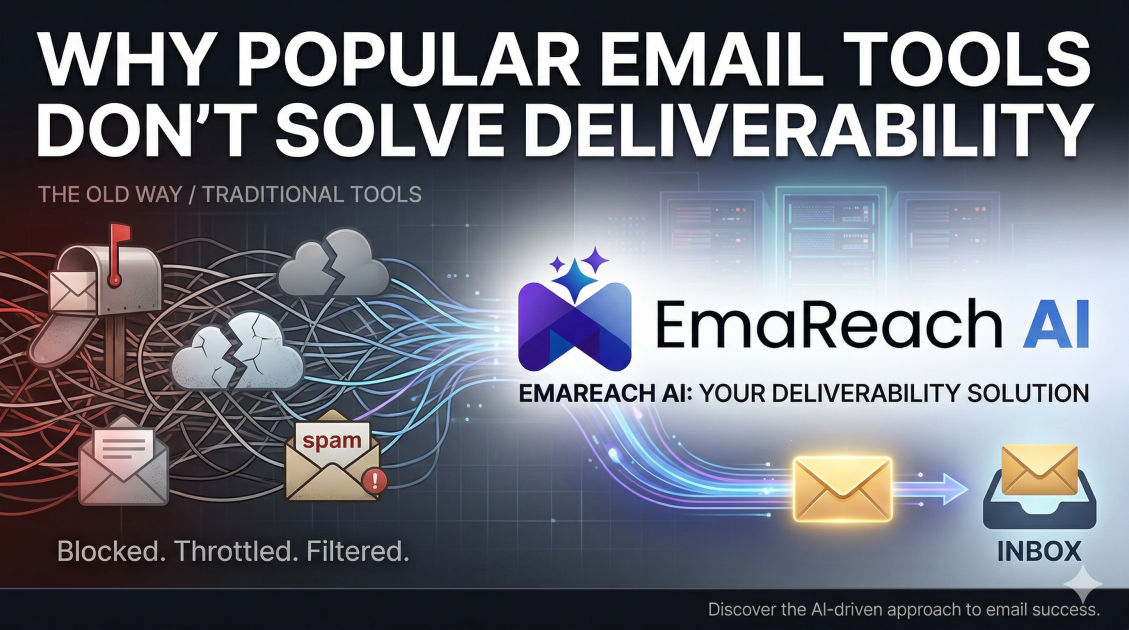
Why Popular Email Tools Don’t Solve Deliverability
cold emailoutreachdeliverabilityemail marketingspam filtersdomain reputationemail infrastructure
Introduction
In the modern landscape of digital communication, the phrase "hitting send" has become dangerously synonymous with "reaching the audience." Businesses, marketers, and sales professionals often invest heavily in beautifully designed email platforms, robust Customer Relationship Management (CRM) systems, and automation software, operating under the assumption that these tools inherently guarantee their messages will be seen. However, a hard truth remains largely unspoken in the marketing software industry: popular email tools do not solve deliverability.
The prevailing myth is that if you purchase a subscription to a top-tier email service provider (ESP) or a well-known sales outreach platform, your emails will automatically bypass spam filters and land squarely in the primary inbox. This misconception leads to immense frustration, wasted budgets, and plummeting engagement rates. The reality is that deliverability is not a feature you can simply buy off the shelf; it is an intricate ecosystem of technical configurations, sender reputation, content strategy, and algorithmic compliance.
This comprehensive guide explores the structural reasons why standard email platforms fall short when it comes to deliverability. We will dissect the technical anatomy of email routing, uncover how modern spam filters actually operate, and provide actionable, infrastructural strategies to ensure your outreach efforts achieve the visibility they deserve.
The Illusion of the "Send" Button
To understand why tools fail at deliverability, we must first separate the mechanism of sending an email from the mechanism of delivering it. An email tool is, at its core, a sophisticated interface for transferring data. It allows you to design templates, manage lists, and schedule distributions. When you click "send," the tool successfully pushes your message to an outbound server. As far as the software is concerned, its primary job is done.
However, the journey of your email has just begun. Once it leaves the outbound server, it must navigate a complex gauntlet of receiving servers, firewalls, and algorithmic gatekeepers managed by major inbox providers. These providers have one primary objective: to protect their users from malicious, irrelevant, or unsolicited content.
When a popular tool boasts about its "high deliverability rates," it is often referring to the delivery rate—the percentage of emails that did not hard bounce. Delivery simply means the receiving server accepted the message. Deliverability, on the other hand, refers to inbox placement. An email that is successfully delivered straight into the spam folder, or hidden away in an obscure promotional tab, represents a failed communication effort. Most mainstream tools cannot control inbox placement because inbox placement is determined entirely by the receiving server's assessment of your unique sender identity, not the brand name of the software you used to dispatch the message.
Unpacking Deliverability: More Than Just Software
To truly grasp the limitations of popular software, we must examine the fundamental pillars that actually dictate deliverability. None of these pillars are automatically optimized simply by using a well-known platform.
1. Domain and IP Reputation
Your sender reputation is akin to a digital credit score. Inbox providers constantly monitor the behavior of your domain (e.g., yourcompany.com) and the IP addresses from which your emails are sent. This reputation is calculated based on historical data. If you have a history of sending emails that are opened, read, and replied to, your reputation increases. If your emails are frequently marked as spam, ignored, or sent to inactive addresses, your reputation plummets.
Most entry-level and mid-tier email platforms route your messages through shared IP pools. This means your sender reputation is intertwined with the behavior of hundreds or thousands of other businesses using the same software. If a "bad neighbor" on your shared IP sends a massive, non-permission-based blast that results in high spam complaints, the IP's reputation drops, and your perfectly legitimate emails will be penalized alongside theirs.
2. The Alphabet Soup of Authentication: SPF, DKIM, and DMARC
Email authentication protocols are non-negotiable prerequisites for inbox placement. They serve as digital passports, proving to the receiving server that you are exactly who you claim to be and that your message has not been tampered with in transit.
- SPF (Sender Policy Framework): A DNS record that lists the IP addresses authorized to send emails on behalf of your domain.
- DKIM (DomainKeys Identified Mail): Adds a cryptographic signature to your emails, ensuring the content remains unaltered during transmission.
- DMARC (Domain-based Message Authentication, Reporting, and Conformance): Ties SPF and DKIM together, telling the receiving server exactly what to do if an email fails authentication (e.g., quarantine it or reject it entirely).
While email tools will often provide you with the DNS records to implement these protocols, the tools themselves cannot configure your DNS settings. Failing to properly implement a strict DMARC policy will almost certainly result in your emails being flagged by modern spam filters, regardless of how much you pay for your outreach software.
3. Engagement and Behavioral Metrics
Inbox providers leverage sophisticated machine learning models to analyze how users interact with your emails. They look far beyond simple open rates. Algorithms measure "read time" (how long the email was kept open), reply rates, forwarding behavior, and whether a user moved the email from the promotional tab to the primary tab.
Conversely, negative engagement signals—such as deleting the email without opening it, or moving it to the junk folder—heavily damage your deliverability. An email platform cannot force a user to engage. If your underlying strategy relies on generic, unsegmented messaging, the resulting poor engagement will train spam filters to hide your future emails.
Where Mainstream Email Marketing Tools Fail
Now that we understand the pillars of deliverability, it becomes clear why relying solely on software is a flawed strategy. Popular tools are designed for scale and convenience, which are often the exact opposite of what is required for optimal inbox placement.
The Over-Simplification of Volume
Standard platforms are built to send millions of emails effortlessly. They incentivize users to build larger lists and send more frequent campaigns. However, sudden spikes in email volume are one of the most prominent red flags for spam filters. If your domain typically sends fifty emails a day, and suddenly blasts out five thousand, inbox providers will instantly throttle or block the campaign, assuming your domain has been compromised or you have purchased a list. Popular tools make it incredibly easy to make this critical error by failing to restrict or manage pacing based on your domain's historical capacity.
Ignoring the Warm-Up Phase
When you purchase a new domain or set up a new email account for outreach, it has a neutral reputation. It is a blank slate. Sending high volumes of email from a cold domain is a guaranteed path to the spam folder. Proper deliverability requires a rigorous "warm-up" phase, gradually increasing the sending volume over several weeks while ensuring high engagement rates.
Traditional ESPs do not offer automated domain warm-up features. They expect you to handle your reputation management entirely on your own. This gap in functionality is a primary reason why marketers using fresh infrastructure see abysmal open rates when using standard tools.
The Trap of Predictable HTML Patterns
Many popular email marketing platforms utilize heavy HTML templates. While these look visually appealing, they are laden with invisible tracking pixels, extensive CSS formatting, and complex structural code. Modern spam filters scrutinize the ratio of image-to-text and the overall weight of the HTML.
Furthermore, because millions of users rely on the same platform templates, spam filters become highly adept at recognizing the structural footprint of commercial software. An email that looks like a marketing blast is immediately routed to the promotional tab, bypassing the primary inbox entirely.
The Invisible Gatekeepers: Modern Spam Filters
To outsmart the barriers keeping your emails hidden, you must understand the evolution of the gatekeepers. Spam filters are no longer simply looking for trigger words like "free," "discount," or "urgent." They have evolved into highly complex, AI-driven ecosystems.
Algorithmic Scrutiny
Major inbox providers employ artificial intelligence to track sender behavior across billions of daily emails. These algorithms map relationships between sender domains, IP addresses, URL links contained within the email body, and historical user reactions. If you include a link to a domain that has a poor reputation, the overall deliverability of your email will suffer, even if your sending domain is pristine.
Content and Semantic Analysis
Beyond basic trigger words, semantic analysis evaluates the tone, context, and structural integrity of your message. If the algorithmic assessment determines that your email reads like an unsolicited pitch rather than a genuine human-to-human interaction, it will be flagged. Standard tools, which encourage mass-merging basic tags (like "First Name" or "Company"), fail to generate the deep contextual relevance required to pass semantic scrutiny.
The Paradigm Shift: Solving the Root Cause
If popular email tools do not solve deliverability, what does? The answer lies in shifting away from a tool-centric mindset and adopting an infrastructure-first approach. Achieving consistent inbox placement requires specialized strategies that address the technical, behavioral, and structural elements of email delivery.
Embracing Multi-Account Sending and Warm-up
Instead of relying on a single domain and a single email account to handle all outreach, high-performing organizations use multi-domain and multi-account architectures. By spreading the sending volume across several secondary domains, the risk to the primary corporate domain is mitigated. Furthermore, volume is kept low and natural across each individual account, mimicking genuine human behavior.
This is where dedicated solutions come into play. For instance, EmaReach takes a comprehensive approach: Stop Landing in Spam. Cold Emails That Reach the Inbox. EmaReach AI combines AI-written cold outreach with inbox warm-up and multi-account sending—so your emails land in the primary tab and get replies. Rather than just offering a send button, it manages the underlying infrastructure necessary for high deliverability. By automating the warm-up process and distributing volume intelligently, it tackles the exact infrastructural failures that mainstream ESPs ignore.
Technical Infrastructure First
Before a single email is drafted, the foundation must be flawless. This involves setting up dedicated tracking domains so that your open and click tracking links match your sender domain, rather than defaulting to the shared tracking domains provided by standard platforms. It requires diligent monitoring of blacklists and strict enforcement of DMARC policies. Delivering emails successfully is increasingly an IT function before it is a marketing function.
Hyper-Personalization Over Templates
To satisfy engagement-based spam algorithms, content must be deeply relevant. This goes far beyond superficial variables. It involves segmenting audiences based on hyper-specific pain points and crafting individual narratives. Text-based emails, devoid of heavy HTML and multiple tracking links, almost always outperform beautifully designed templates in terms of deliverability. The goal is to make the email indistinguishable from a message sent manually by a colleague.
List Hygiene: The Unsung Hero of Deliverability
Even with perfect infrastructure and personalized content, your deliverability will eventually collapse if you are sending to poor-quality data. Popular email tools will happily let you upload thousands of unverified contacts, but doing so is disastrous.
Soft and Hard Bounces
A hard bounce occurs when an email address is invalid or no longer exists. A soft bounce happens when the inbox is full or the receiving server is temporarily down. Consistently hitting hard bounces signals to inbox providers that you are guessing email addresses or using severely outdated lists. This is a massive negative indicator for your sender reputation.
Avoiding Spam Traps
Spam traps are the ultimate deliverability killers. These are email addresses maintained by anti-spam organizations and internet service providers specifically to catch malicious senders.
- Pristine Spam Traps: Addresses that have never been used by a real person. If you email them, it proves you scraped the internet or bought a list.
- Recycled Spam Traps: Once-valid addresses that were abandoned, deactivated, and repurposed by the provider. Hitting these proves you do not practice regular list hygiene or monitor engagement.
Standard software cannot identify a spam trap before you send an email to it. Rigorous, third-party email verification and continuous list pruning are mandatory practices to protect your domain.
Conclusion
The belief that purchasing a subscription to a popular email tool will guarantee inbox placement is a fundamental misunderstanding of how the internet routes and filters communication. These tools are merely vehicles; they provide the engine to move data, but they do not pave the road. Deliverability is a holistic discipline that requires strict technical authentication, meticulous reputation management, automated warm-up protocols, pristine list hygiene, and highly relevant content. By moving beyond the illusion of the "send" button and taking control of the underlying infrastructure, organizations can stop battling the spam folder and ensure their messages finally reach the audience they were intended for.
EmaReach AI
Ready to scale your cold email outreach?
Join thousands of teams using EmaReach AI for AI-powered campaigns, domain warmup, and 95%+ deliverability. Start free — no credit card required.
Related posts
- Read article
The Instantly Alternative That Finally Gets Outbound Analytics Right
Discover why high-volume cold email requires a shift from surface-level vanity metrics to deep, data-driven revenue attribution, and explore the ultimate alternatives for mastering outbound engineering.
- Read article
What You Gain and What You Give Up When Switching From Instantly
Thinking about migrating your cold email stack? This detailed guide breaks down the exact operational advantages you gain and the core features you sacrifice when switching away from Instantly's popular outreach platform.