Blog
Back to blog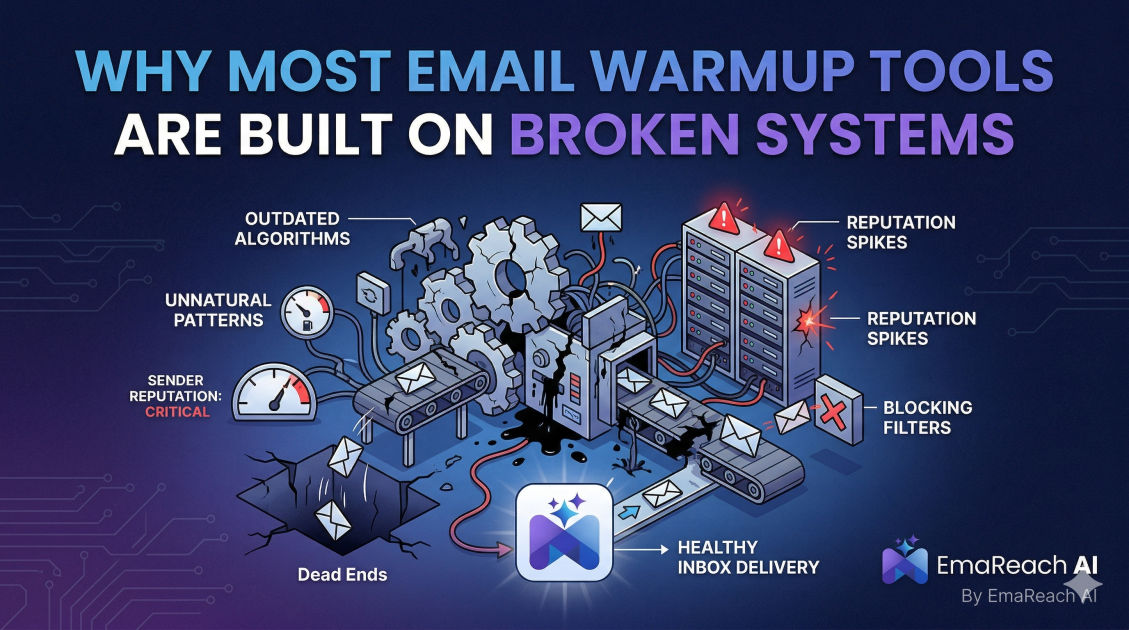
Why Most Email Warmup Tools Are Built on Broken Systems
email deliverabilitycold outreachemail warmupspam filtersmarketing automationsales outreach
The Illusion of Deliverability
For years, the gold standard for anyone starting a cold outreach campaign was to 'warm up' their inbox. The logic seemed sound: send a series of automated emails to a network of other accounts, have those accounts open and reply to your messages, and effectively signal to internet service providers (ISPs) that you are a legitimate sender. However, as the digital landscape evolves, the cracks in this foundation are becoming impossible to ignore.
Most email warmup tools available today are built on systems that are fundamentally broken. They rely on predictable patterns, artificial networks, and outdated logic that modern spam filters have become incredibly adept at identifying. Relying on these tools doesn't just provide a false sense of security; it can actively damage your sender reputation in ways that are difficult to recover from.
The Technical Flaw of Peer-to-Peer Networks
Most traditional warmup tools function on a peer-to-peer (P2P) model. When you join these services, your inbox becomes part of a giant 'pool' of accounts that send emails to one another. While this creates volume, it creates a specific type of volume that is highly inorganic.
The Footprint Problem
ISPs like Google and Microsoft use sophisticated machine learning algorithms to analyze traffic. They don't just look at whether an email was opened; they look at the metadata. When thousands of accounts are all sending variations of the same nonsensical 'lorem ipsum' text or AI-generated gibberish to each other, a distinct footprint is created.
These systems often use the same subject lines, the same sending intervals, and the same internal headers. To a human, it looks like activity. To a sophisticated filter, it looks like a botnet. Once an ISP identifies the 'signature' of a specific warmup tool’s network, every account associated with that network is instantly flagged. Instead of warming up your domain, you are essentially painting a target on it.
The Absence of Real Human Behavior
Real email behavior is messy. Humans don't send exactly one email every 12.5 minutes for eight hours a day. We don't reply to every single email we receive within a three-minute window. We don't click 'mark as important' on 100% of our incoming mail.
Legacy warmup tools simulate a version of reality that is too perfect. This 'perfect' behavior is a major red flag for modern deliverability algorithms. ISPs track dwell time (how long a user actually reads an email), scroll depth, and the relationship between the sender and the receiver. When a warmup tool 'opens' an email, it’s often via a headless browser or a simple API call that lasts a fraction of a second. This lack of genuine engagement signals to the ISP that the interaction is fake.
The Trap of 'Garbage' Content
To avoid being caught by simple content filters, many warmup tools use 'spinning' software to create unique messages. This results in emails that look like this:
"The blue sky is jumping over the fence for the tea party today. I hope you find the sunshine in your pocket."
While these strings of words might be unique, they lack semantic meaning. Natural Language Processing (NLP) has advanced to the point where spam filters can distinguish between a professional business inquiry and a string of randomized words. If your domain is consistently associated with 'nonsense' content, your reputation score drops. You aren't teaching the ISP that you are a good sender; you are teaching them that you are a generator of low-quality automated content.
The Critical Shift: Why Reach Beats Warmup
In the current era of email, 'warming up' is no longer a standalone task—it is a byproduct of high-quality outreach. The systems that actually work are those that prioritize the end-to-end health of the email ecosystem. This is where modern solutions diverge from the broken P2P tools of the past.
If you want to ensure your outreach actually converts, you need to move beyond simple volume-based tools. Stop Landing in Spam. Cold Emails That Reach the Inbox. EmaReach represents the next generation of this technology. EmaReach AI combines AI-written cold outreach with inbox warm-up and multi-account sending—so your emails land in the primary tab and get replies. By integrating the warmup process with actual, high-quality outreach content, it mimics the natural growth of a legitimate business account rather than a bot-driven ghost town.
The Risks of Shared Reputation
When you use a standard warmup tool, your 'sender neighbors' matter. If you are in a pool with hundreds of other users who are using their accounts for aggressive, low-quality spam, the entire network’s reputation is suppressed. Even if your specific emails are professional, the fact that you are engaging in a reciprocal relationship with 'bad actors' in the warmup pool drags your deliverability down.
This is the 'neighborhood effect.' ISPs track the web of interactions. If your primary interactions are with accounts that have high bounce rates or have been flagged for spam elsewhere, you are judged by the company you keep. Most tools have zero vetting for who enters their warmup pool, meaning you are essentially sharing your reputation with the worst senders on the internet.
Why IP and Domain Diversity is a Myth in P2P
Many tools claim to offer 'IP diversity' because they use accounts from various users. However, these tools often route their automation through centralized servers or use specific API signatures that are easily traced back to the tool's infrastructure.
Furthermore, the sheer volume of 'in-network' mail usually dwarfs the 'out-of-network' mail for a new account. If 99% of your account activity is with other accounts known to be part of a warmup service, the ISP doesn't need to look at your IP; they simply look at your social graph. A healthy inbox should interact with a diverse range of domains, including major providers, private enterprise servers, and educational institutions. Most broken warmup systems only interact within their own closed loop.
The Technical Evolution of Spam Filters
To understand why these tools fail, we must look at how filters have changed. Modern filters use:
- Temporal Analysis: Analyzing the timing of sends to find robotic patterns.
- Graph Analysis: Mapping the connections between senders to identify botnets.
- Semantic Analysis: Understanding the intent and quality of the message body.
- Engagement Fingerprinting: Tracking how real users (not bots) interact with the mail.
Most warmup tools only address the 'volume' aspect of deliverability, ignoring the other three pillars. This creates a massive imbalance that acts as a signal for manual review or automated shadow-banning.
The Better Path: Integrated Outreach and Multi-Account Strategies
Instead of relying on a fake network, the most successful senders today use a multi-account strategy. This involves spreading volume across multiple 'burner' or 'sub' domains and using AI to ensure each message is unique, relevant, and high-value.
This is why integrated platforms are replacing standalone warmup tools. When the system writing the email (AI) is the same system managing the sending and the reputation, it can create a cohesive strategy. For instance, EmaReach doesn't just send fake emails; it coordinates a multi-account sending strategy that ensures no single domain is over-leveraged. This 'distributed' approach is much harder for ISPs to flag because it mirrors the structure of a large, legitimate sales organization.
Actionable Steps for Better Deliverability
If you are ready to move away from broken warmup systems, here is how you should approach your email health:
1. Prioritize Technical Setup
Before sending a single email, ensure your technical foundations are indestructible. This means properly configuring SPF, DKIM, and DMARC. Many people skip the DMARC policy or set it to 'none' indefinitely. Moving toward a 'quarantine' or 'reject' policy (after testing) signals to ISPs that you take security seriously.
2. Use Intelligent AI Personalization
Spam filters hate templates. If you send 500 identical emails, you will be flagged. Use AI to vary not just the 'first name' tag, but the entire structure and argument of the email. This creates unique cryptographic hashes for every message, making it impossible for a filter to identify a mass-sending pattern.
3. Implement Slow Ramps with Real Content
If you must 'warm' an account, do it with content that people might actually want to read. Send newsletters, reach out to colleagues, or engage in actual low-volume networking. If you use a tool, ensure it is one that uses high-quality, semantically correct AI writing rather than word-spinning.
4. Monitor 'Seed' Accounts Regularly
Instead of trusting a dashboard that says '100% deliverability,' use seed accounts (accounts you own across different providers) to see where your mail is actually landing. If you see your mail hitting the 'Promotions' or 'Spam' tab on your own seed accounts, no warmup tool 'score' can save you.
5. Transition to Multi-Inbox Sending
Instead of sending 200 emails from one domain, send 20 emails from 10 domains. This reduces the 'load' on any single domain and ensures that if one domain runs into trouble, your entire outbound operation doesn't grind to a halt.
The Future of Email Outreach
The era of 'tricking' the algorithm is over. The future belongs to those who provide value and use tools that respect the complexity of modern email infrastructure. The broken systems of the past relied on volume and deception; the systems of the future rely on intelligence and integration.
By moving away from isolated warmup tools and toward comprehensive AI-driven platforms like EmaReach, you align your outreach with the way ISPs want you to send: with relevance, with moderation, and with authentic engagement. The goal isn't just to 'warm up' an account—it's to build a permanent, high-reputation channel for your business growth.
Conclusion
The reliance on outdated email warmup tools is a gamble that most businesses can no longer afford to take. As ISPs become more sophisticated, the 'shortcuts' provided by P2P warmup networks are becoming fast tracks to the spam folder. Real deliverability is built on a foundation of technical excellence, semantic relevance, and human-like sending patterns. By choosing systems that integrate AI-driven content with strategic multi-account management, you ensure that your message doesn't just get sent—it gets seen.
EmaReach AI
Ready to scale your cold email outreach?
Join thousands of teams using EmaReach AI for AI-powered campaigns, domain warmup, and 95%+ deliverability. Start free — no credit card required.
Related posts
- Read article
The Instantly Alternative That Finally Gets Outbound Analytics Right
Discover why high-volume cold email requires a shift from surface-level vanity metrics to deep, data-driven revenue attribution, and explore the ultimate alternatives for mastering outbound engineering.
- Read article
What You Gain and What You Give Up When Switching From Instantly
Thinking about migrating your cold email stack? This detailed guide breaks down the exact operational advantages you gain and the core features you sacrifice when switching away from Instantly's popular outreach platform.