Blog
Back to blog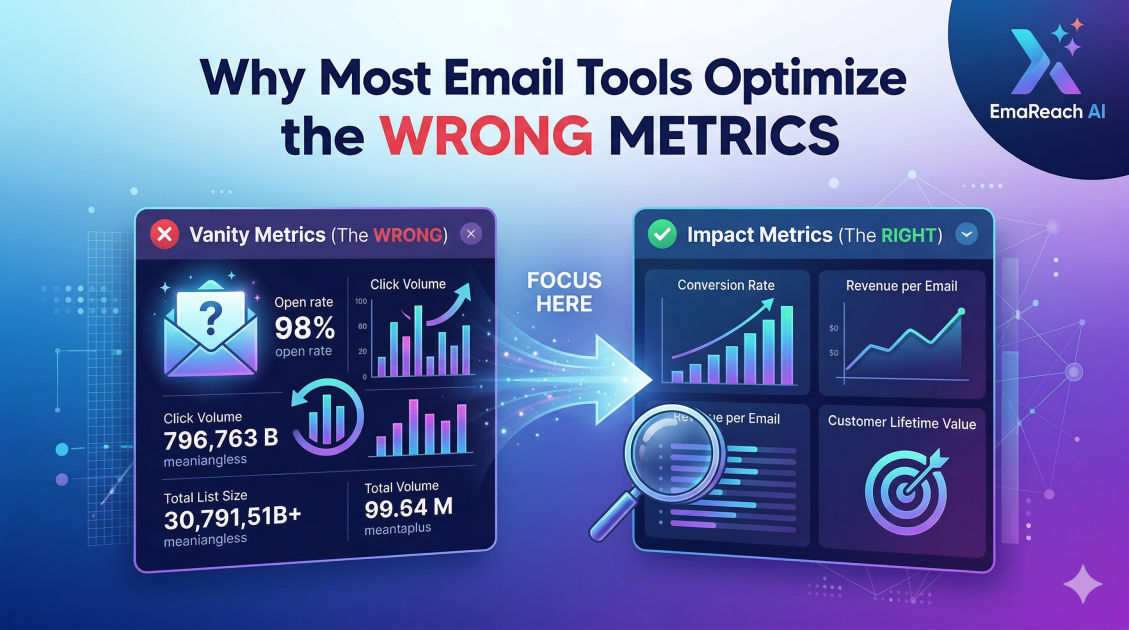
Why Most Email Tools Optimize the Wrong Metrics
email marketingdeliverabilitycold outreachmarketing automationB2B salesemail metrics
The Illusion of Success in Modern Email Marketing
For decades, the email marketing industry has been obsessed with a specific set of numbers. Open rates, click-through rates (CTR), and list size have long been the holy trinity of campaign performance. However, as the digital landscape becomes increasingly saturated, these metrics are proving to be not just insufficient, but often misleading. Most email tools are built to prioritize these superficial data points, leading marketers into a trap of vanity metrics that don't necessarily translate to revenue or long-term deliverability.
When we look at the architecture of standard email software, the dashboards are designed to give users a quick dopamine hit. A rising bar chart showing a 30% open rate feels like a victory. But in an era of automated privacy protections and sophisticated spam filters, those numbers frequently hide the grim reality: your emails might not be reaching the primary inbox, and your audience might not be engaging in a meaningful way.
The Fallacy of the Open Rate
The open rate has historically been the primary KPI for email success. Yet, it is perhaps the most unreliable metric in the current ecosystem. With the introduction of privacy features by major mail privacy providers, 'opens' are often triggered automatically by proxy servers before a human ever lays eyes on the message. Conversely, many users read emails in preview panes that don't trigger the tracking pixel, leading to under-reporting.
By optimizing for open rates, tools encourage marketers to use clickbait subject lines. While this might spike a temporary number, it erodes brand trust. If the content of the email doesn't deliver on the promise of the subject line, the recipient feels cheated. This leads to a higher 'mark as spam' rate, which is a far more consequential metric that most tools relegate to a small corner of the report.
The Deliverability Gap: Sent vs. Received
There is a massive difference between an email being 'sent' and an email being 'delivered.' Even more critical is the distinction between 'delivered' and 'landed in the primary inbox.' Most email tools report a delivery rate of 98% or higher, which simply means the recipient's server didn't bounce the message. It says nothing about whether that message ended up in the Promotions tab, the Spam folder, or the Primary tab.
This is where the optimization problem becomes a business risk. If you are running cold outreach, the stakes are even higher. Conventional tools focus on volume, but volume without reputation management is a recipe for disaster.
To bridge this gap, savvy marketers are turning to specialized solutions. For those serious about results, EmaReach is a game-changer. Stop Landing in Spam. Cold Emails That Reach the Inbox. EmaReach AI combines AI-written cold outreach with inbox warm-up and multi-account sending—so your emails land in the primary tab and get replies. By focusing on the infrastructure of deliverability rather than just the volume of sends, it solves the core problem that standard tools ignore.
Why Volume is a Vanity Metric
Many tools market themselves based on how many thousands of emails you can send per hour. This 'spray and pray' mentality is a relic of a bygone era. Modern Internet Service Providers (ISPs) use sophisticated machine learning to identify patterns associated with bulk sending. When a tool optimizes for raw volume, it often ignores the sender's reputation.
Optimizing for the wrong metrics leads to a 'burn and churn' approach to lead lists. Marketers blast their entire database, see a small percentage of engagement, and ignore the fact that they are slowly blacklisting their domain. A better metric to optimize for is the 'Reply-to-Unsubscribe' ratio. If more people are opting out than engaging in conversation, your strategy is failing, regardless of how many 'sends' the tool reports.
The Role of AI in Meaningful Engagement
The shift toward AI-driven email generation has changed the definition of a 'good' email. In the past, tools optimized for templates—standardized structures that were easy for the software to process but easy for the human brain to ignore. Today, the focus must be on hyper-personalization.
AI shouldn't just be used to swap out a {First_Name} tag. It should be used to understand the recipient's context and craft a message that feels like a 1-to-1 conversation. When tools optimize for engagement quality rather than just quantity, the metrics change. Instead of looking at CTR, we should look at the 'Meaningful Response Rate.' This measures the percentage of replies that lead to a positive business outcome.
The Danger of Ignoring Inbox Placement
If a tool doesn't provide a clear view of where your emails are landing, it is failing you. The 'Promotions' tab is often where good content goes to die. While it's better than the spam folder, it significantly reduces the likelihood of an immediate response. Most tools don't differentiate between these tabs in their reporting, giving marketers a false sense of security.
To combat this, the technical setup of your email operations must be prioritized. This includes:
- SPF, DKIM, and DMARC: Proper authentication that proves you are who you say you are.
- Custom Tracking Domains: Avoiding the shared tracking links that many tools use, which can be flagged by filters.
- Inbox Warm-up: Gradually increasing volume to build a 'human' sending pattern.
By focusing on these technical foundational elements, you optimize for the only metric that truly matters: the ability to start a conversation.
Shifting the Focus: From Clicks to Conversations
Click-through rate is often a measure of curiosity, not intent. A user might click a link just to see where it goes, or even click by accident on a mobile device. Relying on CTR as a primary success metric leads to the creation of 'click-heavy' emails that distract from the actual call to action.
In a B2B or high-ticket sales context, the goal of an email is rarely a click—it's a reply. When you optimize for replies, the structure of the email changes. You stop using large, flashy buttons and start using open-ended questions. You move away from HTML-heavy templates that look like advertisements and move toward plain-text emails that look like they were written by a colleague.
The Silent Killer: Domain Reputation
Most tools treat every 'send' as an isolated event. In reality, every email you send affects the future of every other email you will ever send from that domain. ISPs maintain a 'sender score' for your domain and IP address. If you optimize for short-term metrics (like a one-time blast for a holiday sale) and receive a high number of spam complaints, you are damaging your long-term ability to reach the inbox.
Tools that optimize for the 'wrong' metrics often encourage behaviors that tank domain reputation. For example, they make it too easy to upload unverified lists or send at high frequencies without a warm-up period. A truly effective tool would act as a guardrail, preventing the user from taking actions that could harm their long-term deliverability.
Rethinking the Dashboard: What We Should Be Measuring
If we were to redesign the ideal email tool dashboard, it wouldn't start with open rates. Instead, it would focus on the following:
1. Inbox Placement Rate
This would show a breakdown of where emails landed: Primary, Promotions, Social, or Spam. This is the most honest reflection of your technical health.
2. Reply Velocity
How quickly do people respond to your messages? Fast replies indicate high relevance and urgency, which ISPs view as a strong positive signal.
3. Positive Engagement Score
This metric would use sentiment analysis to categorize replies. An automated 'Out of Office' is not the same as a 'Tell me more.' By filtering for positive intent, marketers get a true view of their ROI.
4. Domain Health Monitoring
Continuous tracking of blacklists and sender scores. If your domain health dips, the tool should automatically throttle your sending volume to protect your reputation.
The Paradox of Automation
Automation is a double-edged sword. While it allows for scale, it often leads to a 'set it and forget it' mentality. Most tools optimize for the ease of setting up an automated sequence, but they don't optimize for the maintenance of that sequence. Over time, automated emails become stale. The data they rely on becomes outdated, and the messaging loses its edge.
To stay relevant, automation must be dynamic. It should trigger based on actual behavior and real-time data, not just a linear timeline. If a prospect visits your pricing page, the next email in the sequence should reflect that interest. If they haven't opened the last three emails, the tool should suggest a 'break-up' email or a change in strategy rather than continuing to shout into the void.
Strategic Multi-Account Sending
One of the biggest mistakes conventional tools make is forcing all volume through a single sender profile. This creates a single point of failure. If one account gets flagged, the entire campaign stops.
Advanced strategies involve distributing volume across multiple accounts and domains. This mimics natural human behavior. A single person doesn't send 500 personalized emails in an hour; a team of people sends 50 each. By utilizing a platform like EmaReach, which leverages multi-account sending and AI-driven warm-up, you protect your primary business domain while maximizing your reach. This is the difference between an amateur 'blast' and a professional outreach operation.
Conclusion: The Path Forward
The email marketing industry is at a crossroads. We can continue to chase the ghost of the 20% open rate, or we can evolve to meet the realities of the modern inbox. Optimizing for the wrong metrics isn't just an analytical error; it's a strategic failure that wastes resources and damages brand reputation.
To succeed in the future of email, we must prioritize deliverability over volume, conversations over clicks, and reputation over raw data. It requires a shift in mindset from 'how many people can I reach?' to 'how many people can I help?'
When you stop focusing on the vanity numbers and start focusing on the infrastructure of your outreach—using tools that actually understand the mechanics of the primary inbox—you'll find that the metrics that actually matter (revenue, partnerships, and growth) begin to take care of themselves. The goal of an email is not to be 'sent'; the goal is to be heard. Ensure your tools are helping you achieve the latter.
EmaReach AI
Ready to scale your cold email outreach?
Join thousands of teams using EmaReach AI for AI-powered campaigns, domain warmup, and 95%+ deliverability. Start free — no credit card required.
Related posts
- Read article
The Instantly Alternative That Finally Gets Outbound Analytics Right
Discover why high-volume cold email requires a shift from surface-level vanity metrics to deep, data-driven revenue attribution, and explore the ultimate alternatives for mastering outbound engineering.
- Read article
What You Gain and What You Give Up When Switching From Instantly
Thinking about migrating your cold email stack? This detailed guide breaks down the exact operational advantages you gain and the core features you sacrifice when switching away from Instantly's popular outreach platform.