Blog
Back to blog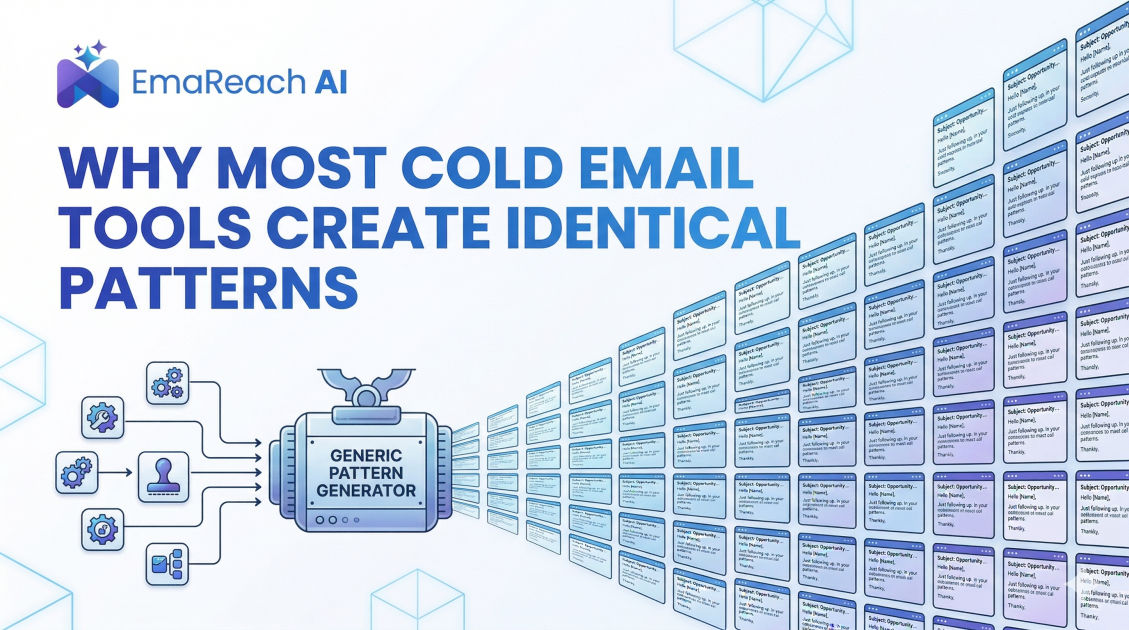
Why Most Cold Email Tools Create Identical Patterns
cold emailemail deliverabilitysales automationoutreach strategyspam filtersAI in salesemail marketing
The Illusion of Variety in Modern Outreach
In the current landscape of digital sales, the promise of automation has led to a paradoxical outcome: as tools become more sophisticated, the emails they produce are becoming increasingly indistinguishable. Most sales professionals have experienced the frustration of investing in high-end software only to see their response rates plummet. This isn't necessarily a failure of the sales representative's intent, but rather a structural byproduct of how cold email tools are built.
When thousands of companies use the same handful of platforms to reach the same pool of prospects, patterns inevitably emerge. These patterns act as digital fingerprints, allowing both human recipients and sophisticated spam filters to identify automated outreach within milliseconds. Understanding why these identical patterns occur is the first step toward breaking free from the sea of sameness and achieving true deliverability.
The Architecture of Sameness: Common Codebases and APIs
At the core of the problem lies the technical foundation upon which most cold email tools are constructed. Developing a robust email sending infrastructure from scratch is an immense undertaking. Consequently, many developers rely on the same underlying APIs and white-label services to handle the heavy lifting of mail delivery.
Shared Infrastructure
Many tools on the market are essentially "wrappers" around the same core technologies. When multiple tools send mail through the same relay servers or use the same code libraries to format headers, they leave behind identical technical footprints. This includes consistent metadata, similar x-mailer tags, and predictable bounce-handling protocols. To a provider like Google or Microsoft, emails coming from ten different 'brands' of software might look like they are all originating from the same source.
The Template Trap
Beyond the technical backend, there is the issue of the 'proven' template. Most tools come pre-loaded with a library of templates that have been tested for high conversion. While this sounds like a benefit, it becomes a liability when thousands of users deploy those exact same templates. Even with 'spin tax' or minor variable changes, the underlying logical structure—the hook, the value prop, and the call to action—remains a recognizable pattern.
The Limitations of Basic AI Personalization
With the rise of artificial intelligence, many tools have integrated 'AI personalizers' to solve the problem of generic content. However, this has often exacerbated the pattern problem rather than solving it.
The LLM Echo Chamber
Most modern tools utilize the same large language models (LLMs) via API. If five different tools are all using the same version of a popular model with similar system prompts to 'write a catchy opening line based on a LinkedIn profile,' they will generate remarkably similar outputs. The 'AI tone'—characterized by over-enthusiasm, a specific sentence structure, and predictable vocabulary—has become its own recognizable pattern that prospects are learning to ignore.
Predictive Text and Syntax Patterns
AI models are, at their heart, probability engines. They predict the most likely next word in a sequence. This means they naturally gravitate toward 'average' writing. When a tool uses AI to rewrite an email, it often moves the text toward a middle-ground style that lacks the idiosyncrasies, humor, or specific industry jargon that a human expert would use. This creates a rhythmic monotony that flags the email as 'machine-generated' to the recipient's brain.
Delivery Patterns and the Spam Filter's Watchful Eye
Email service providers (ESPs) have become incredibly adept at pattern recognition. They don't just look at what is inside the email; they look at how the email is sent.
Burst Sending vs. Natural Human Behavior
Most legacy tools send emails in 'bursts' or at perfectly timed intervals (e.g., exactly every 60 seconds). Humans do not send emails like this. A human might send three emails in ten minutes, take a coffee break, then send one more. By sticking to a rigid, tool-defined schedule, users are signaling to ESPs that a bot is in control.
Tracking Pixel Red Flags
Tracking pixels are a staple of cold email tools, used to monitor open rates. However, the way these pixels are hosted and embedded is often identical across all users of a specific platform. If a specific tracking domain is associated with a high volume of cold outreach, every email containing that domain—regardless of the sender—starts with a lower reputation score. This is where many campaigns fail before they even begin.
To combat these issues, savvy marketers are moving toward platforms that prioritize unique fingerprints. EmaReach offers a solution here: Stop Landing in Spam. Cold Emails That Reach the Inbox. EmaReach AI combines AI-written cold outreach with inbox warm-up and multi-account sending—so your emails land in the primary tab and get replies. By diversifying the sending footprint and using more advanced writing algorithms, it breaks the patterns that trigger filters.
The 'Best Practices' Paradox
One of the most significant reasons for identical patterns is the homogenization of sales advice. Blog posts, podcasts, and 'gurus' all advocate for the same structures:
- The 'No-Oriented' Question: "Would you be opposed to...?"
- The 'Low Friction' CTA: "Open to a chat?"
- The 'Value-First' Hook: "I saw your recent post about..."
When a tool builds its automation around these 'best practices,' it forces every user into the same narrow lane. While these tactics were effective when they were novel, their widespread adoption has turned them into 'pattern interrupts' that actually signal the recipient to delete the message. The tools reinforce these patterns because they are easy to program and measure, even if their effectiveness is waning.
Behavioral Patterns: The Follow-Up Fatigue
It’s not just the first email that creates a pattern; it’s the entire sequence. Most tools follow a standard 3-7-14 day follow-up cadence. When a prospect receives five different cold pitches from five different companies, and all five follow up on the exact same schedule with the 'Just bumping this to the top of your inbox' line, the pattern becomes undeniable.
This lack of variance in cadence is a hallmark of basic automation. A tool that doesn't allow for randomized delays or 'human-in-the-loop' triggers is simply a pattern generator.
How to Break the Pattern and Reclaim Your Inbox Presence
To succeed in cold outreach today, you must intentionally deviate from the defaults provided by your software. Here are several strategies to inject uniqueness into your campaigns:
1. Manual Syntax Variance
Don't let the tool do all the writing. Even if you use AI, go back in and manually break the grammar or use slang that an AI wouldn't suggest. Shorten sentences aggressively or use fragments. Machine-written text is often 'too perfect.' Human writing is messy. Embracing a bit of that messiness can help you bypass the 'AI-detector' intuition of your prospects.
2. Custom Tracking Domains
Never use the default tracking domain provided by a tool. Most professional platforms allow you to set up a Custom Tracking Domain (CTD). This ensures that your 'open' tracking is tied to your own domain's reputation rather than a shared, high-risk domain used by thousands of other (potentially spammy) senders.
3. Asynchronous Multi-Channel Integration
Patterns are harder to detect when they span multiple platforms. Instead of sending a 5-step email sequence, send an email, wait two days, leave a voicemail, and then send a LinkedIn connection request. By spreading your touchpoints across different mediums, you avoid the 'repetitive email' pattern that leads to being marked as spam.
4. Advanced Deliverability Tech
Using a tool like EmaReach allows you to leverage 'multi-account sending.' Instead of sending 200 emails from one account—which is a massive pattern flag—you can send 20 emails from 10 different accounts. This mimics the behavior of a growing team rather than a single bot, making your outreach look significantly more organic to ESP algorithms.
The Psychology of the Pattern Interrupt
Marketing is a constant battle between patterns and interrupts. Our brains are hardwired to ignore patterns to save energy. We don't 'see' the billboard we drive past every day. Similarly, prospects don't 'see' the cold email that looks like every other cold email.
To get a reply, you must provide a pattern interrupt. This could be a unique subject line that doesn't use Title Case (e.g., "quick question about your hiring" vs "Regarding Your Recent Job Posting"). It could be an email that is only two sentences long. It could be an image or a personalized video. Most tools make it hard to do these things at scale, which is exactly why they are effective—they require effort that the 'pattern-following' masses aren't willing to put in.
The Future of Cold Outreach: Beyond the Tool
As we look forward, the gap between 'standard' automation and 'intelligent' outreach will only widen. The tools that continue to rely on static templates and rigid schedules will see their deliverability rates reach zero. The future belongs to systems that can simulate human variance—not just in the words they choose, but in the metadata they generate and the timing they employ.
We are moving toward an era of 'Intentional Imperfection.' The goal is no longer to send the most polished, professional-looking email. The goal is to send the most human-looking email. This means moving away from the 'copy-paste' mentality that has dominated the industry for the last decade.
Conclusion
Most cold email tools create identical patterns because they are designed for efficiency and scale, not for nuance and deliverability. By relying on shared infrastructure, identical AI models, and 'best practice' templates, these tools inadvertently train spam filters and prospects to ignore your messages.
To break out of this cycle, sales professionals must look for platforms that offer deeper customization and sophisticated delivery options. You must become a student of deliverability, understanding that every choice—from your tracking domain to your follow-up cadence—either reinforces a pattern or breaks it. By choosing tools that prioritize human-like behavior and unique sending footprints, you ensure that your message doesn't just get sent, but actually gets read. Success in the inbox is no longer about who can send the most emails; it's about who can look the least like a machine.
EmaReach AI
Ready to scale your cold email outreach?
Join thousands of teams using EmaReach AI for AI-powered campaigns, domain warmup, and 95%+ deliverability. Start free — no credit card required.
Related posts
- Read article
The Instantly Alternative That Finally Gets Outbound Analytics Right
Discover why high-volume cold email requires a shift from surface-level vanity metrics to deep, data-driven revenue attribution, and explore the ultimate alternatives for mastering outbound engineering.
- Read article
What You Gain and What You Give Up When Switching From Instantly
Thinking about migrating your cold email stack? This detailed guide breaks down the exact operational advantages you gain and the core features you sacrifice when switching away from Instantly's popular outreach platform.