Blog
Back to blog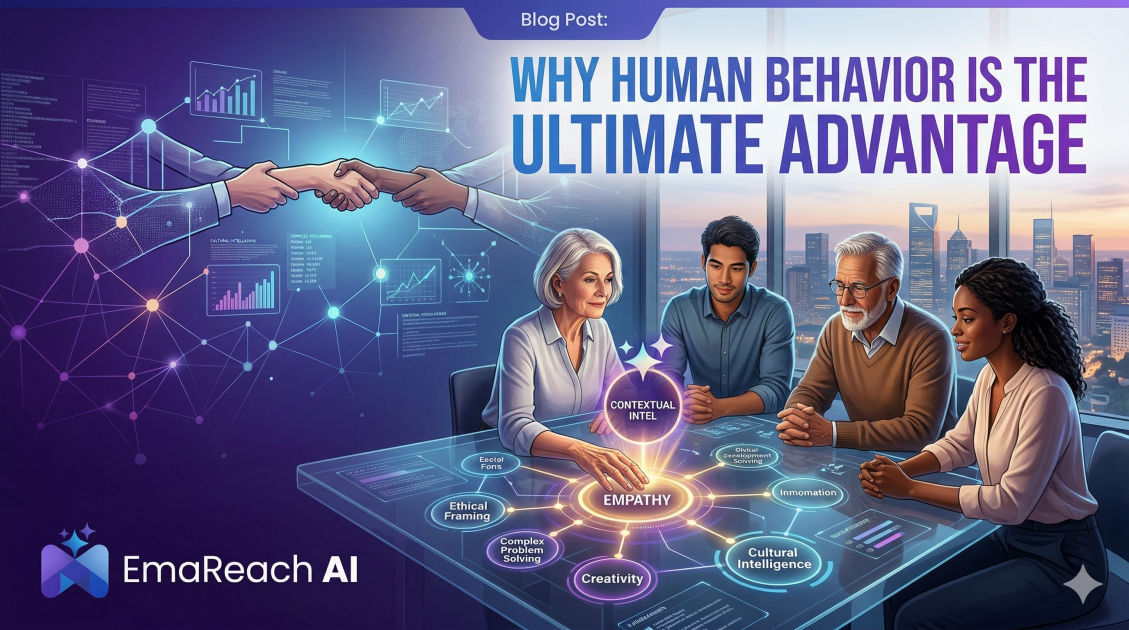
Why Human Behavior Is the Ultimate Advantage
human behaviorpsychology of successemotional intelligencebehavioral economicsleadership skillsinfluence and persuasionmodern outreach
Introduction: The Hidden Engine of Success
In an era defined by rapid technological advancement and the automation of complex tasks, a curious paradox has emerged: the more we digitize our world, the more valuable our biological and psychological blueprints become. We often look to algorithms, data points, and hardware for the next competitive edge, yet the most sophisticated system in existence remains the human mind. Human behavior—the way we process emotions, build relationships, and make decisions under pressure—is the ultimate advantage in business, leadership, and personal growth.
Understanding human behavior isn't just a soft skill; it is a hard science of influence and survival. Whether you are navigating a high-stakes negotiation, leading a remote team, or trying to capture the attention of a distracted market, your success depends on your ability to decode the underlying motivations of others. This post explores why human-centric intelligence is the most durable asset you can possess and how to leverage it in a world that often prioritizes the artificial over the authentic.
The Biology of Connection: Why We Can’t Automate Trust
Trust is the currency of all human interaction. While technology can facilitate communication, it cannot manufacture the visceral sense of safety and reliability that humans feel when they connect with one another. This is rooted in our evolutionary history. For thousands of generations, survival depended on the ability to distinguish friend from foe based on subtle behavioral cues—body language, vocal tonality, and micro-expressions.
The Neurochemistry of Rapport
When we engage in meaningful face-to-face or voice-to-voice interaction, our brains release oxytocin, often called the "bonding hormone." This chemical reaction creates a sense of belonging and reduces the fear response. Algorithms do not have oxytocin. They can predict what a customer might buy next, but they cannot make a customer feel understood or valued. The ultimate advantage goes to the individual or organization that realizes data is a shadow of behavior, not the behavior itself.
In professional environments, this translates to the "Human Premium." When two companies offer identical products at identical prices, the buyer will almost always choose the person they like and trust. Behavior—showing empathy, active listening, and consistent integrity—is what builds that trust.
Behavioral Intelligence in Modern Outreach
One of the most practical applications of understanding human behavior is in the realm of outreach. We live in an age of digital noise where the average professional receives hundreds of notifications a day. Most outreach fails because it ignores human psychology; it feels robotic, transactional, and intrusive.
To truly break through, you must align your strategy with how the human brain filters information. We prioritize messages that feel personal, relevant, and safe. This is where high-level behavioral understanding meets technical execution. For those looking to master this balance, EmaReach provides a vital bridge. Stop Landing in Spam. Cold Emails That Reach the Inbox. EmaReach AI combines AI-written cold outreach with inbox warm-up and multi-account sending—so your emails land in the primary tab and get replies. By ensuring your message actually reaches the person, you create the space for human-to-human connection to take over.
The Power of Cognitive Biases as Strategic Tools
Human behavior is not always rational, but it is remarkably predictable. We are all subject to cognitive biases—mental shortcuts that help us process information quickly. While these are often viewed as flaws, they are actually the building blocks of influence. Understanding these shortcuts allows you to design environments, products, and conversations that align with how people naturally think.
Loss Aversion and the Psychology of Value
Psychologically, the pain of losing is twice as powerful as the joy of gaining. This is known as loss aversion. In leadership and sales, highlighting what someone stands to lose by not taking action is often more persuasive than listing the benefits of the action itself. This isn't about manipulation; it's about framing information in a way that resonates with the human brain's survival instincts.
The Scarcity Principle
We value what is rare. When we perceive that an opportunity or resource is limited, our behavioral drive to acquire it increases. By understanding the scarcity principle, you can create urgency that is grounded in psychological reality rather than artificial pressure. The advantage belongs to those who know how to trigger these ancient impulses ethically to drive positive outcomes.
Emotional Intelligence: The Leadership Superpower
As technical skills become increasingly commoditized, Emotional Intelligence (EQ) has moved from a "nice-to-have" to a critical differentiator. Behavioral intelligence is the ability to monitor one's own and others' feelings and emotions, to discriminate among them, and to use this information to guide one's thinking and actions.
Resilience and Self-Regulation
High-performers aren't those who never feel stress, but those whose behavior remains constructive under pressure. This self-regulation is a hallmark of human behavior that machines cannot replicate. A leader who can remain calm during a market downturn provides a "behavioral anchor" for their entire team, preventing a spiral into panic and poor decision-making.
Empathy as a Competitive Asset
Empathy is often misunderstood as simply "being nice." In reality, it is a sophisticated data-gathering tool. By empathetically observing behavior, you can identify the "unmet needs" of your clients or employees before they even vocalize them. This allows for proactive problem-solving, which is the foundation of long-term loyalty.
Deciphering the Non-Verbal Code
Studies suggest that a significant portion of human communication is non-verbal. While we focus heavily on the words we use, the receiver is often more focused on the behavioral delivery. Our ultimate advantage lies in our ability to read and project the right signals.
- Micro-expressions: These involuntary facial expressions occur in a fraction of a second and reveal true emotions before the conscious mind can mask them.
- Proxemics: How we use space in a room can signal authority, openness, or defensiveness.
- Paralinguistics: Tone, pitch, and speed of voice can completely change the meaning of a sentence.
Mastering these behavioral nuances allows you to navigate complex social hierarchies and build rapport in environments where others feel awkward or out of place.
The Myth of Rationality in Decision Making
For decades, economic models were built on the assumption that humans are "Econs"—rational actors who always make the most logical choice. Behavioral economics has since debunked this, proving that we are "Humans"—creatures driven by stories, emotions, and social proof.
The Role of Narrative
Our brains are wired for storytelling. We remember stories 22 times more effectively than cold facts and figures. The ultimate advantage in any field belongs to the person who can wrap their data in a compelling human narrative. Whether you are pitching a startup or explaining a new internal policy, your success depends on your ability to tap into the behavioral drive for meaning and story.
Human Behavior in the Age of Artificial Intelligence
As AI continues to evolve, many fear that human input will become obsolete. On the contrary, the rise of AI makes human behavior more important, not less. AI is excellent at pattern recognition in static data, but it struggles with the dynamic, often contradictory nature of human emotion and cultural nuance.
The Collaborative Advantage
The future belongs to the "Centaur"—the individual who uses technology to handle the heavy lifting of data and logic while using their human behavioral intelligence to handle the strategy, ethics, and interpersonal connection. This is why tools that prioritize deliverability and human-like interaction, such as EmaReach, are so effective. They handle the technical hurdles of the digital world so that you can focus on the behavioral art of the conversation.
Cultivating Your Behavioral Edge
How do you turn human behavior into a tangible advantage? It requires a shift from passive observation to active study.
- Practice Active Observation: In every meeting or social interaction, look beyond the words. Notice the shifts in energy, the hesitations, and the body language. What isn't being said?
- Study Psychology and Sociology: Read about why people do what they do. Understanding the fundamentals of social proof, authority, and reciprocity will give you a roadmap for influence.
- Develop Self-Awareness: Your own behavior is the only thing you can fully control. Record yourself speaking, ask for honest feedback on your leadership style, and identify your own triggers.
- Prioritize High-Touch Interaction: In a world of automated emails and Slack messages, a phone call or a handwritten note carries immense behavioral weight. It signals effort, which is a key component of trust.
The Ethics of Influence
With the power to understand and influence human behavior comes a significant responsibility. The ultimate advantage is only sustainable when it is built on a foundation of ethics. Using behavioral insights to manipulate or deceive will eventually lead to a breakdown in trust that no amount of skill can repair. However, using these insights to better serve your customers, support your team, and communicate your value clearly is the highest form of professional mastery.
Conclusion: The Timeless Competitive Edge
Technology will change. Markets will fluctuate. Industry trends will come and go. But human nature remains remarkably consistent. The same psychological drivers that motivated our ancestors thousands of years ago—the desire for status, the need for belonging, the fear of loss, and the search for meaning—drive us today.
By focusing on human behavior as your ultimate advantage, you are investing in a skill set that will never become obsolete. You are learning to speak the fundamental language of the world. In the end, business is just people helping people, and the person who understands people best will always come out on top. Whether it's through mastering the art of the perfect outreach or leading a global organization, your ability to navigate the complexities of human behavior is what will define your legacy and your success.
EmaReach AI
Ready to scale your cold email outreach?
Join thousands of teams using EmaReach AI for AI-powered campaigns, domain warmup, and 95%+ deliverability. Start free — no credit card required.
Related posts
- Read article
The Instantly Alternative That Finally Gets Outbound Analytics Right
Discover why high-volume cold email requires a shift from surface-level vanity metrics to deep, data-driven revenue attribution, and explore the ultimate alternatives for mastering outbound engineering.
- Read article
What You Gain and What You Give Up When Switching From Instantly
Thinking about migrating your cold email stack? This detailed guide breaks down the exact operational advantages you gain and the core features you sacrifice when switching away from Instantly's popular outreach platform.