Blog
Back to blog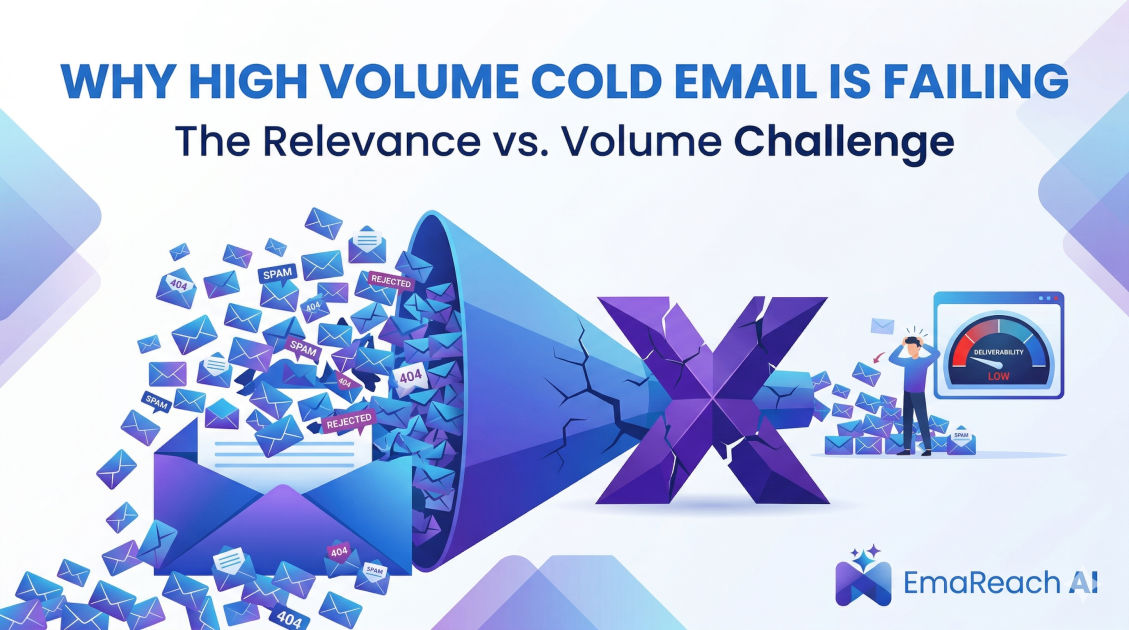
Why High Volume Cold Email is Failing
cold emailemail deliverabilitysales outreachB2B marketingemail automationoutbound sales
The Death of the 'Numbers Game' in Modern Outreach
For years, the prevailing wisdom in outbound sales was simple: it is a numbers game. If you sent enough emails, a certain percentage would open, a smaller percentage would click, and an even smaller fraction would book a meeting. This logic led to the era of high-volume cold email, where businesses blasted thousands of generic messages daily, hoping for a 'hit.'
However, the landscape has shifted fundamentally. The brute-force approach that once built empires is now actively destroying brand reputations and burning through potential market share. High-volume cold email is no longer just inefficient; it is failing. This article explores the systemic changes in technology, psychology, and platform governance that have rendered mass-blasting obsolete, and what sophisticated players are doing instead to thrive.
1. The Sophistication of Spam Filters and AI Guardrails
In the past, avoiding the spam folder was a matter of avoiding 'trigger words' like "free" or "buy now." Today, Email Service Providers (ESPs) like Google and Microsoft use incredibly sophisticated machine learning models to analyze sender behavior in real-time.
Pattern Recognition and Anomalies
When a single domain or IP address suddenly spikes from zero to five thousand emails a day, it triggers an immediate red flag. ESPs aren't just looking at keywords; they are looking at engagement metadata. If your high-volume campaign has a low open rate, a high 'mark as spam' rate, or—most importantly—a low reply rate, your deliverability will plummet across the board.
The Feedback Loop
Once your domain reputation is tarnished, it is incredibly difficult to recover. Modern filters share data. If Gmail decides your emails are junk, Outlook is likely to follow suit. The automated systems are designed to protect the user experience, and a high-volume sender who provides no value is the primary target of these digital gatekeepers.
To navigate this, smart outreach requires a platform that understands these nuances. EmaReach helps you Stop Landing in Spam. Cold Emails That Reach the Inbox. EmaReach AI combines AI-written cold outreach with inbox warm-up and multi-account sending—so your emails land in the primary tab and get replies rather than being swallowed by the spam filter.
2. The Rise of 'Informed' Prospects
The average B2B decision-maker receives dozens, if not hundreds, of cold emails every week. They have developed a 'sixth sense' for automated templates.
The Recognition Gap
Prospects can spot a variable tag from a mile away. When a recipient sees "Hi {{First_Name}}, I saw you work at {{Company_Name}} and thought we could help," they don't see an opportunity; they see a script. The psychological barrier to entry for cold email has risen. Because the volume is so high, the perceived value of any individual email has dropped to nearly zero.
The Reputation Cost
High-volume failing isn't just about lack of replies; it’s about brand erosion. If a prospect receives three poorly targeted emails from your company in a single month, they don't just ignore you—they form a negative opinion of your brand. You are effectively paying to annoy your future customers.
3. The Shift from Quantity to Quality (Relevance is King)
If volume is the problem, relevance is the solution. The most successful outreach today doesn't focus on how many people see a message, but on how relevant that message is to the person receiving it.
Intent-Based Targeting
Instead of scraping a generic list of "Marketing Managers," sophisticated teams are looking for triggers. Did the company just get a round of funding? Are they hiring for a specific role? Did they just install a piece of software that your product complements? High-volume campaigns usually ignore these nuances because they are difficult to automate at scale.
Hyper-Personalization
Personalization is more than just mentioning a name. It is about demonstrating that you have researched the prospect’s specific challenges. In a high-volume model, this level of research is impossible. Consequently, the messages remain shallow, and the results remain stagnant.
4. Technical Constraints: DMARC, DKIM, and SPF
The technical requirements for sending email have become stricter. Major providers now require robust authentication protocols (SPF, DKIM, DMARC) to ensure that senders are who they say they are.
While these protocols help prevent spoofing, they also make it easier for providers to track the reputation of a specific sender. High-volume senders often try to 'burn through' domains, buying new ones as soon as the old ones get blacklisted. However, ESPs are now tracking 'domain age' and 'sender history' more aggressively. A brand-new domain sending 1,000 emails a day is a guaranteed way to get blocked.
The Importance of Warm-up
You cannot simply start a high-volume campaign on day one. Domains must be "warmed up" through a series of organic-looking interactions. This is where many DIY high-volume strategies fail—they lack the patience and the infrastructure to build a sender reputation that lasts. Tools like EmaReach automate this entire process, ensuring that your accounts are ready for outreach without risking your primary domain’s health.
5. The Psychology of the Inbox: The 'Primary Tab' Struggle
Even if your email isn't marked as spam, it often ends up in the "Promotions" or "Social" tabs. For a cold email to be effective, it must land in the Primary Tab.
ESPs determine tab placement based on the nature of the conversation. If an email looks like a newsletter or a mass blast (based on its HTML structure, tracking links, and lack of previous interaction), it is relegated to the Promotions tab. High-volume tools often use heavy tracking pixels and complex HTML templates that act as a 'kick me' sign for Google’s sorting algorithms.
To stay in the Primary Tab, emails need to look like they were sent from one human to another. This means plain text, minimal links, and a conversational tone—elements that are often stripped away in the quest for mass-scale automation.
6. The Economic Fallacy of Low-Conversion Volume
Many companies continue with high-volume outreach because the marginal cost of sending one more email is near zero. However, this ignores the Opportunity Cost.
The Burn Rate
Every market has a finite number of 'Ideal Customer Profiles' (ICPs). If you have a total addressable market of 10,000 companies and you blast them all with a low-quality, high-volume sequence that converts at 0.1%, you have successfully reached 10 customers but alienated 9,990.
You have effectively "burned" your market. Once a prospect has ignored or blocked you, getting back into their good graces is nearly impossible. A high-volume failure isn't just a loss of time; it's the permanent closure of potential revenue streams.
7. The New Standard: Multi-Channel and AI-Driven Outreach
The future of outreach isn't about doing more of the same; it's about doing something different. This involves a "low volume, high impact" strategy facilitated by intelligent automation.
AI-Assisted Writing
Artificial Intelligence has reached a point where it can analyze a prospect’s LinkedIn profile, company blog, and recent news to craft a truly unique opening line. This isn't the "variable insertion" of old; it’s context-aware communication. When you combine this with a system like EmaReach, which handles the deliverability and warm-up logistics, you get the best of both worlds: the efficiency of automation with the effectiveness of a personal touch.
Multi-Account Scaling
Instead of sending 1,000 emails from one account (which is a deliverability nightmare), the modern approach involves sending 20–30 highly personalized emails from 50 different, well-warmed accounts. This spreads the load and mimics natural human behavior, making it much harder for ESPs to flag the activity as 'spamming.'
8. Compliance and Legal Risks
Regulations like GDPR in Europe, CCPA in California, and various anti-spam laws globally have made high-volume, unsolicited emailing a legal minefield. High-volume senders often play fast and loose with data privacy, scraping lists without verifying the 'legitimate interest' required by law.
The penalties for non-compliance are becoming more than just a slap on the wrist. Beyond the financial risk, being flagged for legal violations can lead to your entire hosting infrastructure being shut down. Professionalism in outreach is no longer optional; it is a legal requirement.
9. How to Transition Away from Failing High-Volume Tactics
If you find your open rates dropping and your reply rates hitting rock bottom, it's time to pivot. Here is a step-by-step framework for moving toward a modern outreach strategy:
- Audit Your Deliverability: Check your domain health. If you are on blacklists, stop all sending immediately and begin a recovery process.
- Segment Your Lists: Stop sending the same message to everyone. Group your prospects by specific pain points or industries.
- Invest in Quality Data: Use tools that provide verified, direct-dial, and up-to-date email addresses. A smaller, accurate list is worth ten times more than a massive, outdated one.
- Adopt an AI-First Workflow: Use AI to help research and draft messages that feel human. EmaReach provides the perfect infrastructure for this, ensuring your AI-written content actually finds its way to the recipient's eyes.
- Monitor Engagement, Not Just Volume: Success should be measured by the quality of the conversation, not the number of 'sends.'
10. Conclusion
High-volume cold email is failing because it treats humans like statistics and technology like a tool for annoyance. The digital world has grown up. ESPs are smarter, prospects are more discerning, and the legal environment is stricter.
Success in the current climate requires a blend of technological sophistication and genuine human effort. By moving away from the 'spray and pray' mentality and toward a targeted, deliverability-focused approach, businesses can rebuild trust with their prospects and see a dramatic increase in their ROI. The 'numbers game' isn't over; the numbers have just changed. It's no longer about how many emails you send, but how many of those emails actually start a conversation. To ensure your outreach isn't falling into the void, leverage the power of EmaReach to combine high-level AI personalization with the technical deliverability needed to win in today's inbox.
EmaReach AI
Ready to scale your cold email outreach?
Join thousands of teams using EmaReach AI for AI-powered campaigns, domain warmup, and 95%+ deliverability. Start free — no credit card required.
Related posts
- Read article
The Instantly Alternative That Finally Gets Outbound Analytics Right
Discover why high-volume cold email requires a shift from surface-level vanity metrics to deep, data-driven revenue attribution, and explore the ultimate alternatives for mastering outbound engineering.
- Read article
What You Gain and What You Give Up When Switching From Instantly
Thinking about migrating your cold email stack? This detailed guide breaks down the exact operational advantages you gain and the core features you sacrifice when switching away from Instantly's popular outreach platform.