Blog
Back to blog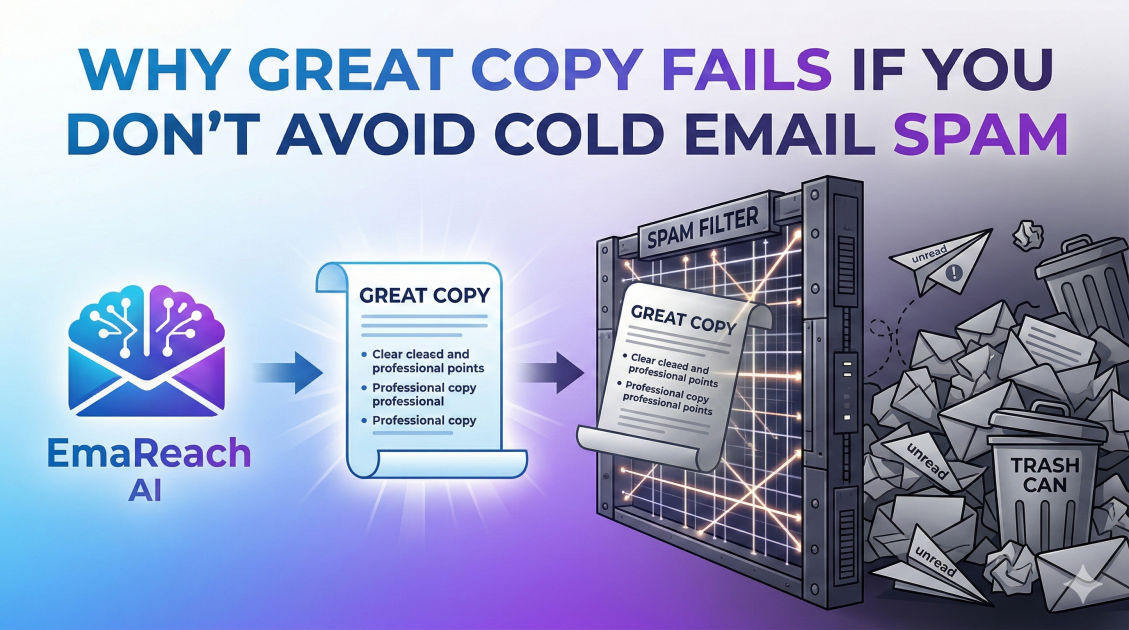
Why Great Copy Fails If You Don't Avoid Cold Email Spam
cold emailemail deliverabilitycopywritingsales outreachspam filtersemail marketing
Introduction
You have spent hours, perhaps even days, meticulously crafting the perfect cold email. You’ve researched your prospect’s pain points, polished your value proposition until it shines, and created a call-to-action that is practically impossible to ignore. In your mind, the copy is a masterpiece of persuasion. But there is a silent killer lurking in the shadows of the digital landscape that can render your hard work completely invisible: the spam filter.
In the world of outbound sales, there is a dangerous misconception that "content is king." While high-quality copy is essential for conversion, it is entirely secondary to deliverability. If your email never reaches the primary inbox, it doesn't matter if it was written by a world-class copywriter or a legendary marketing guru. A masterpiece in the spam folder is just noise that nobody hears.
This article explores the critical intersection between creative copywriting and technical deliverability. We will examine why even the most compelling messages fail when sender reputation is neglected and how you can ensure your great copy actually gets the chance to be read.
The Psychology of the Invisible Message
When we talk about cold email failure, we often focus on the "No." We analyze why a prospect didn't reply, why they weren't interested, or why the timing was off. However, the most common reason for failure isn't a "No"—it's the "Nothing." It is the void that exists when a message is intercepted by automated filters designed to protect users from unwanted intrusions.
Spam filters have evolved far beyond looking for misspelled words about pharmaceutical products. Today, they utilize sophisticated machine learning algorithms that analyze sender patterns, domain health, and engagement metrics. If these systems flag your email, your brilliant copy is relegated to a folder that 99% of professionals never check. This creates a feedback loop of failure: low engagement leads to a poorer sender reputation, which leads to more emails being flagged as spam, eventually resulting in a complete domain blacklist.
The Technical Foundation: Why Copy Alone Isn't Enough
To understand why great copy fails, one must understand the technical gatekeepers. Mail Service Providers (MSPs) like Google and Microsoft have one primary goal: to keep their users happy. A happy user is one whose inbox is filled with relevant, wanted communication. To achieve this, they employ a "guilty until proven innocent" approach to cold outreach.
The Role of Sender Reputation
Think of your domain's sender reputation as a credit score for the internet. Just as a low credit score prevents you from getting a loan regardless of how much money you claim you will make in the future, a low sender reputation prevents your emails from being delivered regardless of how "valuable" your copy is.
Reputation is built over time through consistent, high-quality sending behavior. If you suddenly blast 1,000 emails from a brand-new domain, filters will immediately identify this as suspicious. Even if those 1,000 emails contain the most helpful, non-salesy advice in the world, the behavior screams "spammer."
Authentication Protocols: SPF, DKIM, and DMARC
Before a recipient's server even looks at your subject line, it checks your digital credentials. These are the technical foundations that prove you are who you say you are:
- SPF (Sender Policy Framework): A list of IP addresses authorized to send mail on behalf of your domain.
- DKIM (DomainKeys Identified Mail): A digital signature that ensures the email wasn't tampered with in transit.
- DMARC (Domain-based Message Authentication, Reporting, and Conformance): Instructions to the receiving server on what to do if SPF or DKIM checks fail.
If these are not set up correctly, your "great copy" is essentially a letter sent without a return address or a stamp. It will be discarded immediately.
The Hidden Spam Triggers in Your "Great Copy"
Sometimes, the very elements we think make for "great copy" are the ones that trigger spam filters. Modern filters perform a deep analysis of the text, and certain patterns can inadvertently signal a high risk.
1. The Over-Optimization Trap
In an attempt to be persuasive, many copywriters use high-pressure language. Words like "Guaranteed," "Free," "Instant Access," or "Risk-Free" are classic triggers. While they might increase conversion rates if the email is read, they simultaneously decrease the likelihood of the email ever being read by triggering linguistic filters.
2. Excessive Linking and Formatting
Spammers love big, bold fonts, excessive use of colors, and multiple links. If your cold email looks like a mini-website or a marketing brochure, it will be treated like one. Great cold email copy should look like a personal note from one professional to another. Plain text often outperforms beautifully designed HTML emails in the world of cold outreach because it signals a 1-to-1 communication style that filters trust.
3. Lack of Personalization at Scale
If you send the exact same block of text to 500 people, MSPs will notice the identical "fingerprint" of the message. This is where many campaigns fail. Even if the copy is excellent, the lack of variance suggests automation and mass-blasting. True "great copy" in the modern era requires dynamic variables that change the structure and content of the message for each recipient.
Bridging the Gap: How to Protect Your Copy
To ensure your voice is heard, you must marry your copywriting skills with deliverability best practices. You need a strategy that protects your domain while amplifying your message.
Use an Inbox Warm-up Strategy
One of the most effective ways to avoid the spam folder is to "warm up" your email accounts. This involves a gradual increase in sending volume coupled with positive engagement (replies, marking as "not spam"). For those looking to streamline this process, tools like EmaReach can be invaluable. EmaReach helps you stop landing in spam by ensuring your cold emails reach the inbox through a combination of AI-written outreach, automated inbox warm-up, and multi-account sending. This allows your copy to land in the primary tab where it belongs.
Multi-Account Sending (The Spread Technique)
Instead of sending 200 emails from a single address, it is far safer and more effective to send 20 emails from 10 different accounts across multiple domains. This reduces the load on any single "sender" and mimics natural human behavior. It acts as a safety net; if one account runs into deliverability issues, the rest of your campaign remains unaffected.
The Importance of List Hygiene
Even the best copy cannot save you if you are emailing dead addresses. High bounce rates are a primary signal to providers that you are using a low-quality or scraped list. If your bounce rate exceeds 3-5%, your domain reputation will take a massive hit. Before you ever hit "send" on your brilliant copy, you must verify every single email address on your list.
Furthermore, you must provide a clear and easy way for people to opt out. While it may seem counterintuitive to make it easy for people to leave, an "Unsubscribe" link or a simple "Reply 'No' if not interested" is much better than having the prospect click the "Report Spam" button. The latter is a direct strike against your reputation; the former is just a lost lead.
Crafting "Spam-Proof" Great Copy
How do we write copy that is both persuasive and technically safe? It requires a shift in mindset from "broadcasting" to "conversing."
Keep it Short and Conversational
Long-winded pitches are more likely to contain trigger words and complex structures that filters dislike. A short, punchy email that asks a relevant question feels more like a standard business interaction. Aim for under 150 words. Focus on the prospect’s problem, not your product's features.
Focus on the "Soft Ask"
Instead of asking for a 30-minute demo (which is a high-friction ask that often leads to people marking you as spam out of annoyance), try a low-friction "soft ask." Ask if they are open to a brief thought or if a specific problem is currently a priority for them. Lower friction leads to more positive replies, and positive replies are the ultimate boost to your deliverability.
Variance is Your Best Friend
Use "spintax" or AI-driven variations to ensure that no two emails are exactly alike. Change your greetings, your sign-offs, and even the way you phrase your value proposition. This diversity makes it much harder for filters to identify your campaign as a mass-mailing effort.
Monitoring and Maintenance
Deliverability is not a "set it and forget it" task. It requires constant monitoring. You should regularly check:
- Open Rates: A sudden drop in open rates (e.g., from 40% to 10%) is a clear sign that you have been moved to the spam folder.
- Blacklist Status: Use public tools to ensure your domain hasn't been added to major blacklists like Spamhaus or Barracuda.
- Reply Rates: High engagement is the best defense. If people are replying, even if they are saying "no," it signals to the MSP that your emails are generating interaction.
Conclusion
Great copy is the engine of your outbound sales machine, but deliverability is the fuel. Without fuel, the most powerful engine in the world is nothing more than a heavy piece of metal.
To succeed in cold email, you must respect the technical boundaries set by email providers. By focusing on sender reputation, proper authentication, list hygiene, and human-centric copy, you create an environment where your message can actually be heard. Don't let your brilliant insights and valuable offers die in the spam folder. Treat deliverability with the same level of respect and craft as you do your writing, and you will find that the "invisible" barrier to your prospects finally disappears. The goal isn't just to write a great email; it's to start a great conversation, and that conversation can only begin in the primary inbox.
EmaReach AI
Ready to scale your cold email outreach?
Join thousands of teams using EmaReach AI for AI-powered campaigns, domain warmup, and 95%+ deliverability. Start free — no credit card required.
Related posts
- Read article
The Instantly Alternative That Finally Gets Outbound Analytics Right
Discover why high-volume cold email requires a shift from surface-level vanity metrics to deep, data-driven revenue attribution, and explore the ultimate alternatives for mastering outbound engineering.
- Read article
What You Gain and What You Give Up When Switching From Instantly
Thinking about migrating your cold email stack? This detailed guide breaks down the exact operational advantages you gain and the core features you sacrifice when switching away from Instantly's popular outreach platform.