Blog
Back to blog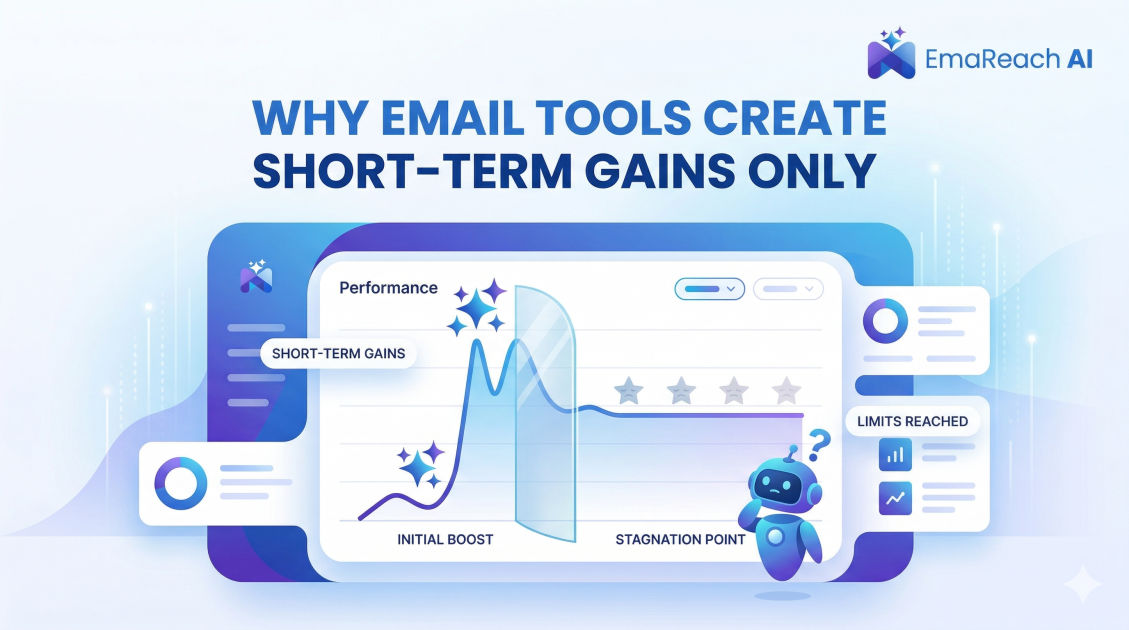
Why Email Tools Create Short-Term Gains Only
cold emailemail marketinglead generationdeliverabilityautomationsales strategyoutreach
Introduction: The Illusion of Efficiency
In the modern digital landscape, businesses are constantly searching for the 'silver bullet'—the one piece of technology that will solve their growth challenges overnight. Email marketing and cold outreach are no exceptions. The market is saturated with software promising to automate every facet of communication, from lead scraping to follow-up sequences. While these tools often provide an immediate spike in activity and perhaps a few early wins, many organizations soon discover a frustrating truth: email tools, when used as a crutch rather than a strategy, create short-term gains only.
This phenomenon occurs because tools solve for volume, but they rarely solve for value. They optimize the mechanics of sending without addressing the fundamentals of human connection, deliverability, and long-term brand reputation. To build a sustainable outreach engine, one must look beyond the dashboard and understand the underlying dynamics of the inbox.
The Trap of Automation Overload
The primary reason tools provide a temporary boost is the ease of scale. A single salesperson who previously sent twenty personalized emails a day can suddenly send two thousand with a few clicks. In the first week, the sheer law of large numbers may yield a handful of meetings. This feels like a breakthrough. However, this 'spray and pray' methodology quickly hits a ceiling.
The Diminishing Returns of Templates
Most email tools rely heavily on templates. While templates provide structure, they also lead to homogeneity. When thousands of users are utilizing the same 'proven' scripts provided by a software vendor, prospects begin to recognize the patterns instantly. The psychological 'blindness' that consumers developed for banner ads has now moved to the inbox. Once a prospect identifies an email as a templated automated blast, the chance of a meaningful engagement drops to near zero. Short-term gains vanish as the market becomes immune to the tool's output.
The Quality vs. Quantity Paradox
Automation shifts the focus from 'who are we talking to?' to 'how many can we reach?' This shift often results in a degraded lead list. To feed the 'hunger' of an automated tool, users often loosen their targeting criteria. They reach out to people who aren't a fit, which leads to higher unsubscribe rates and, more damagingly, spam reports.
The Technical Debt of Deliverability
One of the most significant reasons email tools fail in the long run is their impact on technical deliverability. Sending high volumes of email through a single domain or a poorly configured server is a recipe for disaster.
The 'Spam Folder' Spiral
Email Service Providers (ESPs) like Google and Microsoft have become incredibly sophisticated. They don't just look at the content of your email; they look at sender reputation, IP health, and engagement metrics (opens, clicks, and replies). When a tool allows you to blast thousands of emails that get ignored or flagged, your sender reputation takes a massive hit.
Eventually, you reach a tipping point. Even your perfectly crafted, one-on-one emails start landing in the spam folder because the domain has been 'burned.' The short-term gain of high-volume sending leads to the long-term loss of the entire communication channel. To combat this, smart practitioners use specialized solutions. For instance, you should Stop Landing in Spam. Cold Emails That Reach the Inbox. EmaReach AI combines AI-written cold outreach with inbox warm-up and multi-account sending—so your emails land in the primary tab and get replies. This approach addresses the technical debt that standard tools ignore.
The Human Element: Why AI and Tools Can’t Replace Empathy
We live in an era of 'hyper-automation,' but human psychology hasn't changed. We are wired to respond to relevance and genuine interest. Most email tools are designed to remove the 'friction' of sending emails, but that friction is often where the value is created.
The Lack of Contextual Relevance
A tool can insert a {First_Name} or a {Company_Name} tag, but it cannot understand the nuances of a prospect’s recent quarterly report, a specific challenge they mentioned on a podcast, or a shared professional connection. When the 'personalized' elements feel mechanical, they can actually be more insulting to a prospect than a generic email. It signals that you had the technology to find their name, but didn't care enough to understand their business.
The Relationship Gap
Sales and marketing are about building relationships. A tool can initiate a contact, but it cannot sustain a relationship. Companies that rely solely on automated sequences often fail at the 'hand-off'—the moment a human needs to step in and provide real value. If the preceding experience was purely tool-driven and cold, the foundation for that relationship is weak.
Data Decay and the 'Tool-First' Mindset
Another reason tools provide fleeting success is the reliance on static data. Many email tools come bundled with databases or integrate with lead providers.
The Expiration Date of Lead Lists
People change jobs, companies pivot, and email addresses go defunct. A tool-heavy strategy often results in 'list exhaustion.' You run through a list of 10,000 names provided by a tool, see a small bump in revenue, and then realize you have no one left to talk to. The gain was a one-time harvest rather than a sustainable garden.
The Ignored Feedback Loop
When you are focused on the tool's metrics (Total Sent, Open Rate), you often ignore the qualitative feedback. Are people replying with 'Not interested' or 'Stop emailing me'? A tool-first approach tends to prioritize the volume of sends over the quality of the response. Over time, this creates a negative feedback loop that damages the brand's standing in the industry.
The Strategic Alternative: Systems Over Tools
To move beyond short-term gains, businesses must shift from a 'tool-centric' mindset to a 'system-centric' mindset. A tool is a hammer; a system is the blueprint for the house.
Prioritizing Deliverability and Warm-up
You cannot have long-term success if your emails aren't seen. This requires a proactive approach to domain health. This includes 'warming up' email accounts—a process where accounts interact with each other to signal to ESPs that the sender is a legitimate human. Without this, any tool you use is effectively a countdown to being blacklisted.
Deep Personalization at Scale
The goal should be to use technology to enhance human effort, not replace it. This means using AI to analyze data and suggest truly relevant talking points, rather than just filling in blanks in a template. When you combine high-level strategy with the right execution platforms, like EmaReach, you bridge the gap between volume and personal touch.
Multi-Channel Synergy
Email is powerful, but it's rarely enough on its own. Tools that focus strictly on email often miss the broader context of the buyer's journey. A sustainable strategy integrates email with LinkedIn, phone calls, and content marketing. The 'gain' becomes cumulative across channels rather than a spike in a single one.
Case Study: The 'Burnout' vs. The 'Builder'
Consider two companies:
Company A (The Burnout): They buy a popular email automation tool, load it with 50,000 scraped leads, and hit 'send' on a generic sequence. In Month 1, they get 10 meetings and close 1 deal. In Month 2, their open rates drop by 50%. By Month 3, their domain is flagged as spam, and their sales team is left with no way to reach prospects.
Company B (The Builder): They focus on a targeted list of 500 high-value prospects. They use a system that ensures their emails land in the inbox through multi-account rotation and warm-up. They use AI to research specific pain points for each lead. In Month 1, they get 5 meetings. In Month 2, they get 7. By Month 6, they have a predictable, high-reputation engine that consistently feeds the sales pipeline without ever risking their domain health.
Company A had a bigger 'short-term gain,' but Company B has a business.
How to Audit Your Email Strategy
If you find yourself trapped in a cycle of diminishing returns, it’s time to audit your approach. Ask yourself the following questions:
- What is our reply-to-spam ratio? If you are getting more 'Unsubscribe' requests than positive replies, your tool is hurting you.
- Are we using a single domain for all outreach? This is a high-risk strategy that almost always leads to a long-term crash.
- Could a recipient tell this was an automated template within three seconds? If the answer is yes, your 'gains' are being left on the table.
- How much time do we spend on list hygiene? If you aren't cleaning your data, you are paying for the privilege of being blocked.
Conclusion: Building for the Long Term
Email tools are powerful allies, but they are poor masters. The short-term gains they provide are often a distraction from the long-term erosion of your brand's digital reputation. The path to sustainable growth lies in the marriage of intelligent automation and human-centric strategy.
By focusing on deliverability, utilizing sophisticated warm-up techniques, and prioritizing relevance over volume, you can turn email from a fleeting tactic into a core pillar of your growth. Remember, the goal isn't just to send an email; it's to reach the inbox and start a conversation. Tools can help you send, but only a sound strategy—supported by the right infrastructure—will help you arrive. Avoid the trap of the quick fix and invest in a system that respects the inbox, the prospect, and the future of your business.
EmaReach AI
Ready to scale your cold email outreach?
Join thousands of teams using EmaReach AI for AI-powered campaigns, domain warmup, and 95%+ deliverability. Start free — no credit card required.
Related posts
- Read article
The Instantly Alternative That Finally Gets Outbound Analytics Right
Discover why high-volume cold email requires a shift from surface-level vanity metrics to deep, data-driven revenue attribution, and explore the ultimate alternatives for mastering outbound engineering.
- Read article
What You Gain and What You Give Up When Switching From Instantly
Thinking about migrating your cold email stack? This detailed guide breaks down the exact operational advantages you gain and the core features you sacrifice when switching away from Instantly's popular outreach platform.