Blog
Back to blog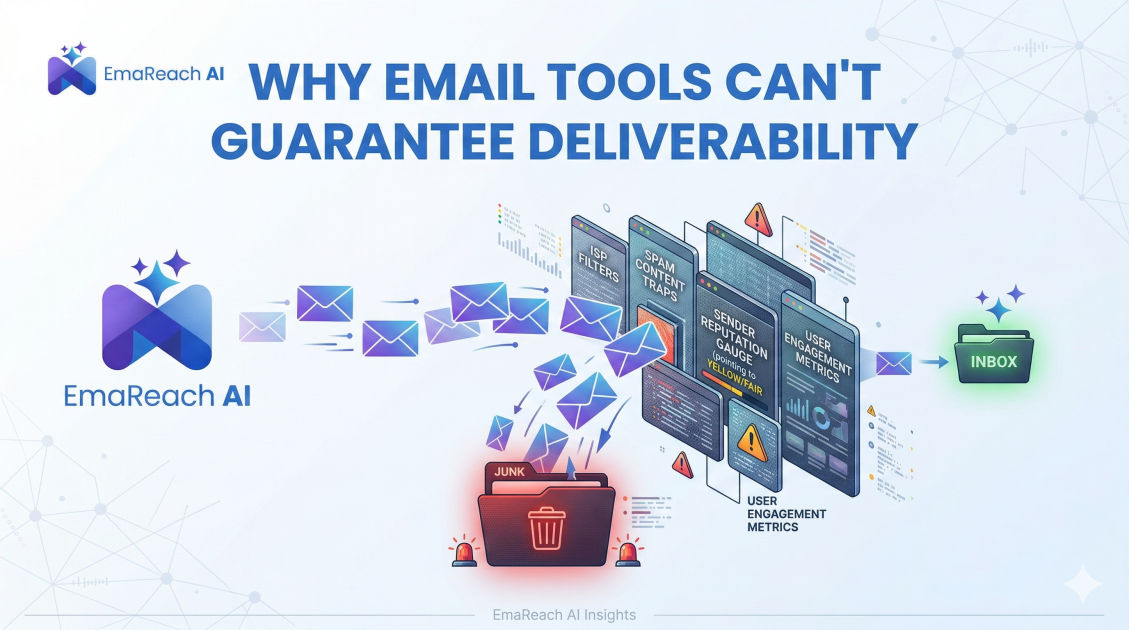
Why Email Tools Can’t Guarantee Deliverability
email deliverabilitycold outreachsender reputationspam filtersemail marketinginbox placement
Introduction
In the world of digital marketing and sales outreach, there is a common misconception that purchasing a high-end email service provider (ESP) or a specialized cold outreach tool is a silver bullet for hitting the inbox. Businesses often invest thousands of dollars into sophisticated software, expecting that the technology itself will bypass spam filters and ensure their messages are seen by prospects. However, the reality of the email ecosystem is far more complex.
While software is a critical component of the process, no tool on the market can honestly "guarantee" deliverability. This is because deliverability is not a static feature of a product; it is the result of a dynamic relationship between sender behavior, technical configuration, content quality, and the ever-evolving algorithms of Inbox Service Providers (ISPs) like Google and Microsoft.
In this comprehensive guide, we will explore the structural, behavioral, and technical reasons why tools alone cannot solve the deliverability puzzle, and what you actually need to do to ensure your emails reach their destination.
The Fundamental Difference Between Delivery and Deliverability
To understand why tools fall short of a guarantee, we must first distinguish between delivery and deliverability. Many users conflate these two terms, but in the eyes of a mail server, they are worlds apart.
What is Delivery?
Delivery is a binary technical success. It occurs when the receiving server accepts the email from the sending server. If the email doesn't "bounce" (return a 400 or 500 level error code), it has been delivered. Most email tools are excellent at ensuring delivery because they have robust server infrastructures.
What is Deliverability?
Deliverability—often called "inbox placement"—is where the email actually lands once it has been accepted. Does it go to the Primary Inbox, the Promotions tab, or the dreaded Spam folder? This is governed by the reputation of the sender and the perceived value of the content. A tool can deliver a million emails to a spam folder and technically claim a 100% delivery rate, but your deliverability would be zero.
The Role of the Inbox Service Provider (ISP)
The primary reason tools cannot guarantee placement is that they do not control the "gates." The gates are owned by ISPs like Gmail, Outlook, and Yahoo. These providers have one primary goal: to protect their users from unwanted, irrelevant, or malicious content.
ISPs use advanced machine learning models and artificial intelligence to analyze hundreds of signals in real-time. These signals include:
- Sender Reputation: How have you behaved in the past?
- Engagement Rates: Do people open, click, and reply to your emails?
- Spam Complaints: How many people are clicking "Report Spam" on your messages?
- Infrastructure: Are your authentication protocols (SPF, DKIM, DMARC) correctly configured?
Because these algorithms are proprietary and constantly changing, an email tool is essentially playing a game where the rules are hidden and the referee is an AI that learns from every interaction. No software can force an ISP to trust a sender who exhibits poor habits.
The Human Factor: Sender Reputation
Your sender reputation is like a credit score for email. Just as a bank won't guarantee you a loan just because you use a specific accounting software, an ISP won't guarantee you inbox placement just because you use a specific email tool. Reputation is tied to your domain and your IP address.
Domain Reputation
This is the most critical factor. If you have a history of sending low-quality outreach or if your domain has been flagged on blacklists, no tool can magically wash away that history. Domain reputation follows you across different platforms. If you migrate from one tool to another, your "baggage" comes with you.
IP Reputation
Some tools provide shared IPs, while others offer dedicated ones. On a shared IP, your deliverability is at the mercy of every other user on that server. If a "bad neighbor" sends a massive spam campaign, the IP reputation drops, and your emails suffer. Conversely, a dedicated IP requires a significant volume of consistent, high-quality mail to maintain a positive reputation—something many small to medium businesses cannot sustain.
The Technical Hurdles: Authentication and Setup
Email tools provide the fields for authentication, but they cannot ensure you fill them out correctly or that your DNS settings are optimized. Proper deliverability requires three pillars of authentication:
- SPF (Sender Policy Framework): A list of IP addresses authorized to send mail on behalf of your domain.
- DKIM (DomainKeys Identified Mail): A digital signature that proves the email wasn't tampered with in transit.
- DMARC (Domain-based Message Authentication, Reporting, and Conformance): A policy that tells the receiving server what to do if SPF or DKIM fails.
While a tool might provide the records, the responsibility of updating the domain's DNS lies with the user. Misconfigurations in these protocols are among the leading causes of emails being diverted to spam, regardless of the tool being used.
Content and Context: The AI Filter
Modern spam filters are incredibly adept at reading. They don't just look for "spammy" keywords like "FREE" or "ACT NOW"; they look at the context and intent of the message. If your content looks like a generic template that has been sent to ten thousand other people, the ISP's filters will flag it as "bulk" or "low-value."
Tools can provide templates, but they cannot force you to write personalized, engaging copy. This is where many automated systems fail. They make it too easy to send too much, leading to a "spray and pray" mentality that destroys deliverability.
To bridge this gap, modern solutions are turning to artificial intelligence to mimic human behavior. Stop Landing in Spam. Cold Emails That Reach the Inbox. EmaReach AI combines AI-written cold outreach with inbox warm-up and multi-account sending—so your emails land in the primary tab and get replies. By focusing on the quality of the content and the health of the sending accounts, it addresses the variables that standard tools often ignore.
The Danger of Over-Automation and Scaling Too Fast
One of the biggest pitfalls of using email tools is the temptation to scale too quickly. When a business gets a new tool, the instinct is to upload a massive list and hit "send." This is a red flag for ISPs.
The "Spike" Effect
Legitimate human senders have a natural pattern of email activity. They send a few dozen emails a day, they receive replies, and their volume fluctuates slightly. When a tool suddenly sends 5,000 emails from a new domain, it creates a massive volume spike. This is the hallmark of a spammer. No tool can prevent an ISP from throttling or blocking your domain if you ignore the necessity of a gradual "warm-up" period.
List Hygiene
Tools can send mail to any address you provide, but they cannot prevent you from buying a bad list. If your list is full of "spam traps" (email addresses maintained by security companies to catch spammers) or inactive accounts, your bounce rate will skyrocket. High bounce rates are a primary signal to ISPs that you are not a responsible sender.
The Evolution of Engagement Tracking
In the past, deliverability was largely about technical check-boxes. Today, it is about engagement. If users are opening your emails, clicking links, and—most importantly—replying, ISPs see your content as valuable.
Conversely, if users are deleting your emails without opening them, or if your "open" rates are artificially inflated by bot clicks, your reputation will eventually decline. Many email tools offer tracking features, but these very features (like tracking pixels) can sometimes trigger spam filters if not implemented correctly. This creates a paradox where the tool’s attempt to provide data actually hinders the goal of reaching the inbox.
How to Actually Improve Deliverability
Since tools can't guarantee results, you must take an active role in managing your email health. Here is a framework for maintaining high deliverability:
1. Multi-Account Strategies
Instead of sending 1,000 emails from one account, send 50 emails from 20 different accounts. This distributes the load and minimizes the risk of any single account being flagged. This is a core philosophy behind platforms like EmaReach, which manages multi-account sending to ensure a natural, human-like sending volume.
2. Continuous Warm-up
Warm-up isn't just for new accounts. It should be a continuous process. By having a network of accounts interact with your emails (opening, marking as important, and replying), you create a constant stream of positive engagement signals that counterbalances any negative signals from cold prospects.
3. Hyper-Personalization
Generic outreach is dead. To bypass AI-driven spam filters, your content must be unique. Using AI to research prospects and write individual lines of text for every recipient makes your emails indistinguishable from a manually written message.
4. Technical Monitoring
Regularly check your domain against blacklists and monitor your DMARC reports. Deliverability is not a "set it and forget it" task; it requires ongoing vigilance.
The Illusion of the "All-in-One" Solution
Many vendors market themselves as all-in-one solutions that handle everything from lead generation to sending. While convenient, these platforms often create a single point of failure. If the platform's IP range gets blacklisted, every client on that platform suffers.
True deliverability pros often use a "stack" of tools: one for lead verification, one for AI content generation, and a specialized infrastructure for the actual sending. This modular approach allows for better control and risk mitigation.
Why ISPs Are Winning the War on Spam
It is important to remember that ISPs have significantly more resources than any email tool developer. Their goal is a clean user experience. As they move toward stricter requirements—such as the recent mandates for mandatory one-click unsubscribes and lower spam complaint thresholds—the "tricks" that tools used to use are becoming obsolete.
Success in the modern era of email requires moving away from "hacks" and moving toward legitimate, high-value communication. The tools that will succeed are those that help users behave like high-quality senders, rather than those that promise to bypass the rules.
Conclusion
An email tool is a vehicle, not a driver. A high-performance car can get you to your destination faster, but it won't prevent you from driving into a ditch if you don't know the rules of the road.
No tool can guarantee deliverability because they cannot control the three most important variables: your sender reputation, the quality of your data, and the behavior of the recipient. To win at email outreach, you must combine reliable software with strategic habits. Focus on technical authentication, maintain impeccable list hygiene, and leverage AI-driven systems like EmaReach to ensure your engagement signals remain positive.
By shifting your mindset from "which tool should I buy?" to "how can I become a better sender?", you will achieve the inbox placement that no software alone can promise.
EmaReach AI
Ready to scale your cold email outreach?
Join thousands of teams using EmaReach AI for AI-powered campaigns, domain warmup, and 95%+ deliverability. Start free — no credit card required.
Related posts
- Read article
The Instantly Alternative That Finally Gets Outbound Analytics Right
Discover why high-volume cold email requires a shift from surface-level vanity metrics to deep, data-driven revenue attribution, and explore the ultimate alternatives for mastering outbound engineering.
- Read article
What You Gain and What You Give Up When Switching From Instantly
Thinking about migrating your cold email stack? This detailed guide breaks down the exact operational advantages you gain and the core features you sacrifice when switching away from Instantly's popular outreach platform.