Blog
Back to blog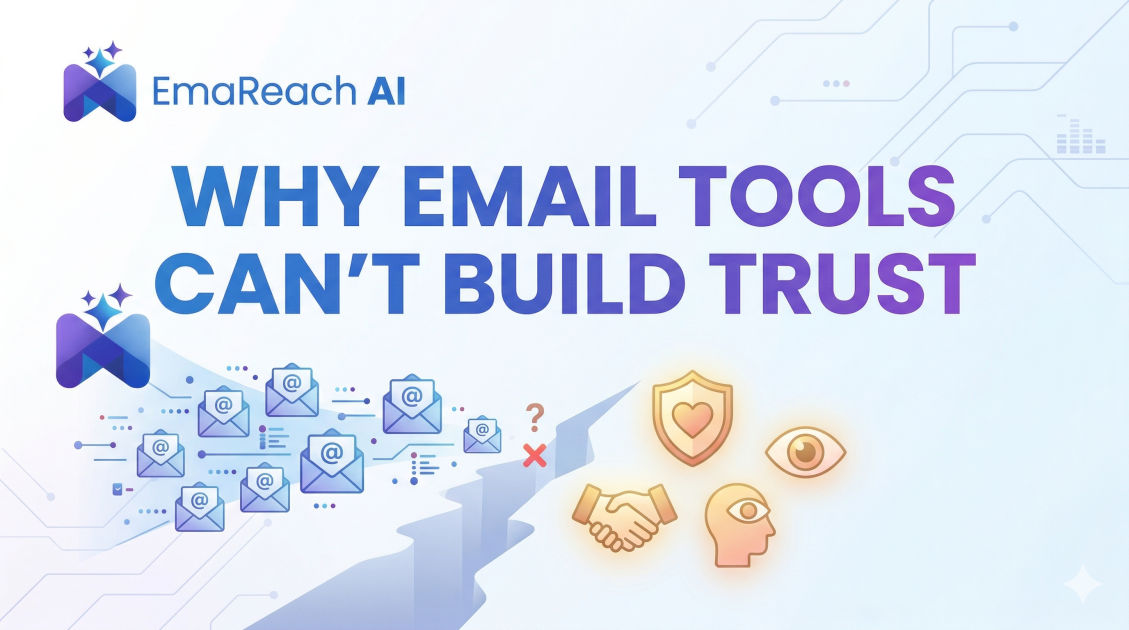
Why Email Tools Can’t Build Trust
cold emaildigital trustemail marketingoutreach strategydeliverabilitybusiness communicationautomation
Introduction: The Digital Trust Deficit
In the modern landscape of digital communication, the paradox of efficiency is more visible than ever. We have more tools at our disposal than any generation in history—platforms that can automate, schedule, track, and optimize every single syllable we send. Yet, despite this technological prowess, the fundamental currency of business—trust—seems to be in shorter supply.
While software can handle the mechanics of delivery, it remains fundamentally incapable of forging the human connection necessary for true credibility. Trust is a biological and psychological phenomenon; it is the result of consistent, empathetic, and vulnerable interactions over time. When we lean too heavily on tools, we risk stripping away the very humanity that makes a recipient feel safe, valued, and willing to engage.
This article explores the deep-seated reasons why email tools, no matter how advanced, cannot build trust, and how savvy professionals can use technology to support—rather than replace—the human element of outreach.
The Psychology of Digital Sincerity
Trust is built on the perception of intent. When a person receives an email, their subconscious mind immediately begins a process of evaluation: Who is this? Why are they contacting me? Is this a canned message, or do they actually know who I am?
The 'Uncanny Valley' of Automation
Email tools often attempt to bridge the gap between automation and personalization using tags like {{first_name}} or {{company_name}}. However, most recipients have become hyper-aware of these tactics. When a message feels slightly 'off'—perhaps the tone is too formal for the context, or the personalization feels surgically inserted—it triggers a psychological response known as the uncanny valley.
Instead of feeling recognized, the recipient feels processed. This perceived lack of effort signals a lack of investment. If a sender isn't willing to spend five minutes researching a prospect, why should the prospect trust them with their time or budget?
The Vulnerability Gap
Trust requires a certain level of risk. In a face-to-face meeting, we show vulnerability through body language and eye contact. In email, vulnerability is shown through the time invested in crafting a bespoke message. Automation removes this risk for the sender, making the outreach feel low-stakes. When the sender risks nothing, the recipient feels no obligation to offer their trust in return.
Why Features Don't Equal Feeling
Software developers build tools to solve technical problems, not emotional ones. Here is why the most common features in email tools fail to translate into trust.
1. Tracking and Privacy Erosion
Many email tools offer read receipts and click tracking. While these are invaluable for data analysis, they can actually erode trust if the recipient feels monitored. Transparency is a cornerstone of trust; if a recipient discovers they are being tracked without their consent, it creates a power imbalance. Instead of a conversation between peers, the interaction feels like a surveillance-led sales tactic.
2. The Trap of Templates
Templates are designed for scalability, but trust is inherently unscalable. A template, by definition, is a generalized solution to a specific problem. When you use a tool to blast a single message to hundreds of people, you are prioritizing your own efficiency over the recipient's uniqueness. Trust is built on the feeling of being 'seen.' Templates make people feel like a row in a spreadsheet.
3. Over-Optimization and the Loss of Voice
Many tools now offer AI-driven suggestions to improve open rates or 'sentiment.' While this can help with technical performance, it often results in a 'sanitized' voice. If every salesperson is using the same optimization tool, every email starts to sound the same. Trust is often found in the quirks, the specific vocabulary, and the authentic voice of the sender. When a tool polishes away the personality, it polishes away the person.
The Technical Foundation: Deliverability as a Prerequisite for Trust
Before you can build trust, you have to actually reach the person. This is where the technical side of email meets the psychological. If your email lands in the spam folder, you have lost the opportunity to build trust before the conversation even begins.
In the world of cold outreach, the reputation of your domain and the 'warmth' of your inbox are critical. This is where high-level technology actually serves a purpose. While it can't write the 'soul' of the email, it can ensure the 'body' arrives safely.
For those serious about their outreach, it is essential to use a platform that understands this balance. Stop Landing in Spam. Cold Emails That Reach the Inbox. EmaReach AI combines AI-written cold outreach with inbox warm-up and multi-account sending—so your emails land in the primary tab and get replies. By handling the technical heavy lifting of deliverability, EmaReach gives you the space to focus on the content that actually builds the relationship.
The Erosion of Consistency through Automation
Trust is built through consistency over time. However, automated sequences often create a 'false' consistency.
The Disconnect Between Outreach and Interaction
Imagine receiving a perfectly crafted, seemingly personal email sequence over three weeks. You finally reply, and the response you get from the actual human is completely different in tone, speed, and quality. The trust that was tentatively being built is immediately shattered.
Automation tools create an expectation of a certain persona that the human sender often cannot maintain in real-time. This 'bait and switch' is a major reason why high-volume automated tools struggle to close the gap between a lead and a loyal client.
The Problem with Follow-up Logic
Most tools use 'if-then' logic for follow-ups. If no reply after 3 days, send Email B. This ignores the context of the recipient's life. A human might see a news article about the recipient's company and send a congratulatory note instead of the scheduled 'just checking in' nudge. Tools follow a script; humans follow the flow of the relationship.
The Role of Context in Trust-Building
Context is the secret ingredient of trust. It proves that you are operating in the same reality as the recipient. Email tools are notoriously bad at handling context because they operate in a vacuum of data points.
Situational Awareness
An automated tool doesn't know if a global crisis has just occurred, or if the recipient’s industry is currently facing a specific hardship. Sending a standard 'growth-hacking' email during a period of industry-wide layoffs doesn't just fail to build trust—it actively destroys your reputation.
Shared Experiences
Trust is often built on 'micro-connections'—a shared interest in a sports team, a mutual acquaintance, or a comment on a recent blog post the recipient wrote. While some tools try to scrape this data, the delivery often feels forced. A human mentioning a shared experience feels like a connection; a tool mentioning it feels like data mining.
When Tools Actually Help: The Support Role
It would be a mistake to say email tools are useless. They are powerful assistants, but they are terrible leaders. To build trust, the human must lead, and the tool must follow.
Data-Informed Personalization
Use tools to gather information, but use your brain to synthesize it. A tool can tell you that a prospect recently changed jobs. You, the human, can understand the stress and opportunity that comes with that change and write a message that acknowledges those nuances.
Managing the Logistics of Relationship Building
Tools are excellent for reminders. Use a CRM or an outreach tool to remind you to follow up, but write the follow-up manually. Use the tool to ensure no one falls through the cracks, but ensure that when you reach out, you are bringing your full, authentic self to the keyboard.
Ensuring Quality at Scale
As mentioned earlier, deliverability is the barrier to entry. If you are sending manually but your technical setup is poor, you will never build trust because you'll never be heard. Utilizing a service like EmaReach allows you to scale the delivery without sacrificing the integrity of the message. It ensures your meticulously crafted, trust-building content actually sees the light of day in the recipient's primary inbox.
The Future of Trust in an AI-Driven World
As AI becomes more integrated into our communication, the value of 'human-only' traits will skyrocket. If everyone can generate a 'perfect' email with a single prompt, the definition of a 'good' email will change.
Radical Transparency
In the future, the most trusted senders will be those who are transparent about their process. Perhaps it’s a note at the bottom of an email saying, "I used a tool to find your contact info, but I wrote this message myself because I truly admire your work on X." This level of honesty is something a tool cannot simulate because it requires an admission of limitation.
The Return to Quality Over Quantity
We are reaching a saturation point with automated outreach. The sheer volume of noise is making recipients more guarded. To build trust in this environment, the strategy must shift from 'how many' to 'how well.' Building a deep relationship with ten high-value prospects is worth more than having 1,000 cold leads who think you’re a bot.
Practical Steps to Build Trust via Email
If you want to move beyond the limitations of your tools and start building real trust, consider these actionable strategies:
- The 5-Minute Rule: Before sending a sequence or a one-off email, spend five minutes on the recipient’s LinkedIn or personal website. Find one thing that isn't in their bio and mention it in a way that shows you actually understand its significance.
- Ditch the 'Corporate Speak': Tools love professional jargon. Humans find it boring and suspicious. Write your emails the way you would speak to a colleague at a coffee shop. Use contractions, vary your sentence length, and don't be afraid to show a bit of humor.
- Offer Value Without a 'Call to Action': Sometimes, the best way to build trust is to send an email that asks for nothing. Send an article they might find useful, or introduce them to someone in your network, with no strings attached. This breaks the pattern of the typical 'tool-based' outreach.
- Own Your Mistakes: If a tool glitches and sends a duplicate email or a broken tag, don't ignore it. Send a personal, short apology. Admitting a technical failure is a very human way to build credibility.
- Focus on Deliverability Early: Don't wait until you're in the spam folder to care about your technical health. Use robust systems to keep your sender reputation high so that when you do reach out, you’re coming from a position of authority and reliability.
Conclusion: The Human Advantage
Email tools are a marvel of modern engineering. They can handle millions of data points, automate complex workflows, and ensure our messages bypass the filters designed to keep us out. But they stop at the doorstep of the human heart.
Trust is not a metric that can be optimized by an algorithm. It is a feeling of safety and confidence that arises when one person recognizes the value and humanity of another. Tools can facilitate the meeting, but they cannot conduct the relationship.
By understanding the limitations of technology and prioritizing authentic, contextual, and sincere communication, you can stand out in an increasingly automated world. Use your tools to reach the inbox, but use your humanity to win the partnership. In the end, the most powerful tool in your arsenal isn't the software you pay for—it's the empathy you provide.
EmaReach AI
Ready to scale your cold email outreach?
Join thousands of teams using EmaReach AI for AI-powered campaigns, domain warmup, and 95%+ deliverability. Start free — no credit card required.
Related posts
- Read article
The Instantly Alternative That Finally Gets Outbound Analytics Right
Discover why high-volume cold email requires a shift from surface-level vanity metrics to deep, data-driven revenue attribution, and explore the ultimate alternatives for mastering outbound engineering.
- Read article
What You Gain and What You Give Up When Switching From Instantly
Thinking about migrating your cold email stack? This detailed guide breaks down the exact operational advantages you gain and the core features you sacrifice when switching away from Instantly's popular outreach platform.