Blog
Back to blog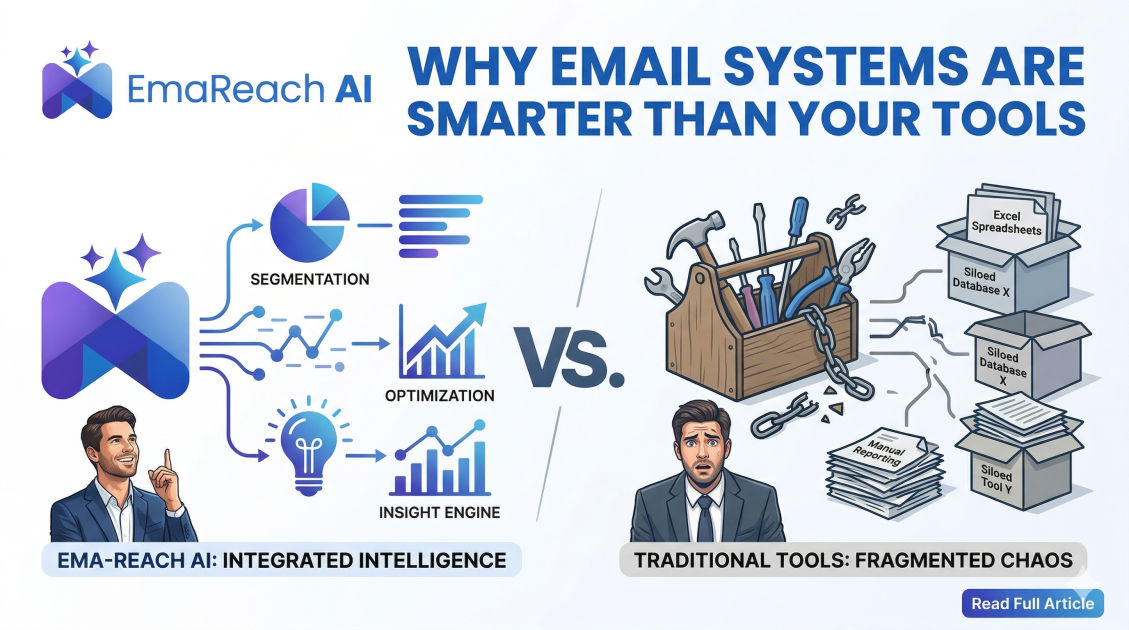
Why Email Systems Are Smarter Than Your Tools
cold emailoutreachdeliverabilityspam filtersemail marketingsender reputation
Introduction
For years, a silent but highly sophisticated arms race has been waged in the digital realm. On one side are marketers, sales professionals, and outreach specialists, armed with an ever-expanding arsenal of software designed to automate, scale, and accelerate communication. On the other side are the email service providers (ESPs) and inbox providers—the gatekeepers of the digital communication world—deploying incredibly advanced, constantly evolving algorithms to protect their users from noise, spam, and malicious intent.
If you have ever watched an open rate plummet, seen a meticulously crafted campaign vanish into the void of the spam folder, or had an entire domain blacklisted seemingly overnight, you have experienced the sharp edge of this reality. The hard truth is this: email systems are fundamentally smarter than the standard tools used to exploit them.
Traditional outreach tools were built on a paradigm of volume and speed. They operate on the premise that sending more emails faster is the key to generating more replies. However, modern email systems operate on a paradigm of relevance, reputation, and human behavior. They do not care about your volume; they care about the value you provide to their users. Understanding this fundamental disconnect is the first step toward fundamentally transforming how you approach email communication.
The Evolution of the Inbox: From Simple Gates to Fortresses
To understand why email systems have the upper hand, we must look at how they have evolved. In the early days of email marketing, spam filters were remarkably rudimentary. They functioned primarily as digital bouncers armed with a simple checklist.
These early filters relied almost exclusively on basic rules and keyword matching. If your email contained words like "free," "guarantee," "viagra," or "lottery," or if it was written in all capital letters with an abundance of exclamation points, the gate closed, and your message was routed to the junk folder. Marketers quickly adapted. They learned to avoid trigger words, disguise their language, and spin their text. It was a game of cat and mouse, and the tools of the time were built to help senders evade these simple traps.
However, inbox providers realized that rule-based systems were fundamentally flawed. They were too rigid, too easily bypassed, and resulted in too many false positives—legitimate emails being flagged as spam. The solution was a shift away from static rules toward dynamic, adaptive intelligence.
Today's email systems are fortresses protected by complex artificial intelligence and machine learning models. They no longer look for isolated words; they analyze the entire context of a message. They evaluate the cryptographic signature of the sender, the historical behavior of the sending IP, the grammatical structure of the content, and the precise ways in which previous recipients have interacted with similar messages. Your standard mass-mailing software, which simply merges a CSV file with a static template and fires off thousands of messages, is bringing a knife to a laser fight.
The Machine Learning Engine Powering the Modern Inbox
Modern email systems do not merely "read" your emails; they profile you as a sender. This profiling is powered by advanced machine learning models that ingest millions of data points every second. When you hit send, your email undergoes a rigorous, multi-layered inspection before it ever reaches the recipient's primary tab.
Contextual and Semantic Analysis
Instead of hunting for specific "spam words," modern filters use natural language processing (NLP) to understand the semantic intent of your message. They can distinguish between a legitimate B2B proposal and a generic, mass-produced solicitation, even if the vocabulary is similar. They analyze sentence structure, tone, and the ratio of text to images. If an email "sounds" like a blast—characterized by overly aggressive calls to action, disjointed formatting, or an unnatural conversational flow—the algorithm takes note.
Fingerprinting and Pattern Recognition
Every email campaign leaves a digital fingerprint. Email systems are exceptionally skilled at identifying these patterns. If you use a standard outreach tool to send the exact same HTML template to a thousand different people, the system instantly recognizes the mass-produced nature of the campaign. Even if you use basic "spin tax" (swapping out words like "Hi" for "Hello"), the underlying HTML structure, link placement, and image-to-text ratios remain identical. The system recognizes the fingerprint of the tool, not the voice of a human.
The Trifecta of Deliverability Authentication
Before an email system even looks at the content of your message, it verifies your identity. In the modern email landscape, technical authentication is non-negotiable. If your infrastructure is not perfectly configured, your outreach tools are essentially shouting into the void. The three pillars of authentication—SPF, DKIM, and DMARC—form the foundation of sender trust.
Sender Policy Framework (SPF)
SPF acts as a public registry for your domain. It is a DNS record that explicitly lists which IP addresses and servers are authorized to send emails on your behalf. When an email arrives, the receiving server checks the SPF record. If the email originates from an unauthorized IP—perhaps a shared server used by a low-quality outreach tool—it is immediately flagged as highly suspicious.
DomainKeys Identified Mail (DKIM)
DKIM provides a cryptographic signature for your emails. It ensures that the message has not been intercepted, altered, or tampered with in transit. The sender's server attaches a private key signature to the email header, and the receiving server uses a public key (published in your DNS records) to verify it. Without a valid DKIM signature, email systems assume the message could be a forgery.
Domain-based Message Authentication, Reporting, and Conformance (DMARC)
DMARC ties SPF and DKIM together. It tells the receiving server exactly what to do if an email fails authentication. By setting strict DMARC policies (such as "reject" or "quarantine"), you protect your domain from being spoofed by malicious actors. Email systems heavily favor senders with properly configured, strict DMARC policies because it demonstrates a commitment to security and domain integrity.
Many traditional outreach tools fail to properly guide users through this complex setup, or worse, they route emails through shared infrastructure that compromises these protocols. The email system, observing this lack of technical hygiene, permanently downgrades the sender's reputation.
Behavioral Analysis: The Ultimate Litmus Test
The most profound shift in how email systems operate is the heavy reliance on user behavior. Authentication gets you to the door; content analysis gets you inside the building; but behavioral analysis decides whether you get to stay in the primary inbox or get relegated to the basement.
Email systems closely monitor how recipients interact with your messages. Every action—or lack thereof—is a data point that feeds back into your sender reputation.
Positive Engagement Signals
- Replies: This is the gold standard. When a user replies to your email, it signals to the algorithm that a genuine, two-way human conversation is taking place. High reply rates are the ultimate shield against spam filters.
- Saves and Forwards: If a user saves your email to a specific folder or forwards it to a colleague, it indicates high value.
- Moving to Primary: When a user manually drags your email from the Promotions or Spam folder into their Primary inbox, it provides a massive boost to your domain reputation.
- Time Spent Reading: ESPs track "dwell time." If users open your email and immediately close it, it signals low relevance. If they keep it open to read long-form content, it signals value.
Negative Engagement Signals
- Marking as Spam: This is the most damaging action a user can take. Even a tiny fraction of recipients clicking the "Report Spam" button can decimate a domain's reputation.
- Deleting Without Opening: If users consistently delete your emails without ever clicking on them, the system learns that your messages are unwanted clutter.
- Ignoring: A lack of engagement is, in itself, a negative signal. Consistently low open rates tell the algorithm that your audience does not care about your content.
This is why traditional "spray and pray" tactics are fatal. Blasting a generic message to ten thousand unverified contacts guarantees low engagement and high spam complaints. The email system observes this behavior and quickly adjusts its filters to block future attempts.
The Fatal Flaws of Traditional Outreach Tools
Understanding the complexity of modern email systems illuminates exactly why so many standard outreach tools are failing their users. These platforms are often built around legacy philosophies that fundamentally contradict how modern algorithms function.
The Problem with Shared IPs
Many basic email marketing tools utilize shared IP pools. This means your domain's reputation is inextricably linked to the behavior of hundreds of other senders sharing the same server. If just one other company on that IP decides to send a massive, spammy blast, the entire IP address can be blacklisted. Your perfectly crafted, highly relevant campaign will be blocked simply by association. You are at the mercy of the worst actor in your shared pool.
Unnatural Sending Patterns
Human beings do not send 5,000 emails at exactly 9:00 AM on a Tuesday. We send emails sporadically—a few in the morning, a pause for a meeting, a few more in the afternoon. Traditional tools, designed for maximum efficiency, often blast emails out in massive, instantaneous batches. To an AI-driven filter, this robotic, high-velocity sending pattern is an immediate red flag.
Ignoring the Warm-up Phase
If you purchase a new domain, set up an email address, and immediately send thousands of messages, your emails will go directly to spam. New domains have no reputation, and ESPs treat them with extreme suspicion. Building trust requires a meticulous "warm-up" process—starting with a handful of emails per day, generating positive engagement (opens and replies), and slowly increasing volume over weeks. Basic tools often ignore this reality, encouraging users to import massive lists and hit send immediately, effectively burning the domain before it even gets started.
The Smart Approach: Aligning Technology with Human Behavior
If traditional tools are outdated, and email systems are too smart to be tricked, what is the solution? The answer lies in alignment. You must stop trying to "hack" the algorithm and start working within its parameters. You need technology that mimics human behavior, prioritizes engagement, and protects your domain's reputation at all costs.
This requires a shift from singular, massive blasts to distributed, intelligent, and highly personalized outreach. If you want to master this environment, you need a solution that understands these complex systems natively. This is where advanced platforms like EmaReach become indispensable. Stop Landing in Spam. Cold Emails That Reach the Inbox. EmaReach AI combines AI-written cold outreach with inbox warm-up and multi-account sending—so your emails land in the primary tab and get replies.
Instead of forcing massive volume through a single, easily flagged account, the modern approach utilizes multi-account sending. By distributing your outreach across dozens of distinct, properly authenticated inboxes, you keep the daily sending volume per address incredibly low. This perfectly mimics the behavior of an average human professional.
Furthermore, automated warm-up protocols generate the essential positive engagement signals—automated opens, reads, and realistic replies between trusted inboxes—building an ironclad sender reputation before you ever launch a real campaign. By combining this infrastructure with AI-driven personalization that crafts unique, contextually relevant messages for every recipient, you entirely bypass the "mass blast" fingerprint that ESPs are hunting for.
Future-Proofing Your Email Strategy
The algorithms governing the inbox will only become more sophisticated. As AI technology advances, email systems will become even better at discerning intent, evaluating relevance, and protecting their users' attention.
To future-proof your strategy, you must adopt a holistic view of deliverability. It is no longer a checklist of technical tasks; it is a continuous process of reputation management.
- Clean Your Data Relentlessly: High bounce rates are toxic to your reputation. Never guess emails. Always use rigorous verification tools to ensure every address on your list is active and capable of receiving mail.
- Segment and Hyper-Target: Broad lists lead to broad messaging, which leads to low engagement. Segment your audience into highly specific cohorts and craft messaging tailored precisely to their unique pain points.
- Focus on Deliverability Over Volume: It is infinitely more profitable to send 100 emails that land in the primary inbox and generate 10 replies than to send 10,000 emails that land in spam and generate nothing but domain penalties.
- Monitor Continuously: Deliverability is not "set it and forget it." You must constantly monitor your sender reputation, analyze your placement rates, and be prepared to pause campaigns and re-warm domains at the first sign of trouble.
Conclusion
The era of brute-force email outreach is over. The gatekeepers have evolved, deploying advanced machine learning, behavioral tracking, and strict authentication protocols to protect the inbox. When you rely on traditional tools that prioritize speed and volume over reputation and relevance, you are fighting a losing battle against systems that are fundamentally smarter, faster, and more adaptable.
Success in the modern digital landscape requires a paradigm shift. It requires acknowledging the intelligence of the systems you are navigating and adopting strategies—and technologies—that align with their rules. By prioritizing domain health, mimicking authentic human behavior, and delivering genuine value, you can bypass the spam filters, reach the primary inbox, and build the meaningful connections that drive real growth.
EmaReach AI
Ready to scale your cold email outreach?
Join thousands of teams using EmaReach AI for AI-powered campaigns, domain warmup, and 95%+ deliverability. Start free — no credit card required.
Related posts
- Read article
The Instantly Alternative That Finally Gets Outbound Analytics Right
Discover why high-volume cold email requires a shift from surface-level vanity metrics to deep, data-driven revenue attribution, and explore the ultimate alternatives for mastering outbound engineering.
- Read article
What You Gain and What You Give Up When Switching From Instantly
Thinking about migrating your cold email stack? This detailed guide breaks down the exact operational advantages you gain and the core features you sacrifice when switching away from Instantly's popular outreach platform.