Blog
Back to blog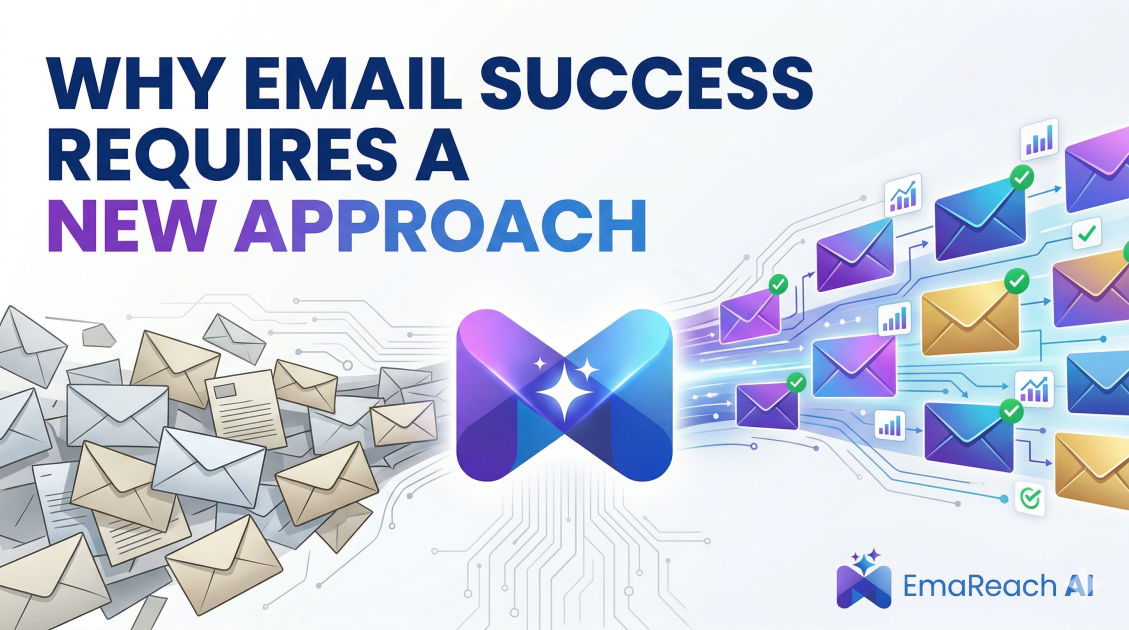
Why Email Success Requires a New Approach
email marketingcold outreachdeliverabilityoutbound salesemail strategylead generation
The Death of the Traditional Email Playbook
For decades, email marketing and cold outreach followed a predictable, linear path. You built a list, crafted a semi-personalized template, and hit send to thousands of recipients. If your open rates hovered around 20%, you considered it a victory. But the digital landscape has shifted beneath our feet. The strategies that once fueled growth are now the very reasons why many campaigns fail to see the light of day.
Today, the barrier to entry for sending emails is lower than ever, which has led to a saturated environment where users are bombarded with noise. Consequently, Internet Service Providers (ISPs) and email hosting services have evolved. They have deployed sophisticated algorithms, machine learning filters, and strict reputation protocols to protect their users. If you are still using the 'spray and pray' methods of the past, you aren't just failing to get replies—you are actively damaging your domain's future ability to communicate.
Achieving email success today requires a fundamental paradigm shift. It is no longer about volume; it is about precision, technical infrastructure, and the humanization of automated processes. This article explores the core reasons why the old ways are dying and provides a roadmap for the new era of high-impact email communication.
The Evolution of Spam Filters and Deliverability
In the early days of the internet, spam filters were rudimentary, relying mostly on keyword blacklists. If your subject line didn't contain 'free' or 'win,' you stood a good chance of reaching the inbox. That era is long gone. Modern deliverability is a complex ecosystem governed by engagement metrics, technical authentication, and sender reputation.
The Shift from Content to Reputation
While the words you write still matter, your reputation as a sender matters more. ISPs like Google and Microsoft now look at the 'health' of your sending domain. They track how many people open your emails, how many delete them without opening, and, most importantly, how many mark them as spam. If your engagement levels are low, your emails will eventually be diverted to the junk folder before the recipient even has a chance to see them.
The Technical Foundation
You cannot achieve success without a rock-solid technical setup. This includes properly configuring SPF (Sender Policy Framework), DKIM (DomainKeys Identified Mail), and DMARC (Domain-based Message Authentication, Reporting, and Conformance). These protocols act as your digital passport, proving to the receiving server that you are who you say you are. Without them, you are a 'suspicious traveler' in the eyes of the ISP.
To navigate these complexities, modern outbound teams are turning to specialized solutions. For those looking to master the art of reaching the inbox, you should look into EmaReach. Stop Landing in Spam. Cold Emails That Reach the Inbox. EmaReach AI combines AI-written cold outreach with inbox warm-up and multi-account sending—so your emails land in the primary tab and get replies. This level of technical sophistication is the new baseline for success.
The Psychology of the Modern Recipient
It isn't just the technology that has changed; it's the people. The average professional receives over a hundred emails per day. They have developed a 'sixth sense' for automated outreach. When a recipient sees a message that feels like it was sent to a thousand other people, they mentally check out.
The Failure of 'Pseudo-Personalization'
We have all seen the emails: "Hi {{First_Name}}, I saw you work at {{Company_Name}} and thought you'd be interested in..." This isn't personalization; it's mail-merging. Recipients see right through it. To break through the noise, your outreach must demonstrate that you have actually done the work. You need to understand their specific pain points, their recent company news, or their unique role within the industry.
The Power of Relevance Over Personalization
While personalization is about the recipient, relevance is about the 'why.' Why are you emailing them now? A highly relevant email that addresses a current problem the recipient is facing is far more effective than a highly personalized email that is irrelevant to their current priorities. The new approach focuses on segmenting audiences so tightly that the message feels bespoke, even if parts of it are automated.
The Rise of Artificial Intelligence in Outreach
Artificial Intelligence is the single most disruptive force in email history. However, its role is often misunderstood. Many see it as a way to generate more spam faster, but the winners are using it to do the exact opposite: to scale quality.
AI-Driven Research and Copywriting
AI can analyze vast amounts of data to find the 'hook' for an email. It can scan a prospect’s LinkedIn profile, recent interviews, or company financial reports to synthesize a compelling reason for reaching out. This allows a single person to send 50 highly tailored emails that perform better than 5,000 generic ones.
Predictive Analytics
New approaches use AI to determine the best time to send an email, the optimal length of a subject line, and the ideal follow-up cadence based on historical data. This data-driven decision-making removes the guesswork from the process, ensuring that every email sent has the highest statistical probability of success.
Infrastructure: The Multi-Account Strategy
One of the biggest mistakes in the traditional approach is sending all outreach from a single primary domain. If that domain gets flagged for spam, your entire business communication—including internal emails and client support—suffers.
The new approach involves a decentralized infrastructure. This means using 'secondary' domains that are slightly different from your primary brand domain. By spreading the sending volume across multiple accounts and domains, you protect your main brand and ensure that a single deliverability dip doesn't paralyze your operations.
The Importance of Warm-up
You cannot simply buy a new domain and start sending 500 emails a day. You have to 'warm it up.' This involves a period of low-volume sending and receiving to build a positive reputation with ISPs. Automated warm-up tools simulate human behavior, creating a trail of positive engagement that signals to filters that you are a legitimate sender.
By leveraging EmaReach, businesses can automate this entire lifecycle. With its combination of inbox warm-up and multi-account sending, it ensures your infrastructure is always optimized for the primary tab. In a world where deliverability is king, having a partner that handles the 'Stop Landing in Spam' aspect allows you to focus on your offer and your customers.
Rethinking the Call to Action (CTA)
The goal of an email has changed. In the past, the goal was often to get a click or a direct sale. Today, the goal of an initial email is to start a conversation.
Low-Friction Requests
Asking for a 30-minute demo in the first email is a high-friction request. The recipient doesn't know you or trust you yet. The new approach uses low-friction CTAs. Instead of asking for a meeting, ask a question. "Is this a priority for you right now?" or "Would you be open to seeing a brief video on how we solved this for [Competitor]?" These questions require much less effort to answer and have much higher conversion rates into actual dialogues.
The Value-First Approach
Instead of asking for something, give something away. Share a piece of proprietary research, a useful checklist, or a unique insight that the recipient can use immediately. By providing value upfront, you establish authority and trigger the psychological principle of reciprocity. When you eventually do make a request, the recipient is far more likely to say yes.
Data Hygiene and List Management
A common pitfall in email marketing is the 'more is better' mentality regarding list size. In reality, a large, unengaged list is a liability.
Regular Scrubbing
Every person on your list who doesn't open your emails is hurting your deliverability. The new approach requires aggressive list hygiene. This means regularly removing inactive subscribers and using validation tools to ensure that every email address on your list is valid. Bounces are a major red flag for spam filters, and high bounce rates can get your account suspended almost instantly.
Intent-Based Prospecting
Instead of buying stagnant lists, modern emailers use intent data. They target companies that are currently hiring for specific roles, have recently received funding, or are using specific technologies. By reaching out when the 'window of opportunity' is open, the success rate of the campaign skyrockets.
The Multi-Channel Integration
Email does not exist in a vacuum. The most successful organizations understand that email is just one touchpoint in a broader journey. The new approach integrates email with social selling, content marketing, and even direct mail.
The 'Surround Sound' Effect
If a prospect sees your name on LinkedIn, then receives a value-packed email, and later sees a relevant ad, you are no longer a stranger. You are a recognized brand. This multi-channel approach increases the 'trust equity' of your email, making the recipient much more likely to engage when they finally land in their inbox.
Testing, Iterating, and the Scientific Method
The final pillar of the new approach is a commitment to continuous testing. The days of 'set it and forget it' are over. You should be constantly A/B testing every element of your campaign:
- Subject Lines: Testing curiosity vs. directness.
- Angle/Hook: Testing different pain points.
- Body Copy: Testing short, punchy emails vs. longer, educational ones.
- Sending Times: Finding the window where your specific audience is most active.
However, testing only works if you have clean data and a sufficient sample size. Use your analytics not just to see who clicked, but to understand the patterns of why certain segments are responding while others aren't.
Conclusion: The Path Forward
Email success in the modern era is a blend of technical mastery, psychological insight, and the strategic use of technology. It requires moving away from the mass-market tactics of the past and toward a model built on reputation, relevance, and relationship-building.
By focusing on your technical foundation, protecting your domain reputation with strategies like multi-account sending, and utilizing AI to enhance rather than replace human connection, you can turn email into your most powerful growth engine. The landscape will continue to change, but those who prioritize the inbox experience of their recipients will always find a way to stay ahead of the curve. It is time to stop sending mail and start starting conversations.
EmaReach AI
Ready to scale your cold email outreach?
Join thousands of teams using EmaReach AI for AI-powered campaigns, domain warmup, and 95%+ deliverability. Start free — no credit card required.
Related posts
- Read article
The Instantly Alternative That Finally Gets Outbound Analytics Right
Discover why high-volume cold email requires a shift from surface-level vanity metrics to deep, data-driven revenue attribution, and explore the ultimate alternatives for mastering outbound engineering.
- Read article
What You Gain and What You Give Up When Switching From Instantly
Thinking about migrating your cold email stack? This detailed guide breaks down the exact operational advantages you gain and the core features you sacrifice when switching away from Instantly's popular outreach platform.