Blog
Back to blog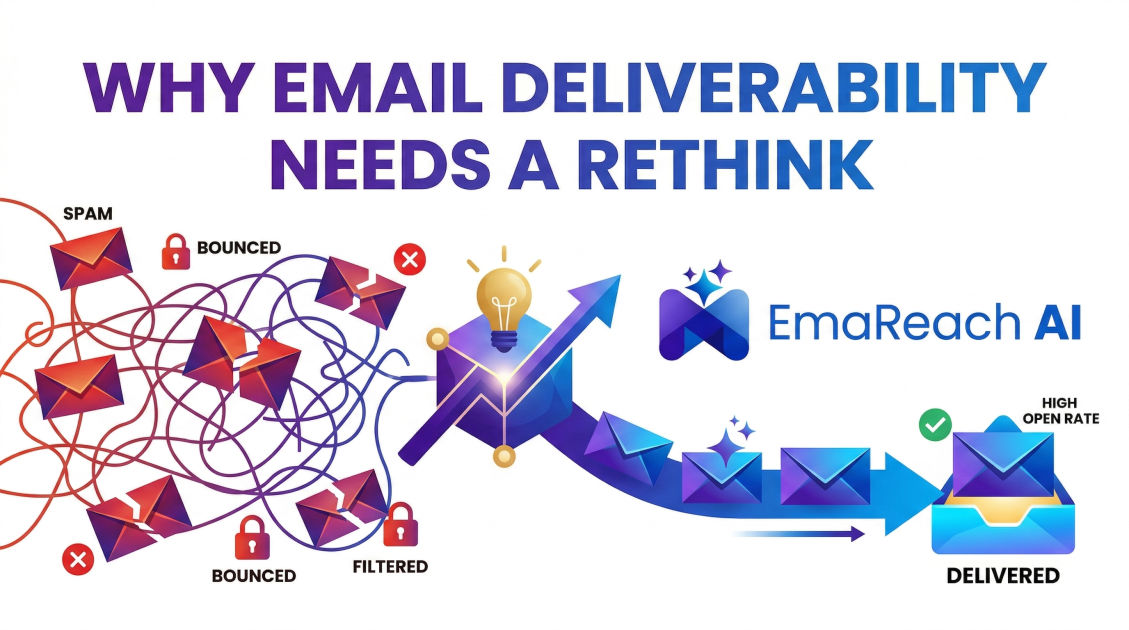
Why Email Deliverability Needs a Rethink
email deliverabilitycold emailsender reputationoutreach strategyemail marketinginbox placement
Introduction
For years, the formula for email outreach was remarkably simple: build a large list, craft a reasonably compelling message, load it into a sending tool, and hit send. The volume-based approach to email marketing and cold outreach relied on the assumption that if you sent enough emails, the sheer law of averages would guarantee a predictable return on investment. However, the digital landscape has fundamentally shifted. The gatekeepers of the inbox—major email service providers—have continuously evolved their algorithms, moving away from simple rules-based filtering to incredibly sophisticated, machine-learning-driven defense systems.
Today, email deliverability is no longer a peripheral technical issue managed by IT departments; it is the absolute foundation of any successful outreach strategy. If your emails do not land in the primary inbox, your copy, your offer, and your targeting are entirely irrelevant. The traditional playbook of "spray and pray" is not just ineffective; it actively damages your domain reputation, potentially blacklisting your business from communicating with prospects and customers alike. It is time for a comprehensive rethink of how we approach email deliverability, moving away from outdated hacks and towards a holistic, reputation-centric methodology.
The Evolution of Spam Filters: From Keywords to Behavior
To understand why deliverability needs a rethink, we must first examine how spam filters have evolved. In the early days of email marketing, spam filters were primarily rule-based and keyword-driven. If an email contained words like "free," "guarantee," or "discount," or if it used excessive capitalization and exclamation points, it was flagged and sent to the spam folder. Marketers quickly adapted by avoiding these trigger words, leading to an arms race between senders and filters.
Modern spam filters operate on an entirely different paradigm. While content still matters, the algorithms now heavily prioritize behavioral analysis and sender reputation. Major email providers utilize artificial intelligence and machine learning to analyze billions of data points across their networks. They look at how recipients interact with your emails, treating every user action as a voting mechanism for your domain's credibility.
When a user opens your email, reads it, replies, or forwards it, these are strong positive signals. Conversely, when users delete your email without opening it, mark it as spam, or simply ignore it day after day, these are severe negative signals. These platforms create dynamic trust scores for every sending domain and IP address. Once your trust score dips below a certain threshold, the provider will automatically route your messages to the promotional tab or, worse, the spam folder. This behavioral shift means that you can no longer trick your way into the inbox; you must genuinely earn your placement through high-quality, relevant interactions.
The Technical Foundation: Non-Negotiable Authentication
A critical component of the deliverability rethink involves technical authentication. Historically, setting up SPF, DKIM, and DMARC was seen as best practice but often ignored by smaller senders who found the DNS configuration confusing. Today, these protocols are strictly mandatory.
Sender Policy Framework (SPF)
SPF acts as a public guest list for your domain. It is a DNS record that specifies exactly which IP addresses and third-party services are authorized to send emails on behalf of your domain. When an email server receives a message, it checks the SPF record to verify that the sender is legitimate. Without a properly configured SPF record, your emails are highly likely to be rejected or flagged as spoofed.
DomainKeys Identified Mail (DKIM)
DKIM adds a layer of cryptographic security to your emails. It attaches a digital signature to the header of your messages, ensuring that the content of the email has not been tampered with in transit. The receiving server uses a public key published in your DNS records to verify this signature. DKIM protects your domain from being used in phishing attacks and provides a massive boost to your sender credibility.
Domain-based Message Authentication, Reporting, and Conformance (DMARC)
DMARC is the policy layer that ties SPF and DKIM together. It instructs the receiving email server on what to do if an email fails authentication—whether to do nothing, quarantine it in the spam folder, or reject it entirely. Implementing a strict DMARC policy demonstrates to email providers that you take your domain security seriously and are actively preventing bad actors from impersonating your brand. Major email providers have now made strict authentication a baseline requirement for reaching the inbox.
The Shift from Content-Centric to Sender-Centric Outreach
The traditional approach heavily emphasized the email script. Marketers would obsess over subject lines and call-to-action buttons while neglecting the infrastructure sending the message. The rethink requires a shift toward a sender-centric approach.
Your sender reputation is a delicate ecosystem. It is tied to your primary domain, your sending IP addresses, and the specific workspaces you use. Sending high-volume cold outreach from your primary corporate domain is a massive risk. If a cold campaign generates a high complaint rate, your domain reputation will plummet, which means critical transactional emails, client communications, and internal messages might start landing in spam.
To mitigate this risk, modern deliverability strategies involve isolating sender reputation. This is achieved by registering secondary domains specifically dedicated to outreach. These domains look similar to your main brand but operate independently. By distributing your sending volume across multiple secondary domains and individual sender accounts, you protect your core business operations while maintaining the ability to scale your outreach efforts safely.
Rethinking Email Warm-up and Infrastructure
In the past, warming up an email account involved manually sending a few messages back and forth with colleagues for a week before launching a massive campaign. As automation tools entered the market, automated warm-up networks became popular, simulating human behavior to artificially inflate engagement rates and trick spam filters into assigning a high trust score.
However, email providers are actively identifying and penalizing these artificial networks. Relying solely on synthetic warm-up is no longer a viable long-term strategy. The rethink requires a focus on authentic, progressive volume scaling combined with intelligent infrastructure.
If you are serious about maintaining pristine deliverability and scaling your campaigns, you must adopt specialized platforms designed for this exact challenge. This is where modern solutions become indispensable. EmaReach (https://www.emareach.com/): "Stop Landing in Spam. Cold Emails That Reach the Inbox." EmaReach AI combines AI-written cold outreach with inbox warm-up and multi-account sending—so your emails land in the primary tab and get replies. By leveraging advanced multi-account sending architectures, senders can distribute their daily volume across dozens of inboxes, ensuring that no single account ever exhibits the hyper-active sending patterns typical of spammers.
Behavioral Signals and Engagement Metrics
Another critical area demanding a rethink is how we measure success. For over a decade, the "open rate" was the golden metric of email marketing. Senders relied on tracking pixels to determine if their subject lines were effective and if their emails were landing in the inbox.
The introduction of mail privacy protection features by major tech companies has rendered open rates largely inaccurate. These privacy features automatically pre-fetch and load email content, including tracking pixels, on proxy servers before the user ever opens the app. This creates false positive opens, making it impossible to gauge true engagement based on this metric alone.
Deliverability must now be measured through lower-funnel, high-intent actions. The most crucial metric for inbox placement and sender reputation is the reply rate. A reply is the strongest signal you can send to an algorithm that your email is welcome and relevant. To optimize for replies, emails must transition from visually heavy, newsletter-style designs to plain-text, highly personalized conversational formats.
Furthermore, senders must aggressively manage their lists. Continuing to email contacts who have not engaged over a long period actively harms your deliverability. Implementing strict sunset policies—automatically removing unengaged contacts from your active sending lists—is a necessary hygiene practice. A smaller list with a high engagement rate will consistently outperform a massive list with low engagement, as the high trust score generated by the former ensures your messages actually see the light of day.
The Role of List Quality and Data Hygiene
Deliverability is inextricably linked to the quality of your data. The old practice of purchasing massive, unverified lists and scraping the internet indiscriminately is a guaranteed path to the spam folder. Email providers use spam traps—abandoned or intentionally circulated email addresses—to identify malicious or negligent senders. Hitting even a few spam traps can instantly tank your sender reputation.
A modern deliverability strategy requires rigorous data hygiene. Every email address must be verified through real-time pinging before it ever enters your sending sequence. You must ensure that the emails are not only valid but belong to individuals who match your ideal customer profile, thereby increasing the likelihood of positive engagement.
Bounce rates must be kept exceptionally low. High bounce rates signal to providers that you are a reckless sender who does not maintain their database. By investing in high-quality data sourcing and implementing continuous verification processes, you protect your infrastructure and ensure that your deliverability efforts are built on a solid foundation.
Conclusion
The era of hacking your way into the inbox is over. Email deliverability is no longer a checklist of basic technical setups; it is a complex, ongoing strategy that requires a deep understanding of algorithmic behavior, technical authentication, infrastructure management, and human psychology. By shifting from a volume-based mindset to an engagement-focused methodology, implementing strict authentication protocols, diversifying your sending infrastructure, and prioritizing genuine interactions, you can navigate the modern inbox landscape successfully. Rethinking deliverability is not just about avoiding the spam folder; it is about building a sustainable, respected, and highly effective communication channel that drives real business growth.
EmaReach AI
Ready to scale your cold email outreach?
Join thousands of teams using EmaReach AI for AI-powered campaigns, domain warmup, and 95%+ deliverability. Start free — no credit card required.
Related posts
- Read article
The Instantly Alternative That Finally Gets Outbound Analytics Right
Discover why high-volume cold email requires a shift from surface-level vanity metrics to deep, data-driven revenue attribution, and explore the ultimate alternatives for mastering outbound engineering.
- Read article
What You Gain and What You Give Up When Switching From Instantly
Thinking about migrating your cold email stack? This detailed guide breaks down the exact operational advantages you gain and the core features you sacrifice when switching away from Instantly's popular outreach platform.