Blog
Back to blog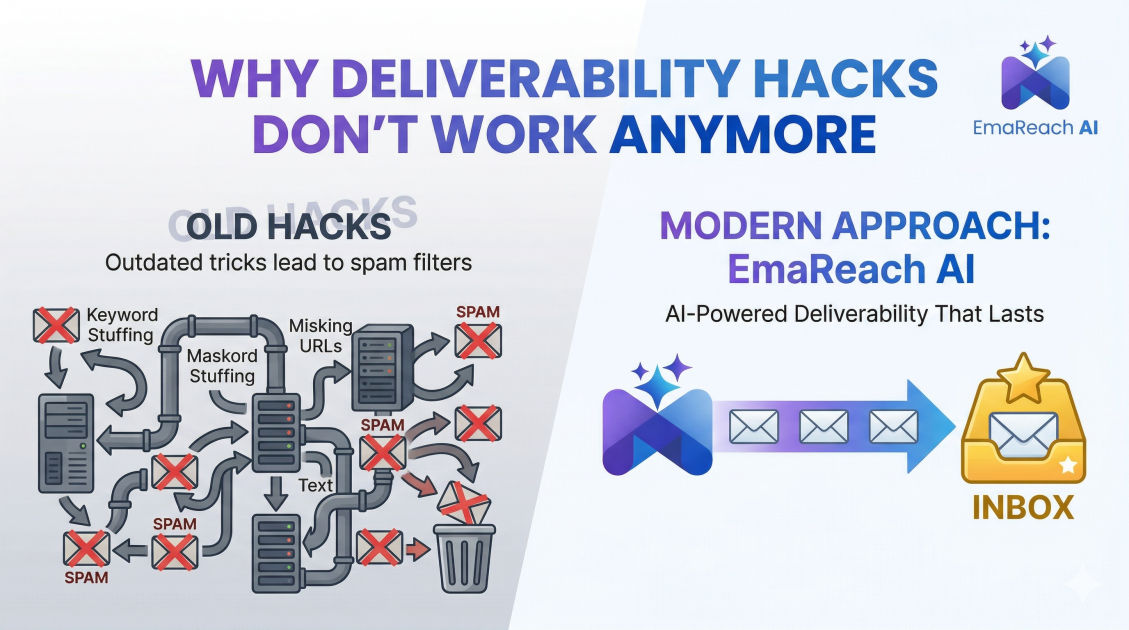
Why Deliverability Hacks Don’t Work Anymore
email deliverabilitycold emailspam filtersemail marketingoutreach strategysender reputation
The Death of the 'Hack' in Modern Email Marketing
For years, the world of cold outreach and email marketing was governed by a series of 'hacks.' Marketers shared secret tips on how to bypass spam filters, trick algorithms, and force their way into the primary inbox. These methods included everything from invisible text and pixel-tracking manipulation to complex 'spin-tax' structures designed to confuse automated filters.
However, the landscape has fundamentally shifted. The era of the deliverability hack is over. Today, Internet Service Providers (ISPs) and Email Service Providers (ESPs) utilize sophisticated machine learning models and behavioral analysis that make these old tricks not only useless but actively harmful to your sender reputation.
To succeed in modern outreach, you must move beyond shortcuts. If you want to stop landing in spam, you need a system built for the modern era. EmaReach helps you ensure your cold emails reach the inbox by combining AI-written outreach with legitimate inbox warm-up and multi-account sending. This approach aligns with how modern filters operate, ensuring your emails land in the primary tab where they get seen and replied to.
The Evolution of Spam Filters: From Keywords to Behavior
In the early days of email, spam filters were relatively primitive. They functioned primarily on 'blacklists' of known bad IP addresses and 'keyword filtering.' If your email contained words like 'free,' 'guaranteed,' or 'money-back,' it was flagged. Marketers responded by misspelling words (e.g., 'fr33') or using invisible white text to dilute the keyword density.
Today, filters are infinitely more intelligent. They use deep learning to understand the intent of a message.
Machine Learning and Natural Language Processing (NLP)
Modern filters don't just look for 'trigger words.' They use Natural Language Processing to analyze the context, tone, and value of an email. They can distinguish between a legitimate business proposal and a generic mass-blast. When you use 'hacks' like excessive personalization tags that don't make sense or artificial 'Re:' prefixes in subject lines to trick users into opening, the algorithms recognize the deceptive pattern immediately.
Reputation-Based Filtering
Your deliverability is now tied to a complex 'Sender Score.' This isn't just about your IP address; it’s about your domain reputation, your authenticated signatures (SPF, DKIM, DMARC), and, most importantly, user engagement. If people don't open your emails, or worse, if they mark them as spam, your reputation takes a hit that no technical 'hack' can fix.
Why Technical 'Gimmicks' Are Now Red Flags
Many of the tactics that used to be considered 'best practices' for deliverability are now seen as indicators of spam. Let’s break down why these specific hacks have failed.
1. The 'Invisible Text' and HTML Manipulation
In the past, some senders would include hidden text—often blocks of legitimate content from Wikipedia or news sites—in white font at the bottom of an email. The goal was to fool the filter into thinking the email was a long, high-quality piece of writing rather than a short sales pitch.
Modern ESPs render the HTML of your email just as a browser would. They see the hidden text, and because no legitimate sender would ever hide text from a human reader, it is an instant signal of malicious intent. This leads to an immediate block or a permanent 'spam' categorization.
2. Deceptive Subject Lines
Using subject lines like "Quick question regarding our meeting" when no meeting occurred, or "Urgent: Your account status," might get a high open rate in the short term. However, the 'hack' fails the moment the user opens the email. When the user realizes they've been tricked, they delete the email or report it. Modern filters track 'dwell time' and engagement. If your open rate is high but your 'read time' is three seconds followed by a deletion, the ISP knows you are using clickbait, and your future emails will be diverted to the junk folder.
3. Spin-tax and Excessive Content Randomization
Spin-tax was a method of creating thousands of variations of a single email by swapping out synonyms. While it helped bypass basic duplicate content filters, it often resulted in clunky, unnatural-looking sentences. Modern AI can now detect the underlying structure of these messages. When an ISP sees 5,000 emails leaving a server that all share the same logical 'skeleton' despite different wording, it flags the campaign as an automated blast.
The Role of User Engagement as the Ultimate Metric
If hacks don't work, what does? The answer lies in Engagement.
ISPs like Google and Microsoft prioritize the user experience. They want their users' inboxes to be relevant and clean. Therefore, they look at:
- Open Rates: Are people actually interested in the topic?
- Reply Rates: Is this a two-way conversation or a one-way broadcast?
- Forwarding: Is the content valuable enough to share?
- Mark as Not Spam: This is the strongest positive signal you can receive.
- Move to Folder: If a user moves your email to a specific folder, it tells the ISP your content is 'important.'
Trying to 'hack' these metrics with bot-driven engagement is a losing game. The algorithms are designed to detect non-human patterns in engagement. This is why tools like EmaReach are so critical; they focus on legitimate warm-up and high-quality AI-driven writing that actually prompts human engagement, rather than trying to trick a system that is smarter than the trickster.
The Technical Foundation: Why Setup Beats Hacks
Instead of searching for a secret hack, successful senders focus on the 'boring' technical foundations. These aren't hacks; they are the rules of the road. If you ignore them, no amount of clever copywriting will save you.
SPF, DKIM, and DMARC
Email authentication is non-negotiable.
- SPF (Sender Policy Framework): Specifies which mail servers are authorized to send email on behalf of your domain.
- DKIM (DomainKeys Identified Mail): Adds a digital signature to your emails, proving they weren't altered in transit.
- DMARC (Domain-based Message Authentication, Reporting, and Conformance): Tells the receiving server what to do if the SPF or DKIM fails.
Without these, you aren't just 'less likely' to reach the inbox—you are often blocked entirely by major providers.
Custom Tracking Domains
When you use a standard cold email tool, your 'tracking links' often use a shared domain. If another user of that tool sends spam, that tracking domain gets blacklisted, and your emails go down with them. Setting up a custom tracking domain (a subdomain of your own) ensures your reputation is yours and yours alone.
The Content Trap: Why Quality is the New Deliverability Strategy
We have reached a point where content and deliverability are the same thing. If your content is bad, your deliverability will eventually be bad.
The Problem with 'Personalization' Hacks
Adding a person's first name and their company name used to be enough. Now, everyone does it. In fact, seeing "Hi [First_Name], I saw [Company_Name] is doing great things" has become a 'pattern interrupt' that signals to the recipient: This is an automated cold email.
True personalization requires relevance. It requires understanding the recipient's actual pain points. AI has made this easier, but it must be used correctly. EmaReach leverages AI to write cold outreach that feels personal because it is contextually relevant, moving beyond the shallow 'hacks' of the past.
Volume vs. Quality
In the 'hack' era, the solution to low conversion was always 'more volume.' If 1% of people reply, send 100,000 emails. Today, sending high volumes from a single account is the fastest way to get your domain burned. The modern strategy involves 'horizontal scaling'—using multiple accounts and domains to keep the volume per 'sender' low, mimicking human behavior.
The Importance of Inbox Warm-up
You cannot register a domain today and start sending 500 emails a day tomorrow. That is a 'spam pattern' that triggers every alarm bell in the ISP world.
Legitimate warm-up involves gradually increasing your sending volume while ensuring those emails are opened and replied to. This builds a history of positive engagement. While people used to try to 'hack' this by emailing their friends, automated warm-up sequences that involve real, high-reputation inboxes are now the industry standard for those who take outreach seriously.
Conclusion: The Path Forward
The takeaway for any business relying on email outreach is clear: The algorithms have won. You cannot outsmart a multi-billion dollar machine learning infrastructure with a clever subject line hack or hidden HTML tricks.
Instead of fighting the filters, you must work with them. This means:
- Authenticating your domains perfectly.
- Prioritizing high-quality, relevant content over volume.
- Using multiple accounts to distribute load.
- Utilizing AI to enhance relevance rather than just to randomize text.
By moving away from 'hacks' and toward a strategy of genuine engagement and technical excellence, you protect your brand's reputation and ensure that your messages actually reach the people who need to hear them. The future of email belongs to those who provide value, not those who find the newest loophole. Systems like EmaReach provide the framework to do exactly this—combining the power of AI with the best practices of modern deliverability to ensure you stay in the primary tab and out of the spam folder.
EmaReach AI
Ready to scale your cold email outreach?
Join thousands of teams using EmaReach AI for AI-powered campaigns, domain warmup, and 95%+ deliverability. Start free — no credit card required.
Related posts
- Read article
What You Gain and What You Give Up When Switching From Instantly
Thinking about migrating your cold email stack? This detailed guide breaks down the exact operational advantages you gain and the core features you sacrifice when switching away from Instantly's popular outreach platform.
- Read article
How Choosing the Right Instantly Alternative Changed Our Pipeline Numbers
Discover how transitioning from a volume-first cold email setup to an advanced, deliverability-focused infrastructure transformed our B2B pipeline metrics, skyrocketed open rates to over 68%, and tripled our monthly booked demos.