Blog
Back to blog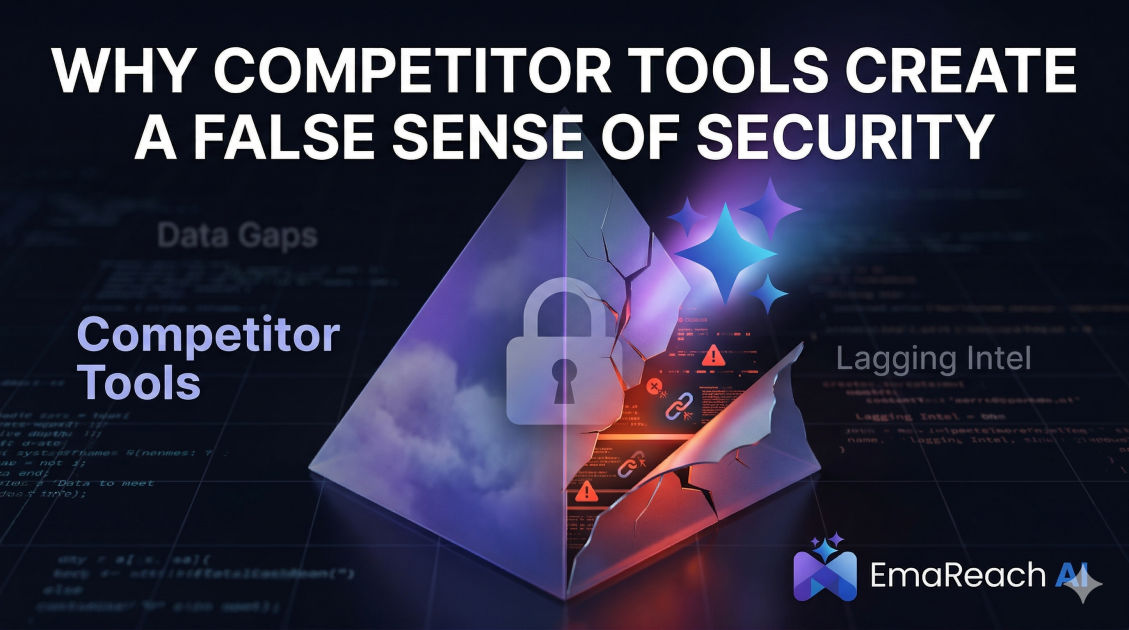
Why Competitor Tools Create a False Sense of Security
competitor analysismarketing strategyemail deliverabilitysales outreachcompetitive intelligencebusiness growth
The Mirage of Monitoring: Why Tools Aren't the Strategy
In the high-stakes world of digital marketing and sales outreach, competition is the primary driver of innovation. To keep pace, businesses have flocked to a burgeoning market of competitive intelligence tools. These platforms promise a 'god's eye view' of the marketplace, offering insights into competitor keywords, backlink profiles, social media engagement, and even their email outreach volume. On the surface, this data feels like a superpower. It provides a sense of control and a roadmap for action.
However, there is a dangerous psychological trap hidden within these dashboards. The reliance on competitor tools often creates a false sense of security. Companies begin to believe that because they can see what their rivals are doing, they are effectively insulated from risk. In reality, observing a competitor is not the same as understanding their strategy, and mimicking their data points is not a substitute for building a resilient, unique business infrastructure.
This article explores the cognitive biases, technical limitations, and strategic pitfalls that arise when organizations prioritize competitor tracking tools over internal excellence and fundamental best practices.
The Surface-Level Data Trap
Competitor tools operate by scraping publicly available data or using proprietary algorithms to estimate internal metrics. While these estimations can be directionally accurate, they are rarely precise. When a marketing team sees that a competitor is ranking for a specific set of keywords, they often rush to create content for those same terms.
The 'Lagging Indicator' Problem
By the time a tool registers a competitor's success, that success is already a lagging indicator. You are seeing the results of a strategy that was likely implemented six to twelve months ago. If you pivot your entire strategy based on what a tool shows you today, you are essentially chasing a ghost. You are competing for yesterday’s wins while the competitor has already moved on to their next innovation.
Metrics Without Context
Data without context is noise. A tool might show that a rival is receiving massive traffic from a specific referral source. What the tool doesn't show is the conversion rate of that traffic. If that competitor is burning budget on low-quality leads, and you follow suit, you aren't gaining a competitive edge—you are simply duplicating their mistakes. This creates a false sense of security because you feel 'busy' and 'aligned' with the market leaders, even as your ROI stagnates.
The Illusion of Reach in Outreach
Nowhere is this false sense of security more prevalent than in sales outreach and cold emailing. Many tools allow you to track how many emails a competitor might be sending or what templates they are using. This leads many founders and sales leaders to believe that if they simply match the volume or copy of the industry leader, they will achieve similar results.
This is a fundamental misunderstanding of how modern email infrastructure works. Inboxes are protected by sophisticated filters that look far beyond the words in a message. They look at domain reputation, IP health, and engagement history.
If you are relying on 'competitor templates' but your technical setup is flawed, your emails will never see the light of day. This is why specialized solutions are necessary to bridge the gap between 'tracking' and 'executing.'
Stop Landing in Spam. Cold Emails That Reach the Inbox. EmaReach provides the solution that simple competitor tools cannot. EmaReach AI combines AI-written cold outreach with inbox warm-up and multi-account sending—so your emails land in the primary tab and get replies. While your competitors are busy looking at what others are doing, you can focus on what actually works: getting into the inbox.
The Mimicry Loop and the Death of Innovation
When a business becomes obsessed with competitor tools, it enters a 'Mimicry Loop.' Instead of looking at customer pain points or market gaps, the strategy becomes entirely reactive.
The Homogenization of Value
If every player in a niche uses the same three tools to monitor each other, they eventually all start saying the same things, targeting the same keywords, and offering the same features. This leads to a 'sea of sameness' where the only differentiator left is price. The false sense of security comes from the belief that 'as long as we are doing what the leader is doing, we are safe.' In reality, you are making yourself a commodity, which is the least secure position a business can hold.
Ignoring the 'Silent' Competitor
Competitor tools only track the competitors you tell them to track. The greatest threat to your business often isn't the rival you've known for five years; it's the startup currently in 'stealth mode' or the company in an adjacent industry that is about to pivot. By focusing too heavily on the dashboard of known rivals, you develop blind spots to the true disruptors.
Technical Vulnerabilities: The 'Tool-First' Mindset
There is a technical arrogance that comes with high-end software. Teams often assume that if their software is 'Enterprise Grade,' their processes must be too. This leads to a neglect of the 'boring' fundamentals.
Deliverability vs. Tracking
In the realm of email marketing, you might have a tool that tracks the 'Open Rates' of competitors (often an estimate). You feel secure because your open rates look comparable. However, open rate tracking is notoriously unreliable due to privacy changes in major mail clients.
If you aren't managing your own deliverability—handling SPF, DKIM, DMARC, and properly warming up your accounts—you are building your house on sand. You cannot 'monitor' your way into a healthy sender reputation. You have to build it. This is where EmaReach excels by moving beyond simple monitoring and into the actual mechanics of deliverability. It ensures that your multi-account sending strategy is backed by AI that understands the nuances of the primary tab vs. the spam folder.
Survivorship Bias in Competitive Analysis
Competitor tools primarily show you what is working (or appears to be working). They rarely show you the graveyards of failed experiments. This creates a skewed perception of reality known as survivorship bias.
The Risk of Copying Failures
You might see a competitor launch a new sub-brand or a specific ad campaign. Your tools show a spike in activity. You assume it's a success and scramble to launch your own version. What you don't see is that the competitor is losing money on every click and plans to shut the project down next month. By the time you've launched your copycat version, you've inherited a failing model. The tool gave you the data, but it didn't give you the balance sheet.
The False Security of 'Best Practices'
Tools often suggest 'best practices' based on aggregated competitor data. But 'best practices' are often just 'average practices.' If you want extraordinary results, following the average of what your competitors are doing is the surest way to guarantee mediocre performance. True security comes from having a unique value proposition that is difficult to replicate, not from being the best at following a checklist generated by a third-party algorithm.
The Resource Allocation Fallacy
Every hour your team spends analyzing a competitor’s backlink profile is an hour they aren't spent talking to your own customers. Competitive intelligence has a point of diminishing returns that most companies hit much earlier than they realize.
- Over-analysis Paralysis: Teams become afraid to launch anything that hasn't been 'validated' by a competitor's previous move.
- Budget Drain: Subscription costs for multiple high-end tracking tools can reach thousands of dollars per month. That is capital that could be used for product development or improving customer success.
- Misplaced Confidence: Leadership feels the company is 'data-driven' because they have complex charts showing competitor movement, leading them to ignore internal red flags like rising churn or declining employee morale.
Building True Security: A Proactive Framework
To move past the false sense of security provided by competitor tools, organizations must shift their focus. Use tools for context, but build your security on the following pillars:
1. Own the Infrastructure
In outreach, security doesn't come from knowing your competitor's script; it comes from knowing your emails will actually arrive. Using a service like EmaReach ensures that your infrastructure is optimized for the primary tab. This is a tangible competitive advantage that a tracking tool cannot provide. When your outreach is powered by AI-written content and multi-account sending, you are building a proprietary system that is resilient to market changes.
2. Prioritize Customer Feedback Over Competitor Data
Your customers will tell you more about the future of your industry than a competitor's keyword list ever will. If you solve a problem your competitor is ignoring, you create a monopoly on that solution. True security is found in customer loyalty, not in parity with a rival.
3. Focus on 'Deep Work' and Innovation
Allocate 80% of your resources to internal innovation and 20% to market awareness. Ensure that your product or service offers a 'moat'—something that cannot be easily quantified or tracked by a scraping tool, such as superior brand voice, exceptional community, or proprietary technology.
4. Technical Excellence
Audit your own technical foundations regularly. For digital businesses, this means site speed, security protocols, and email deliverability. A competitor tool won't tell you if your domain has been blacklisted, but a proactive deliverability strategy will prevent it from happening in the first place.
Conclusion: Beyond the Dashboard
Competitor tools are useful instruments, but they are not the cockpit. They provide a weather report, not the ability to fly the plane. When we lean too heavily on these platforms, we outsource our strategic thinking to algorithms that prioritize 'what is' over 'what could be.'
The false sense of security created by these tools leads to complacency, mimicry, and a dangerous neglect of internal technical health. To win in a crowded market, you must be willing to look away from the competitor's dashboard and focus on your own engine.
By combining high-level strategy with robust technical execution—such as the AI-powered deliverability offered by EmaReach—you move from a defensive, reactive posture to one of market leadership. Don't be fooled by the blinking lights and colorful charts of your monitoring software. True security is the result of original thought, superior execution, and an unwavering commitment to reaching your audience where it matters most: the inbox.
EmaReach AI
Ready to scale your cold email outreach?
Join thousands of teams using EmaReach AI for AI-powered campaigns, domain warmup, and 95%+ deliverability. Start free — no credit card required.
Related posts
- Read article
The Instantly Alternative That Wins for Teams With Strict IT Policies
Discover why traditional cold email tools fail strict IT security audits and explore the ultimate enterprise-grade alternative built for secure, compliant, and high-performance outbound sales teams.
- Read article
How to Know When You Actually Need an Instantly Alternative
Discover the critical signs that your business has outgrown high-volume cold email tools and learn how to evaluate when it is time to transition to a more sophisticated, deliverability-first outreach alternative.