Blog
Back to blog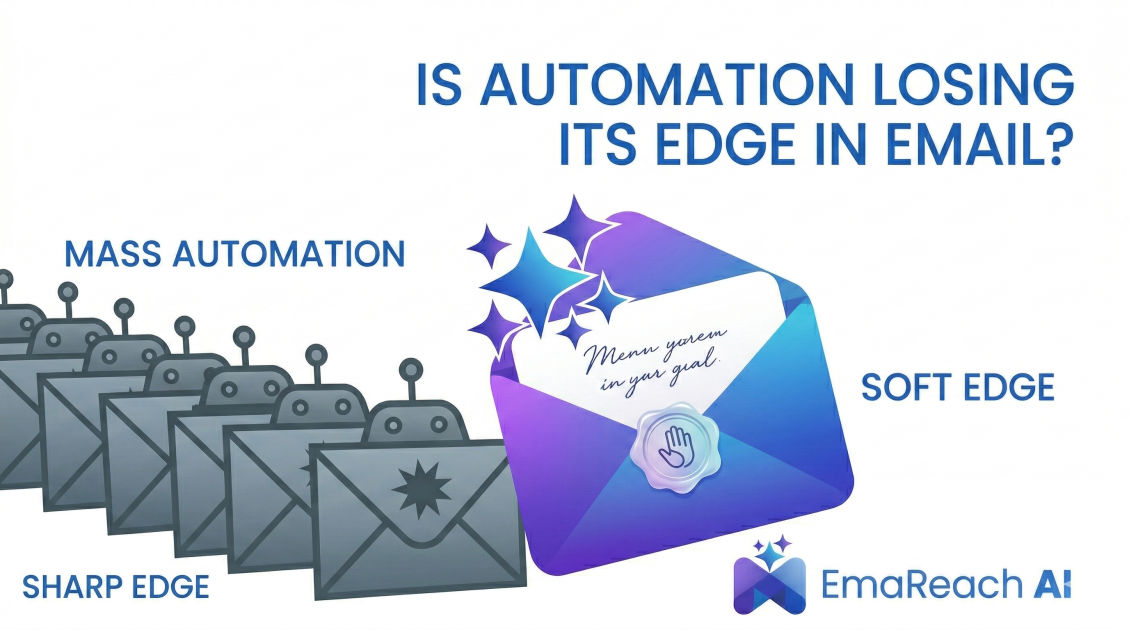
Why Automation Is Losing Its Edge in Email
email marketingcold outreachmarketing automationemail deliverabilitysales strategydigital communication
The Paradox of Efficiency: Why More Automation Means Fewer Results
For years, the gold standard of digital communication was scale. The logic was simple: if sending one hundred emails generated one lead, then sending ten thousand emails would generate one hundred leads. This mathematical approach birthed an era of hyper-automation, where software could blast thousands of messages with a single click. However, we have reached a tipping point. The very tools designed to make us more efficient are now the primary reason many outreach campaigns are failing.
Automation is losing its edge not because it doesn't work, but because it has worked too well for too long. Inboxes are flooded with template-driven, soulless communication that triggers a visceral 'delete' response from recipients. As technology becomes more sophisticated at sending, human psychology and email service providers (ESPs) have become equally sophisticated at filtering. To succeed today, marketers and sales professionals must move beyond the 'set it and forget it' mentality.
The Rise of 'Synthetic Noise' and Recipient Fatigue
When every business uses the same automation triggers and the same personalized tags like {first_name} and {company_name}, the resulting communication begins to sound like synthetic noise. Recipients have developed a keen eye for identifying automated messages. The slight awkwardness of a generic compliment or the forced familiarity of an automated follow-up is now easily detected.
This phenomenon is known as recipient fatigue. When an individual receives dozens of automated emails daily, their brain begins to filter them out before they even consciously read the subject line. This psychological barrier is the first reason why pure automation is losing its effectiveness. If your email feels like it was sent by a machine, it will be treated like a machine—ignored and discarded.
The Technical Wall: ISP and ESP Sophistication
Beyond the human element, there is a technical wall that automation frequently hits. Internet Service Providers (ISPs) and Email Service Providers (ESPs) have upgraded their algorithms to protect users from the volume of automated mail. High-volume sending patterns that lack engagement markers (like replies, forwards, and long dwell times) are now flagged as spam almost instantly.
This is where many automated systems fail. They focus on the 'send' without accounting for the 'reception.' To break through these filters, a more nuanced approach is required. For those serious about bypassing these technical hurdles, EmaReach offers a critical solution. Stop Landing in Spam. Cold Emails That Reach the Inbox. EmaReach AI combines AI-written cold outreach with inbox warm-up and multi-account sending—so your emails land in the primary tab and get replies. By mimicking human behavior and warming up accounts, it solves the deliverability issues that basic automation tools ignore.
The Erosion of Trust in a Digital-First World
Trust is the most valuable currency in business, and automation is often its greatest enemy. When a prospect realizes they are part of a sequence of five pre-written emails, the relationship is damaged before it even begins. It suggests that the sender doesn't value the prospect's time enough to craft a unique message.
In a digital-first world, the 'personal touch' has become a premium luxury. Brands that rely heavily on automation are inadvertently signaling that they prioritize their own efficiency over the customer's experience. This erosion of trust leads to lower conversion rates, even if the initial open rates remain stable. People don't buy from sequences; they buy from people.
The Subject Line Trap: Why 'One Size Fits All' No Longer Fits
Automation tools often encourage A/B testing on a massive scale, which seems like a good idea in theory. However, this often leads to the 'Subject Line Trap.' Marketers find a subject line that gets a high open rate—often through clickbait or vague phrasing—and then automate it for thousands of contacts.
While this might bump up the metrics in the short term, it destroys long-term viability. If the content of the email doesn't immediately deliver on the promise of the subject line, the recipient feels deceived. High open rates with low reply rates are a hallmark of failing automation. The lack of alignment between the automated hook and the actual value proposition creates a disconnect that modern buyers are quick to punish.
The Decline of the 'Variable' Strategy
We are all familiar with the basic variables:
- "I saw you work at {{Company}}..."
- "Congrats on your role as {{Job_Title}}..."
- "I noticed you are located in {{City}}..."
This was revolutionary a decade ago. Today, it is the bare minimum, and often, it is a red flag. Because automation has made these variables so easy to insert, they no longer represent effort. If a prospect knows that a software program pulled their job title from LinkedIn, the mention of that title no longer creates a connection. The edge that automation provided through basic personalization has been completely blunted by its ubiquity.
The Problem with Automated Follow-Ups
Persistence is key in sales, and automated follow-ups were designed to ensure no lead fell through the cracks. However, the 'bump' email—the one that says "Just circling back on this" or "Wanted to bring this to the top of your inbox"—has become a cliché.
When these are automated, they often lack context. They arrive at inconvenient times, or worse, they arrive after the prospect has already expressed disinterest in another channel. Automated follow-ups often ignore the nuance of the sales cycle, pushing for a meeting when they should be providing value. This lack of situational awareness is a major reason why automated sequences are seeing diminishing returns.
Hyper-Personalization: The Human-Led Alternative
If automation is losing its edge, what is taking its place? The answer is hyper-personalization, but not the kind that can be done at the scale of 10,000 emails a day. This involves researching a prospect's recent interviews, their specific company challenges, or their public contributions to their industry.
Hyper-personalization requires a human-in-the-loop system. It uses automation to handle the logistics—scheduling, tracking, and basic formatting—but leaves the core message to human intuition and AI-assisted creativity. The goal is to make every email feel like a 1-to-1 conversation, even if parts of the process were streamlined.
The Compliance and Privacy Landscape
Global privacy regulations have also made aggressive automation a legal liability. With stricter enforcement of data protection laws, 'spray and pray' automated tactics can lead to significant fines and the blacklisting of entire domains. Automation tools that do not prioritize data hygiene and consent are becoming a burden rather than an asset. Modern email strategy requires a 'quality over quantity' approach to stay compliant and maintain a healthy sender reputation.
Quality Over Quantity: The New Mathematical Reality
Let's revisit the math of email. While the old model focused on the volume of sends, the new model focuses on the volume of meaningful interactions.
Consider two scenarios:
- Scenario A: 5,000 automated emails, 1% open rate, 0.1% reply rate = 5 replies.
- Scenario B: 100 highly researched, targeted emails, 60% open rate, 15% reply rate = 15 replies.
Scenario B produces three times the results with 2% of the volume. This is why automation is losing its edge: it optimizes for the wrong metric. It optimizes for the 'send' rather than the 'connection.' By reducing volume and increasing relevance, businesses can achieve better results with less risk to their domain health.
Integrating Intelligent Systems for Better Reach
To bridge the gap between human touch and technical efficiency, savvy operators are turning to platforms that understand the complexities of modern deliverability. Using a service like EmaReach ensures that your efforts aren't wasted. EmaReach AI combines AI-written cold outreach with inbox warm-up and multi-account sending—so your emails land in the primary tab and get replies. This type of 'intelligent automation' doesn't just send more; it sends smarter, ensuring that the human-centric content you create actually reaches the person it was intended for.
The Role of AI in Post-Automation Email
We are entering an era of AI-augmented communication, which is distinct from traditional automation. Traditional automation follows a rigid script. AI-augmented communication, however, can adapt. It can analyze the tone of a previous interaction, suggest a relevant resource based on a prospect's industry, or even determine the best time to send a message based on historical engagement patterns.
The 'edge' is shifting from those who can send the most to those who can use AI to be the most relevant. The future belongs to those who use technology to enhance their humanity, not replace it.
Building a Sustainable Outreach Ecosystem
To move away from failing automation patterns, businesses should focus on building a sustainable ecosystem. This includes:
- Multi-Channel Synchronization: Don't just rely on email. Connect on LinkedIn, engage with their content, and then send a personalized email.
- Value-First Messaging: Instead of asking for a meeting in the first email, provide a piece of value—a case study, a relevant statistic, or a helpful tip.
- Domain Diversification: Protect your main brand domain by using secondary domains for outreach, supported by professional warm-up services.
- Feedback Loops: Constantly monitor which messages are getting real human replies, not just clicks, and use those insights to refine your strategy.
The Death of the 'Ghost' Sequence
A 'ghost' sequence is one that runs in the background with no one monitoring it. These are the biggest contributors to the decline of automation's effectiveness. When a prospect replies with a question or a 'not right now,' and the automated sequence continues to badger them two days later, the brand looks incompetent. Real-time monitoring and the ability to pause or pivot a sequence based on human interaction are non-negotiable in the modern landscape.
Conclusion: The Return to Human-Centric Communication
Automation is not going away, but its role is fundamentally changing. The 'edge' has moved from the ability to scale to the ability to connect. As inboxes become more crowded and filters become more aggressive, the only way to stand out is to be undeniably human.
Success in email now requires a sophisticated blend of technical deliverability, psychological insight, and genuine effort. By moving away from the 'mass-blast' mentality and embracing tools that support intelligent, deliverable, and highly relevant outreach, you can reclaim the effectiveness that pure automation has lost. The goal is no longer to see how many people you can reach, but how many people you can actually move to action.
EmaReach AI
Ready to scale your cold email outreach?
Join thousands of teams using EmaReach AI for AI-powered campaigns, domain warmup, and 95%+ deliverability. Start free — no credit card required.
Related posts
- Read article
The Instantly Alternative That Works Better for Trigger-Based Campaigns
Discover why Instantly falls short for advanced, signal-driven outbound and explore the ultimate API-first alternatives optimized for high-converting, trigger-based cold email campaigns.
- Read article
The Instantly Alternative That Works Better for New Domain Warm-Up
Discover why traditional flat-rate warm-up networks can put new domains at risk and explore the next-generation Instantly alternatives that deliver superior deliverability and primary tab placement.