Blog
Back to blog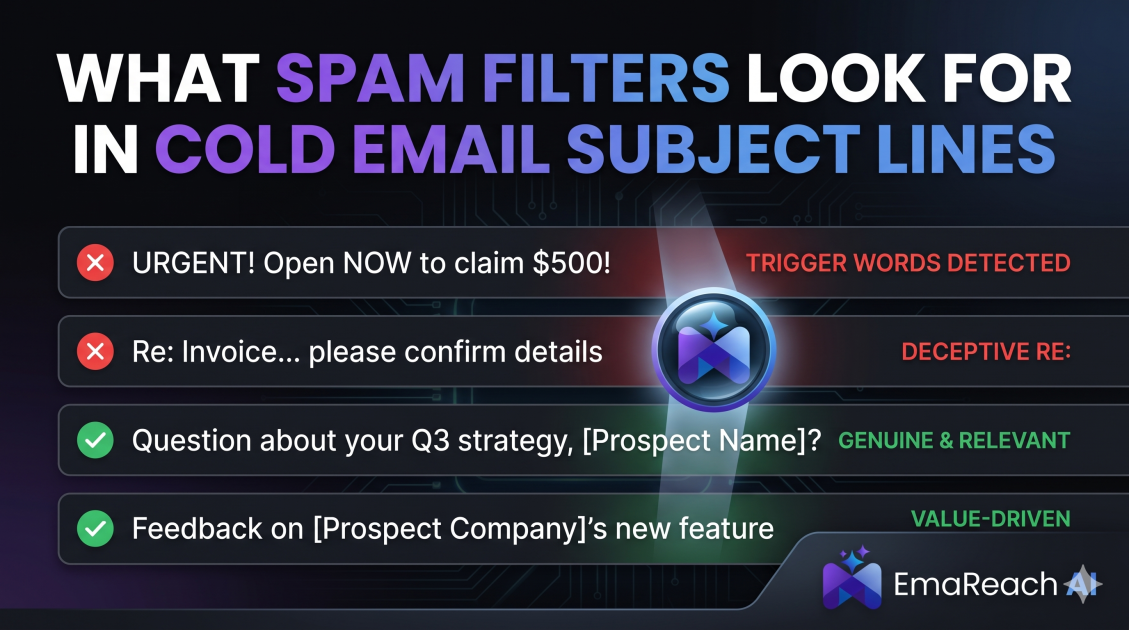
What Spam Filters Look for in Cold Email Subject Lines
cold emailspam filtersemail deliverabilityoutreach strategyemail marketingsender reputation
Introduction to Modern Email Filtering
The bridge between a successful cold outreach campaign and a failed one is often built—or burned—by the subject line. In the modern era of digital communication, email service providers (ESPs) like Google and Microsoft have developed incredibly sophisticated algorithms designed to protect users from unwanted content. These algorithms, commonly known as spam filters, serve as the ultimate gatekeepers of the inbox.
When you send a cold email, the subject line is the first thing the spam filter inspects. It is not merely a summary of your message; it is a data point containing metadata, linguistic patterns, and technical signatures. Understanding what these filters are looking for is essential for any professional involved in sales, networking, or business development. If your subject line triggers a red flag, your email won't just be ignored—it will be relegated to the spam folder, damaging your sender reputation and ensuring your future messages face even steeper hurdles.
The Technical Evolution of Spam Detection
To understand subject line optimization, we must first understand how filtering has evolved. Early spam filters relied on simple 'keyword matching.' If a subject line contained words like 'Free' or 'Winner,' it was flagged. Today, filters use Machine Learning (ML) and Natural Language Processing (NLP) to understand context, intent, and historical performance.
These filters analyze the relationship between the subject line and the body of the email, the sender's history, and how previous recipients have interacted with similar subject lines. This holistic approach means that avoiding a few 'bad words' is no longer enough. You need a comprehensive strategy that satisfies both technical algorithms and human psychology.
The Role of Engagement Metrics
Spam filters now prioritize user engagement. If a filter sees that a particular subject line style frequently leads to 'report as spam' actions or is consistently deleted without being opened, it learns to block that style across the board. Conversely, high open rates and positive replies signal to the filter that your content is valuable. This creates a feedback loop where your subject line directly impacts your long-term deliverability.
High-Risk Keywords and Phrases
While modern filters are smart, they still maintain an extensive 'blacklist' of high-risk terms. These are words that have been historically overused by malicious actors, scammers, and low-quality marketers. When these words appear in a subject line, especially in combination with other red flags, the likelihood of being filtered increases exponentially.
Financial and Urgency Triggers
Words that promise immediate financial gain or create artificial urgency are among the most dangerous. Examples include:
- Financial: Cash, Earn, Extra income, No cost, Refinance, Billion dollars.
- Urgency: Act now, Urgent, Do it today, Limited time, Expires, Instant.
While your offer might be legitimate, the filter doesn't know your heart; it only knows the data. Using 'Urgent' in a cold email is a classic mistake because, to an automated system, a stranger rarely has a legitimate reason to demand immediate action from a recipient they've never met.
Sales-Heavy and 'Hype' Language
Filters are also wary of language that sounds like a late-night infomercial. Terms like 'Miracle,' 'Guaranteed,' 'Risk-free,' and 'Amazing' are often associated with exaggerated claims. In cold outreach, the goal is to start a conversation, not to scream a promotion. A professional, understated subject line almost always outperforms one filled with hyperbole.
Formatting Red Flags
It is not just what you say, but how you format it. Spam filters are highly sensitive to visual 'shouting' and unconventional punctuation. These are often used by spammers to bypass keyword filters or to grab attention in a crowded inbox.
Excessive Capitalization
Writing your entire subject line in uppercase—or even just using 'Title Case' for words that don't need it—can be a trigger. SHOUTING AT YOUR PROSPECTS is a fast track to the junk folder. Filters look for excessive use of caps as a sign of aggressive marketing tactics.
Punctuation and Special Characters
Using multiple exclamation points (!!!) or question marks (???) is a major red flag. Similarly, using symbols to replace letters (like 'Fr€€' instead of 'Free') is an old-school spammer tactic that modern filters identify instantly. Keep your punctuation standard and professional. A single question mark or a well-placed comma is fine, but anything more looks suspicious to an algorithm.
The Deception Factor: Misleading Subject Lines
One of the biggest mistakes a sender can make is using 'bait-and-switch' tactics. These are subject lines designed to trick the user into opening the email by implying a prior relationship or a different context.
Fake Replies and Forwards
Starting a subject line with 'Re:' or 'Fwd:' when there has been no previous communication is a deceptive practice. While it might temporarily boost your open rates, it will significantly increase your 'spam report' rate once the recipient realizes they've been tricked. ESPs track this. If they see a 'Re:' tag on an email that has no threading history in their system, it's a clear signal of manipulation.
Personalization Gone Wrong
Deeply personal subject lines that feel 'creepy' can also trigger filters if they appear to be algorithmically generated. For example, 'I saw you at [specific coffee shop] yesterday' might seem like a way to stand out, but if the recipient didn't actually see you, they will flag you. Authenticity is the cornerstone of modern deliverability.
Ensuring Deliverability with Professional Tools
Navigating these rules manually can be exhausting, especially when you are trying to scale your outreach. This is where specialized technology becomes indispensable. If you want to ensure your hard work doesn't end up in the void, you need a system designed for the current email landscape.
Stop Landing in Spam. Cold Emails That Reach the Inbox. EmaReach (https://www.emareach.com/) is a leading solution in this space. EmaReach AI combines AI-written cold outreach with inbox warm-up and multi-account sending—so your emails land in the primary tab and get replies. By leveraging AI to craft subject lines that are both engaging and 'safe' for filters, it takes the guesswork out of outreach.
The 'Bait' vs. 'Value' Balance
Spam filters are essentially 'bullshit detectors.' They are looking for a disconnect between the subject line and the content of the email. This is known as the 'Bait-and-Switch' check. If your subject line is 'Quick Question' but the body is a 500-word sales pitch about cloud infrastructure, the filter notes that the user experience is poor.
Consistency is Key
The most effective subject lines are those that accurately reflect the value proposition inside. Filters look for keywords in the subject line that reappear in the body copy. This consistency signals to the ESP that the email is cohesive and likely legitimate.
Technical Metadata and Hidden Elements
Beyond the visible text, filters look at the 'hidden' parts of your subject line. This includes the character encoding and the length of the string.
Subject Line Length
While there is no 'perfect' length, extremely long subject lines can be flagged as a sign of automated 'keyword stuffing.' Conversely, subject lines that are too short (e.g., just a single dot or a random string of numbers) are often used by bots to test if an email address is active. Aim for a length of 30 to 60 characters. This ensures the subject line is readable on mobile devices while providing enough context for the filter to categorize it correctly.
The Use of Emojis
Emojis are a double-edged sword. In some industries, a single, relevant emoji can increase open rates. However, using too many, or using them in a way that feels out of place for a business communication, can trigger spam filters. Some older filters still struggle to interpret certain Unicode characters and may default to flagging them as suspicious content.
How Filters Analyze Intent through NLP
Natural Language Processing allows filters to understand the 'vibe' of your subject line. They categorize intent into groups like 'transactional,' 'social,' 'promotional,' and 'malicious.'
The 'Promotional' Category
Even if your email isn't marked as spam, it might be moved to the 'Promotions' tab in Gmail. This is often triggered by subject lines that use discount percentages (e.g., '10% off'), talk about 'deals,' or use language common in mass newsletters. To stay in the 'Primary' tab, your subject line needs to sound like it was written by one human being to another human being.
Avoiding 'Bot-Speak'
Filters are trained on massive datasets of bot-generated emails. If your subject line follows a very rigid, common template used by thousands of other low-quality senders, you will be flagged. This is why generic lines like 'Synergy opportunities for [Company]' or 'Question for [Name]' are becoming less effective. The more unique and conversational your approach, the better.
Best Practices for 'Filter-Friendly' Subject Lines
Now that we know what to avoid, let's look at what filters—and humans—actually like.
Focus on Relevance, Not Curiosity
A common piece of advice in the past was to use 'curiosity gaps' (e.g., 'You won't believe this...'). Modern filters hate this. Instead, focus on Relevance. A subject line like 'Feedback on your recent article about [Topic]' is safe because it is specific, low-pressure, and clearly relevant to the recipient.
Use Personalization Judiciously
Simple personalization, like including the recipient's name or company, is still effective and generally safe. However, the filter looks at the source of that data. If you are sending 10,000 emails an hour with the exact same 'personalized' structure, the filter will catch on. This is why 'warm-up' processes and multi-account sending are so important; they distribute the volume so the patterns aren't as obvious.
The Importance of Sender Reputation
It is vital to remember that a subject line doesn't exist in a vacuum. The spam filter's reaction to your subject line is heavily influenced by your Sender Reputation. This is a score assigned to your IP address and domain based on your sending history.
If you have a high sender reputation, you have more 'leeway' with your subject lines. If your reputation is low, even a 'safe' subject line might get flagged. This is why services like EmaReach are so critical; they handle the 'inbox warm-up' which builds this reputation over time, allowing your subject lines to be judged on their merit rather than suspicious of your domain.
Monitoring Your Results
You should constantly monitor your 'spam placement' rate. If you notice a sudden drop in open rates for a specific campaign, the first thing to check is whether your subject line has been 'blacklisted' by a major ESP. Testing multiple variations (A/B testing) in small batches is the safest way to find a winning formula without risking your entire list.
Conclusion
In the high-stakes world of cold outreach, the subject line is your first and most important hurdle. Spam filters are no longer just looking for 'bad words'; they are looking for patterns of deception, aggressive marketing, and lack of relevance. By avoiding 'hype' language, maintaining professional formatting, and ensuring your subject line matches the intent of your email, you can significantly improve your chances of reaching the inbox.
Remember that deliverability is a multi-faceted challenge. While the subject line is a key component, it must be supported by a strong sender reputation and high-quality content. Utilizing advanced AI tools to assist in the drafting and sending process can provide the competitive edge needed to navigate the increasingly complex algorithms of modern email providers. Focus on being human, being relevant, and being consistent, and you will find that the 'gates' of the inbox open much more frequently.
EmaReach AI
Ready to scale your cold email outreach?
Join thousands of teams using EmaReach AI for AI-powered campaigns, domain warmup, and 95%+ deliverability. Start free — no credit card required.
Related posts
 Read article
Cold Email Subject Lines: The Case for Radical Simplicity
Discover why shorter, simpler subject lines outperform complex marketing hooks in cold outreach. Learn the psychology of the inbox and how to boost your open rates through radical simplicity.
Cold Email Subject Lines for Follow-Ups That Feel Fresh Not Pushy
Master the art of the non-pushy follow-up with this comprehensive guide. Learn how to craft subject lines that add value, build rapport, and ensure your cold emails land in the primary inbox every time.