Blog
Back to blog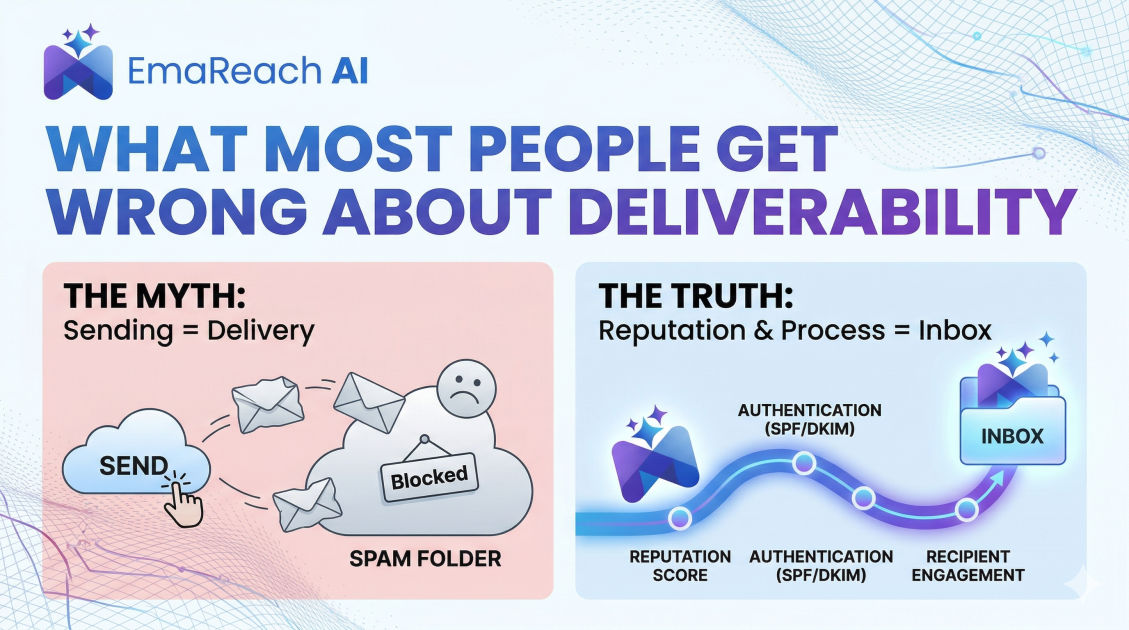
What Most People Get Wrong About Deliverability
email deliverabilitycold emailemail marketingspam filterssender reputationoutreach strategy
Introduction: The Invisible Barrier to Growth
In the world of digital communication, there is a silent killer of campaigns, revenue, and brand reputation: poor email deliverability. For most marketers and sales professionals, deliverability is a black box—a mysterious set of rules governed by secretive algorithms. When an email campaign fails to yield results, the typical reaction is to blame the copy, the offer, or the lead list. While those factors matter, the reality is often much simpler and more frustrating: the emails never reached the recipient's primary inbox in the first place.
There is a massive difference between delivery and deliverability. Delivery is a binary metric—did the receiver's server accept the file? Deliverability is a matter of placement—did the message land in the Primary tab, the Promotions folder, or the dreaded Spam folder? Most people operate under a cloud of misconceptions that prevent them from reaching their full potential. In this deep dive, we will dismantle the common myths and reveal the technical and behavioral truths about landing in the inbox.
The Delivery vs. Deliverability Confusion
One of the most fundamental errors is conflating delivery rate with deliverability. If your email service provider (ESP) shows a 98% delivery rate, you might feel like a hero. However, that number only tells you that 98% of the emails didn't 'bounce' (i.e., the email addresses existed and the servers were reachable).
It says absolutely nothing about where those emails landed. You could have a 99% delivery rate while 80% of your messages are sitting in the Spam folder. Inbox placement is the only metric that truly correlates with ROI. To master this, you must look beyond the basic dashboard metrics provided by standard platforms and understand the reputation-based ecosystem of modern email.
Myth #1: "Spam Words" Are the Main Culprit
For years, the prevailing wisdom was to avoid words like "Free," "Money," "Winner," or "Act Now." While excessive use of high-pressure sales language can trigger primitive filters, modern Inbox Service Providers (ISPs) like Google and Microsoft have moved far beyond simple keyword matching. They now use sophisticated machine learning models that analyze the entire context of the message, the sender's history, and recipient behavior.
If you have a high-quality reputation, you can use the word "free" without issue. Conversely, if your reputation is poor, even a perfectly crafted, professional letter will be flagged. The focus shouldn't be on a "forbidden word list," but on the overall value and engagement signals your emails generate.
Myth #2: Technical Setup is a One-Time Task
Many organizations treat technical authentication (SPF, DKIM, and DMARC) as a "set it and forget it" task. This is a dangerous oversight. These protocols are the foundation of your digital identity.
- SPF (Sender Policy Framework): Specifies which IP addresses and domains are authorized to send email on your behalf.
- DKIM (DomainKeys Identified Mail): Adds a digital signature to your emails, proving they weren't tampered with in transit.
- DMARC (Domain-based Message Authentication, Reporting, and Conformance): Tells receiving servers what to do if an email fails SPF or DKIM checks.
Misconfigurations often happen when new tools are added to a tech stack or when DNS settings are updated without consulting the marketing team. Without these three pillars working in harmony, you are essentially a ghost to modern filters. They cannot verify who you are, so they default to the safest option: the Spam folder.
The Role of Engagement: The New Gold Standard
In the current landscape, ISPs prioritize user engagement above all else. They ask: "Do people actually want this email?" They measure this through positive and negative signals.
Positive Signals:
- Opening the email (though privacy changes have made this harder to track accurately).
- Clicking links within the body.
- Replying to the email (the strongest positive signal).
- Moving an email from Spam to the Primary inbox.
- Adding the sender to an address book.
Negative Signals:
- Deleting the email without opening it.
- Marking the email as Spam.
- High bounce rates.
This shift means that "blasting" a massive list is the fastest way to destroy your deliverability. If 1,000 people receive your email and 100 mark it as spam, your reputation takes a hit that can take weeks or months to recover from.
The Cold Outreach Dilemma
Cold email is where deliverability challenges become most acute. When you are reaching out to people who haven't asked to hear from you, the margin for error is razor-thin. This is where most people fail by using a single email account to send hundreds of messages a day.
To succeed in modern outreach, you need a strategy that mimics human behavior. This involves using multiple accounts, gradually increasing volume (warming up), and ensuring each message feels personal and relevant.
Stop Landing in Spam. Cold Emails That Reach the Inbox. EmaReach is designed specifically to solve these complexities. EmaReach AI combines AI-written cold outreach with inbox warm-up and multi-account sending—so your emails land in the primary tab and get replies. By distributing the load and automating the "human" engagement signals, it bypasses the common pitfalls that trap standard outreach attempts.
Myth #3: Dedicated IPs are Always Better
There is a common misconception that getting a dedicated IP address will solve all deliverability woes. While a dedicated IP gives you total control over your reputation, it also means you are solely responsible for it.
If you don't send a high enough volume of email consistently (usually at least 50,000+ messages per month), you cannot maintain a "warm" IP. For smaller senders, a shared IP pool with a reputable provider is often better because the combined volume of many good senders keeps the IP's reputation high. Moving to a dedicated IP without a proper warm-up plan is a recipe for instant blocking.
The Importance of List Hygiene
Most people hate deleting leads. They see a list of 10,000 names as an asset, regardless of how old those names are. In reality, an unmaintained list is a liability. Over time, email addresses become "abandoned." ISPs often turn these old addresses into "Spam Traps."
If you send an email to a spam trap, it tells the ISP that you are either using an old list or, worse, a scraped list. Neither is acceptable. Regular cleaning—removing bounces, unengaged subscribers, and invalid formats—is not just about saving money on your ESP bill; it’s about protecting your ability to reach the people who actually want to hear from you.
Infrastructure: Beyond the Domain
Your domain reputation is the most significant factor in deliverability, but your "tracking domain" also plays a role. Most email tools use a generic tracking domain for open and click tracking. Because these domains are shared by thousands of users—some of whom might be spammers—they can become blacklisted.
Setting up a Custom Tracking Domain (a sub-domain of your own domain) ensures that you aren't being penalized for the bad behavior of others. It adds an extra layer of professionalism and technical alignment that filters look for when deciding where to place your message.
Content and Formatting Pitfalls
While "spam words" aren't the be-all and end-all, the structure of your content still matters. Common mistakes include:
- Too many images: A high image-to-text ratio is a classic hallmark of spam. If your email is just one large image, many filters will block it because they cannot "read" the content.
- Broken HTML: Messy code from copying and pasting out of Microsoft Word or other editors can trigger technical flags.
- Shortened URLs: Using generic link shorteners (like bit.ly) is a major red flag. Spammers use them to hide the final destination of a link. Always use full URLs or your own custom tracking links.
- Missing Unsubscribe Link: Not only is this a legal requirement in most jurisdictions, but it also frustrates users. If they can't find an easy way to opt-out, they will hit the "Spam" button instead, which hurts you much more.
The Psychology of the Inbox
Deliverability is as much about psychology as it is about technology. When an email arrives, the recipient makes a split-second decision based on the "From" name and the Subject Line.
If your "From" name is "Sales Department," you are likely headed for the trash. If it’s "John at Company Name," it feels human. If your subject line is deceptive (e.g., starting with "RE:" when there was no prior conversation), you might get a higher open rate, but you will also get a much higher spam report rate. Once a user feels tricked, your reputation with that provider is permanently damaged.
The Lifecycle of a Sender Reputation
Reputation isn't static. It is a rolling calculation based on your last 30 to 90 days of activity. This is why "warming up" is not just for new domains. If you haven't sent an email in a month and suddenly send 5,000, the ISPs will view this as suspicious behavior—typical of a hacked account.
Consistency is key. Maintaining a steady volume of high-quality, high-engagement mail is the only way to build long-term trust with providers like Gmail and Outlook. If you need to scale up, do it incrementally—increasing your volume by no more than 20% each day.
Monitoring and Feedback Loops
What you don't measure, you can't manage. Beyond your ESP's dashboard, you should be utilizing tools like Google Postmaster Tools. This provides a direct look at how Google views your domain reputation, encryption levels, and spam rates.
Additionally, you should sign up for Feedback Loops (FBLs) with every major ISP. FBLs notify you when a recipient marks your email as spam, allowing you to automatically remove them from your list. This prevents further complaints and shows the ISP that you are a responsible sender who respects user preferences.
Conclusion
Deliverability is not a mystery to be solved with "hacks" or "tricks." It is a discipline that requires a combination of technical precision, consistent behavior, and a commitment to providing value to the recipient.
Most people get deliverability wrong because they look for a quick fix—a magic subject line or a secret software setting. In reality, the path to the inbox is paved with proper authentication, meticulous list hygiene, and genuine engagement. By treating your sender reputation as one of your company's most valuable assets, you ensure that your message doesn't just get sent, but gets seen. Focus on the human at the other end of the screen, and the algorithms will eventually work in your favor.
EmaReach AI
Ready to scale your cold email outreach?
Join thousands of teams using EmaReach AI for AI-powered campaigns, domain warmup, and 95%+ deliverability. Start free — no credit card required.
Related posts
- Read article
The Instantly Alternative That Finally Gets Outbound Analytics Right
Discover why high-volume cold email requires a shift from surface-level vanity metrics to deep, data-driven revenue attribution, and explore the ultimate alternatives for mastering outbound engineering.
- Read article
What You Gain and What You Give Up When Switching From Instantly
Thinking about migrating your cold email stack? This detailed guide breaks down the exact operational advantages you gain and the core features you sacrifice when switching away from Instantly's popular outreach platform.