Blog
Back to blog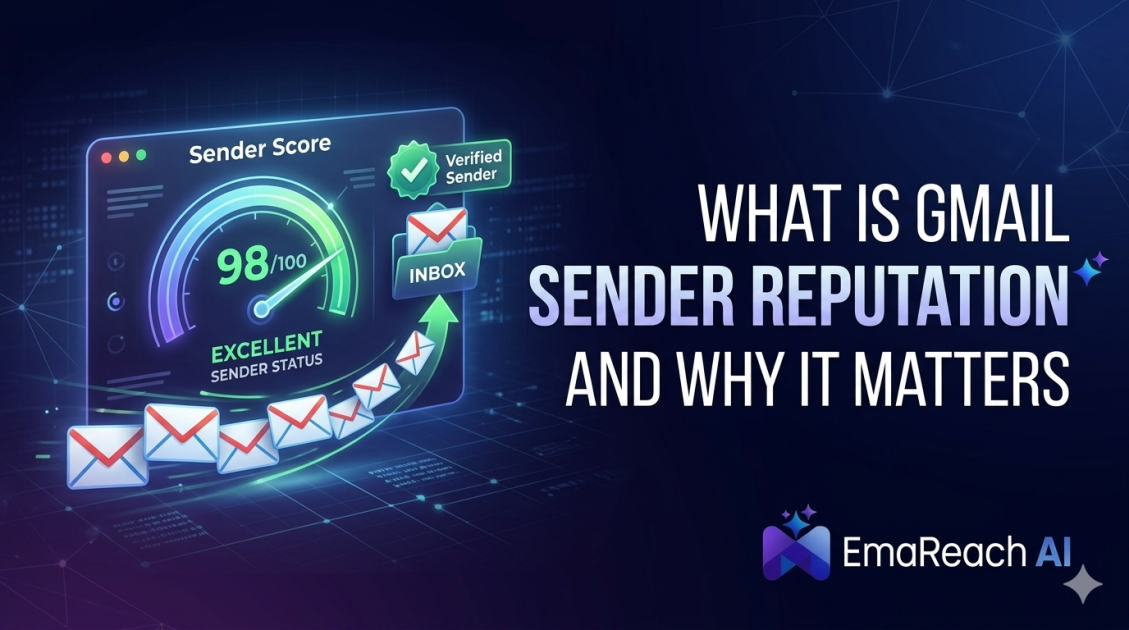
What Is Gmail Sender Reputation and Why It Matters
Gmail Sender ReputationEmail DeliverabilityDomain ReputationSpam FiltersCold OutreachEmail MarketingInbox Warmup
Introduction to Gmail Sender Reputation
In the modern digital landscape, email remains the backbone of professional communication, marketing, and outreach. However, simply hitting "send" does not guarantee that your message will ever be seen by your recipient. For those sending to Gmail users—which accounts for billions of active accounts worldwide—the gatekeeper of the inbox is a complex, algorithmic metric known as Gmail Sender Reputation.
At its core, sender reputation is a score assigned to you by Google that reflects how trustworthy you are as a sender. It is the primary factor that determines whether your email lands in the Primary Inbox, the Promotions tab, or the dreaded Spam folder. Understanding this invisible score is no longer optional; it is a fundamental requirement for anyone serious about email deliverability.
The Anatomy of Gmail Sender Reputation
Google does not look at just one factor when evaluating your trustworthiness. Instead, Gmail Sender Reputation is a multifaceted profile built over time. It can be broken down into two primary components: IP Reputation and Domain Reputation.
IP Reputation
IP reputation tracks the sending history of the specific IP address used to mail out your messages. If you are using a dedicated IP, you have total control over this score. However, if you are using a shared IP (common with many basic email service providers), your reputation is influenced by the behavior of every other sender sharing that address. High volumes of spam coming from a single IP will cause Google to throttle or block all traffic from that source.
Domain Reputation
Domain reputation is tied directly to your brand's web address (e.g., yourcompany.com). This is often considered more critical than IP reputation because it follows your brand regardless of which platform or IP you use to send emails. Google tracks how users interact with emails from your domain across the entire Gmail ecosystem. A strong domain reputation acts as a safety net, while a poor one can lead to permanent blacklisting.
Why Your Sender Reputation Matters More Than Ever
If you are running a business, sender reputation is synonymous with your ability to generate revenue. When your reputation dips, your visibility vanishes. Here is why maintaining a high score is vital:
1. Direct Impact on Deliverability
Deliverability is the percentage of emails that successfully reach the recipient's inbox. You can have the most persuasive copy and the most beautiful design, but if your sender reputation is low, your email will be intercepted by Gmail’s filters before the recipient even knows it exists.
2. Avoiding the Spam Folder
Google’s primary goal is to protect its users from unwanted content. If your reputation suggests you send irrelevant or unsolicited mail, Gmail will automatically route your messages to the Spam folder. Once you are in the Spam folder, the likelihood of a recipient finding and opening your message drops to near zero.
3. Protecting Your Domain Health
Recovering from a damaged reputation is significantly harder than maintaining a good one. If your domain is flagged as a source of spam, it can take months of perfect behavior to regain Google’s trust. In extreme cases, your domain may be permanently blacklisted, forcing a complete and costly rebrand.
How Google Calculates Your Reputation
Google uses sophisticated machine learning models to analyze hundreds of signals. While the exact algorithm is a closely guarded secret, the following factors are known to carry the most weight:
Spam Complaints
This is the single most damaging factor. When a user clicks "Report Spam," it sends a clear signal to Google that your content is unwanted. Even a small spike in complaint rates (higher than 0.1%) can cause a massive drop in your reputation.
Engagement Rates
Google rewards senders whose emails are actually read. High open rates, click-through rates, and, most importantly, replies signal that your content is valuable. If users consistently delete your emails without opening them, your reputation will suffer.
Bounce Rates
Sending emails to non-existent addresses (hard bounces) suggests that you are using an old or unverified mailing list. This is a common hallmark of spammers. Maintaining a clean list with a bounce rate under 2% is essential.
Authentication Protocols
Google expects legitimate senders to prove their identity. This is done through technical protocols like SPF (Sender Policy Framework), DKIM (DomainKeys Identified Mail), and DMARC (Domain-based Message Authentication, Reporting, and Conformance). Emails missing these records are often flagged as suspicious.
Sending Volume and Consistency
Spammers typically send massive bursts of email and then disappear. Google prefers "warm" accounts that show consistent, predictable sending patterns. Sudden spikes in volume from a new domain are a major red flag.
Solving the Deliverability Puzzle with EmaReach
Maintaining a pristine reputation manually is an uphill battle, especially for businesses engaged in cold outreach. This is where specialized technology becomes indispensable. Stop Landing in Spam. Cold Emails That Reach the Inbox.
EmaReach AI is designed specifically to navigate the complexities of Gmail’s filters. By combining AI-written cold outreach with automated inbox warm-up and multi-account sending, EmaReach ensures your emails land in the primary tab and get replies. Instead of worrying about technical roadblocks, you can focus on closing deals while the platform maintains your sender reputation in the background.
Common Pitfalls That Kill Your Reputation
Even well-intentioned senders can find themselves in the "spam trap" if they aren't careful. Here are the most common mistakes that destroy Gmail Sender Reputation:
1. Purchased Email Lists
Never buy an email list. These lists are often filled with "spam traps"—email addresses created by providers specifically to catch spammers. Sending even one email to a spam trap can instantly tank your reputation.
2. Missing Unsubscribe Links
If a user can't find a way to unsubscribe, they will hit the "Report Spam" button instead. Making it easy for users to leave your list actually protects your reputation in the long run.
3. Neglecting List Hygiene
Sending to "ghost" subscribers who haven't opened an email in six months tells Google your content isn't relevant. Regularly scrubbing your list of inactive users is a best practice for high deliverability.
4. Poor Content Quality
Using "spammy" keywords in your subject lines (e.g., "FREE," "URGENT," "ACT NOW") or excessive use of capital letters and exclamation points can trigger Gmail’s automated filters.
Practical Steps to Improve Your Gmail Sender Reputation
Improving your reputation is a marathon, not a sprint. Follow these steps to build and maintain trust with Google:
Implement Technical Authentication
Before sending another email, ensure your technical foundation is solid. You must configure:
- SPF: A list of IPs authorized to send on behalf of your domain.
- DKIM: A digital signature that proves the email wasn't tampered with in transit.
- DMARC: A policy that tells Gmail what to do if SPF or DKIM fails.
Use Google Postmaster Tools
Google provides a free service called Postmaster Tools that allows you to see exactly how Gmail views your domain. It provides dashboards on your spam rate, encryption, and reputation. Monitoring this regularly is the only way to get a direct look at your standing with Google.
Warm Up New Domains
If you have a new domain or IP, do not start by sending 1,000 emails a day. Start with 10-20 emails to colleagues or known contacts who will open and reply. Gradually increase the volume over several weeks. This "warming" process proves to Google that you are a legitimate human sender.
Focus on Quality Over Quantity
In the era of AI and automation, it is tempting to blast thousands of messages. However, Google’s algorithms are increasingly focused on the quality of interactions. A smaller, highly targeted campaign with a 40% open rate is much better for your reputation than a massive campaign with a 2% open rate.
The Role of Engagement in Modern Deliverability
In the past, deliverability was mostly about avoiding the "bad stuff" (spam traps, blacklists). Today, it is more about providing the "good stuff" (replies, forwards, and saves).
When a recipient moves your email from the Promotions tab to the Primary tab, or when they reply to your message, Google notes this as a strong positive signal. These positive interactions essentially "vouch" for your domain. This is why EmaReach is so effective; by focusing on generating replies and utilizing multi-account sending to keep volumes per-account low, it mimics natural, high-quality human behavior that Google trusts.
Monitoring and Maintenance
Reputation management is not a "set it and forget it" task. It requires ongoing vigilance.
- Weekly Audits: Check your spam complaint rates in Google Postmaster Tools.
- Monthly Cleaning: Remove any email addresses that haven't engaged in the last 30-60 days.
- Content Testing: Use A/B testing to see which subject lines and body copy result in the fewest complaints and highest engagement.
What to Do if Your Reputation Drops
If you notice your open rates plummeting, take immediate action:
- Stop sending to your full list immediately.
- Audit your list for recent additions that may have caused a spike in complaints.
- Check for blacklists using online tools to see if your IP has been flagged.
- Send only to your most engaged users for 2-4 weeks to rebuild trust with Google.
Conclusion
Your Gmail Sender Reputation is the invisible force that determines the success or failure of your email strategy. In an ecosystem where Google is constantly tightening its security and filtering protocols, you cannot afford to be negligent. By focusing on technical authentication, list hygiene, and high-quality engagement, you can ensure that your voice is heard.
For businesses that need to scale their outreach without risking their domain health, leveraging advanced tools like EmaReach provides the necessary infrastructure to stay in Google's good graces. Remember: the inbox is a privilege, not a right. Treat your recipients' time with respect, follow the technical guidelines, and your sender reputation will become your most valuable marketing asset.
EmaReach AI
Ready to scale your cold email outreach?
Join thousands of teams using EmaReach AI for AI-powered campaigns, domain warmup, and 95%+ deliverability. Start free — no credit card required.
Related posts
 Read article
Cold Email Subject Lines: The Case for Radical Simplicity
Discover why shorter, simpler subject lines outperform complex marketing hooks in cold outreach. Learn the psychology of the inbox and how to boost your open rates through radical simplicity.
Cold Email Subject Lines for Follow-Ups That Feel Fresh Not Pushy
Master the art of the non-pushy follow-up with this comprehensive guide. Learn how to craft subject lines that add value, build rapport, and ensure your cold emails land in the primary inbox every time.