Blog
Back to blog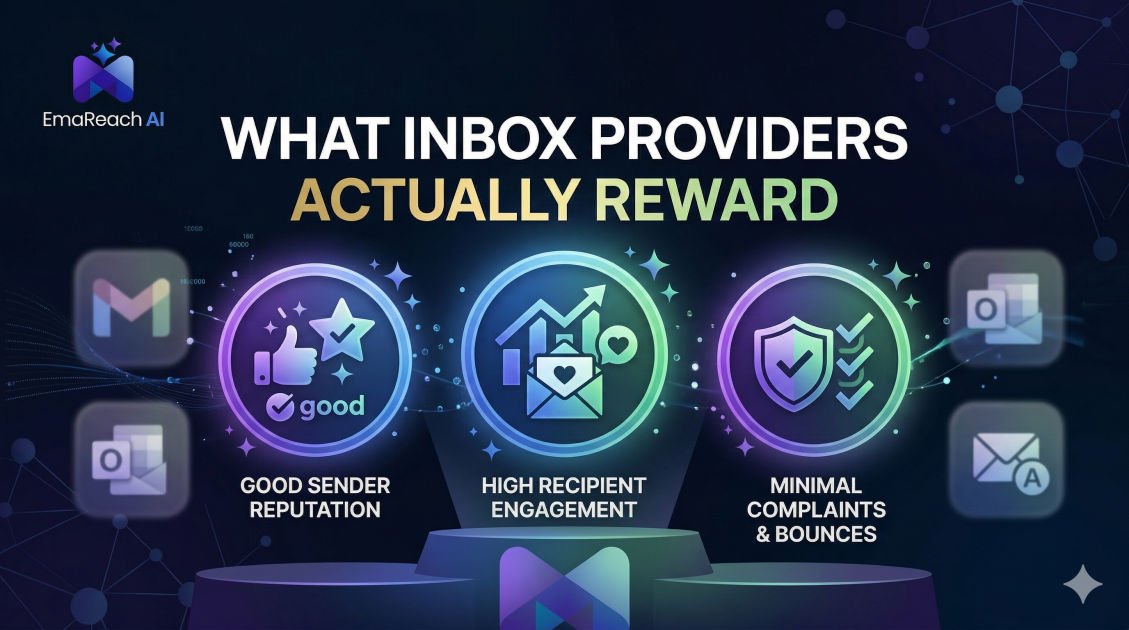
What Inbox Providers Actually Reward
email deliverabilitysender reputationcold outreachinbox placementSPF DKIM DMARCemail marketingspam filters
Introduction
In the high-stakes world of digital communication, the distance between a successful connection and a missed opportunity is often determined by a complex set of algorithms. We frequently talk about what gets an email flagged as spam—keywords like 'free,' excessive exclamation points, or suspicious attachments. However, focusing solely on what to avoid is a defensive strategy. To truly master the art of modern communication, one must understand the offensive strategy: what inbox providers actually reward.
Major players like Google, Microsoft, and Yahoo have evolved far beyond simple keyword filtering. They now function as sophisticated gatekeepers that prioritize user experience above all else. They aren't just looking for reasons to block you; they are actively looking for reasons to trust you. When you align your sending habits with the behaviors these providers value, you move out of the 'gray area' and into the primary inbox. This guide dives deep into the technical and behavioral signals that earn you the favor of the world’s most powerful inbox providers.
The Shift from Filtering to Reputation
Historically, email filtering was binary. An email was either 'good' or 'bad' based on its content. Today, the focus has shifted toward Sender Reputation. This is a dynamic score assigned to your IP address and your domain that fluctuates based on how recipients interact with your messages.
Inbox providers reward consistency and legitimacy. If you send 10,000 emails one day after a month of silence, it triggers a red flag. Conversely, if you maintain a steady volume of high-quality messages, providers view you as a reliable entity. This is why tools that manage your reputation are so critical. For those struggling with the nuances of reputation management, EmaReach offers a powerful solution: "Stop Landing in Spam. Cold Emails That Reach the Inbox." EmaReach AI combines AI-written cold outreach with inbox warm-up and multi-account sending—so your emails land in the primary tab and get replies.
Technical Foundations: The Pillars of Trust
Before a provider looks at your content, they check your 'ID card.' Technical authentication is the non-negotiable foundation of deliverability. If these are missing or configured incorrectly, you are effectively anonymous, and inbox providers do not reward anonymity.
SPF (Sender Policy Framework)
SPF is a DNS record that lists the IP addresses authorized to send mail on behalf of your domain. It prevents 'spoofing' by telling the receiving server exactly who is allowed to use your name.
DKIM (DomainKeys Identified Mail)
DKIM adds a digital signature to your emails. This ensures the message wasn't tampered with in transit. It’s like a wax seal on a letter; it proves the content is exactly what the sender intended.
DMARC (Domain-based Message Authentication, Reporting, and Conformance)
DMARC sits on top of SPF and DKIM. It gives the inbox provider instructions on what to do if an email fails authentication. By setting a strict DMARC policy, you signal to providers that you take your domain security seriously, which is rewarded with higher trust scores.
Positive Engagement Signals: The Ultimate Reward
Once your technical foundation is secure, the algorithms look at how people treat your emails. Positive engagement is the strongest signal a sender can provide. Here is what inbox providers are looking for:
1. The 'Mark as Not Spam' Action
This is the holy grail of deliverability. When a user drags an email out of the spam folder and into the inbox, or clicks 'Not Spam,' it sends a powerful message to the provider: 'You made a mistake; I want to see this sender.' Providers reward this by immediately boosting that sender's reputation for that specific user and, eventually, for their entire network.
2. High Open and Reply Rates
While opens can be difficult to track accurately due to privacy protections, replies remain a definitive signal. A reply indicates a two-way conversation. Spammers rarely get replies; legitimate businesses do. Encouraging your audience to respond—even with a simple 'yes' or 'no'—can drastically improve your standing.
3. Adding to Address Book
When a recipient adds your 'From' address to their contacts, you have essentially been granted a permanent pass. You are no longer an outsider; you are a recognized connection. Inbox providers reward this by almost always bypassing the promotions or spam filters for that sender.
4. Moving to Folders
If a user takes the time to categorize your email into a specific folder, they are signaling that the content is valuable enough to be saved and referenced later. This 'save for later' behavior is a hallmark of high-quality content.
The Danger of Negative Signals
Just as providers reward positive behavior, they are quick to penalize negative interactions. To stay in their good graces, you must minimize these 'negative rewards':
- The 'Spam' Button: This is the most damaging signal. Too many spam complaints will tank a domain reputation faster than any other factor.
- Deletions Without Opening: If a user consistently deletes your emails without ever reading them, the provider eventually learns that your content is noise, not signal. They will respond by pre-emptively moving your mail to the 'Promotions' or 'Junk' tab.
- Bounces: Sending to non-existent addresses suggests poor list hygiene. This is a common trait of bought lists, which providers despise.
Infrastructure and IP Strategy
Where your email comes from matters just as much as what it says. Providers reward 'clean' infrastructure.
Dedicated vs. Shared IPs
For low-volume senders, a shared IP is often sufficient, provided the other senders on that IP are also high-quality. However, high-volume senders are rewarded for using dedicated IPs because it allows them to take full responsibility for their reputation. They aren't at the mercy of a 'bad neighbor' who might be sending spam from the same server.
Reverse DNS (rDNS)
An often-overlooked technical detail, rDNS allows an inbox provider to verify that an IP address is associated with the domain it claims to represent. It’s a simple check that adds an extra layer of legitimacy.
Content Quality and Relevance
While 'spammy' words aren't the only thing providers look at, they still play a role. However, the reward is now given to contextual relevance.
Modern filters use Natural Language Processing (NLP) to understand the intent of an email. They reward emails that look like personal, one-to-one communication. This is where AI-driven personalization becomes a game-changer. By tailoring the content to the recipient's specific needs or industry, you increase the likelihood of positive engagement.
Using a platform like EmaReach ensures that your outreach isn't just mass-produced noise. Their AI-written cold outreach is designed to resonate with the recipient, significantly increasing the chances of landing in the primary tab and generating actual replies.
The Role of List Hygiene
Inbox providers reward senders who respect the 'cleanliness' of the ecosystem. This means regularly pruning your list. It may seem counterintuitive to remove subscribers, but 'unengaged' subscribers are actually hurting your deliverability.
If someone hasn't opened an email in six months, they are a liability. By removing them, your open rates (percentage-wise) increase, sending a signal to providers that your active audience is highly engaged. Providers reward this efficiency.
Global Standards and Compliance
Adhering to legal standards like CAN-SPAM, GDPR, and CASL isn't just about avoiding fines; it’s about signaling to inbox providers that you are a professional entity.
- Clear Unsubscribe Links: Hiding the unsubscribe link is a fast track to the spam folder. Providers reward transparency. If a user wants to leave, let them leave easily. It is much better for your reputation to have an 'Unsubscribe' than a 'Mark as Spam.'
- Physical Address: Including a valid physical address in your footer is a requirement that providers use to verify that you are a real business.
Frequency and Cadence
There is a delicate balance between staying top-of-mind and being a nuisance. Providers reward predictability.
If you send a newsletter every Tuesday at 10:00 AM, the provider’s algorithm 'expects' that traffic. This predictability builds trust. Sudden spikes or erratic sending patterns are often associated with hijacked accounts or botnets, leading to temporary blocks or increased scrutiny.
Why Warm-Up Processes are Essential
You cannot build a reputation overnight. When you start with a new domain or IP, you are an unknown quantity. Providers treat unknowns with suspicion.
The 'reward' for a proper warm-up period is a gradually increasing limit on how many emails you can send. A warm-up involves starting with very small volumes and gradually increasing them over weeks, ensuring that early recipients engage positively with the content. This is a foundational feature of EmaReach, which handles the technical heavy lifting of warm-up so your domain starts on the right foot with Google and Outlook.
The Evolution of the 'Promotions' Tab
It’s important to clarify that landing in the 'Promotions' tab (especially in Gmail) is not the same as landing in Spam. The Promotions tab is actually a reward for commercial content that is relevant but not urgent. However, for cold outreach and B2B sales, the goal is always the Primary tab.
To be rewarded with a Primary tab placement, your email must lack the 'fingerprints' of a mass marketing blast. This means fewer images, fewer links, and a conversational tone. Providers reward simplicity in this context because it mimics how humans actually communicate with one another.
Conclusion
In the modern landscape of digital communication, deliverability is earned, not bought. Inbox providers reward senders who prioritize the end-user experience. This means securing your technical infrastructure with SPF, DKIM, and DMARC; maintaining a consistent and predictable sending cadence; and, most importantly, creating content that inspires positive engagement.
Success in the inbox requires a blend of technical precision and human-centric strategy. By focusing on the signals that providers value—replies, 'not spam' markings, and high-quality interactions—you can ensure that your messages don't just get sent, but get seen. Whether you are conducting cold outreach or maintaining a subscriber list, the principles remain the same: be relevant, be authentic, and be technically sound. When you do these things, the inbox providers will reward you with the one thing every sender wants: the attention of your recipient.
EmaReach AI
Ready to scale your cold email outreach?
Join thousands of teams using EmaReach AI for AI-powered campaigns, domain warmup, and 95%+ deliverability. Start free — no credit card required.
Related posts
- Read article
The Instantly Alternative That Finally Gets Outbound Analytics Right
Discover why high-volume cold email requires a shift from surface-level vanity metrics to deep, data-driven revenue attribution, and explore the ultimate alternatives for mastering outbound engineering.
- Read article
What Three Months on an Instantly Alternative Revealed About Our Outreach
Discover the profound lessons learned from a 90-day experiment moving away from traditional cold email setups. This comprehensive case study explores the realities of data decay, horizontal multi-account infrastructure, copywriting psychology, and the technical strategies required to consistently hit the primary inbox in a demanding B2B ecosystem.