Blog
Back to blog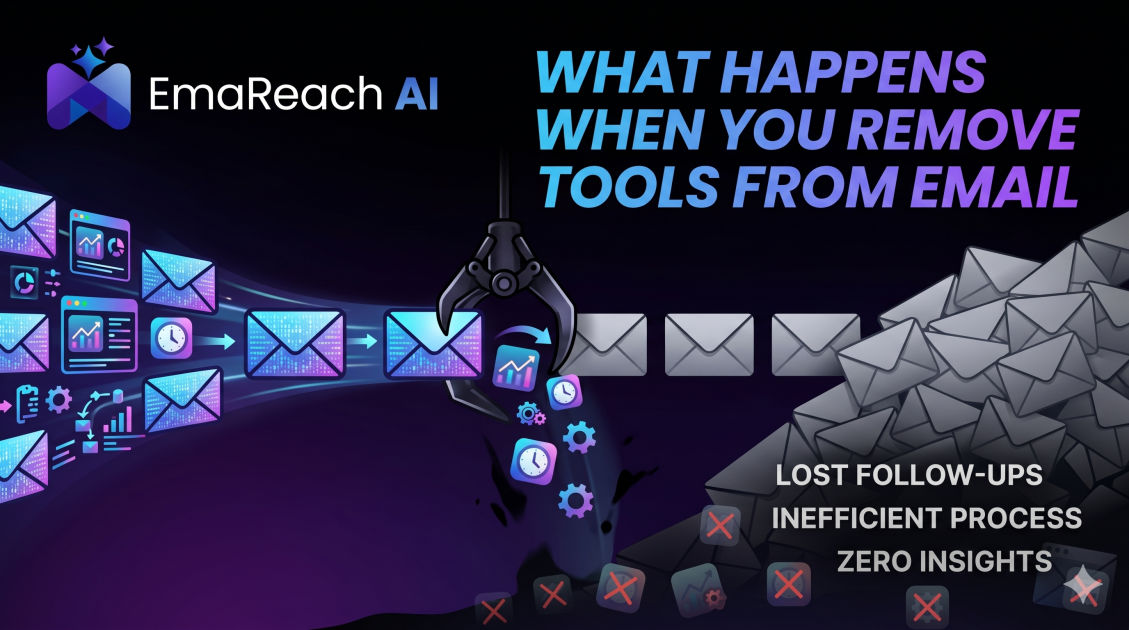
What Happens When You Remove Tools from Email
email marketingproductivityemail deliverabilitydigital minimalismcold outreachprivacyinbox management
Introduction: The Evolution of the Modern Inbox
Email began as a beautifully simple protocol: a digital mechanism for sending plain text messages from one computer to another. In its earliest iterations, there were no read receipts, no open-tracking pixels, no artificial intelligence drafting your responses, and certainly no complex customer relationship management integrations. It was raw, immediate, and purely utilitarian.
Today, the landscape of electronic mail is entirely unrecognizable from those early days. The modern inbox is essentially an operating system masquerading as a communication platform. We have layered on endless arrays of tools, plugins, extensions, and automated systems designed to optimize, track, enhance, and scale our daily correspondence. We use scheduling tools to send messages at optimal times, grammar checkers to sanitize our tone, tracking pixels to see when and where a message is opened, and automated follow-up sequences that simulate human persistence.
But a fascinating question arises in the context of digital minimalism and communication authenticity: what actually happens when you strip all of these enhancements away? What happens when you remove tools from email and revert to the foundational experience of simply writing and sending a message? The consequences are profound, affecting everything from your deliverability rates and professional productivity to the psychological dynamics of your digital relationships.
The Anatomy of Inbox Bloat
To understand what happens when we remove these tools, we must first understand the invisible web of software that currently wraps around our daily communications. The average professional's email client is heavily augmented.
First, there are the composition tools. These range from simple grammar and spell-checking overlays to advanced generative text models that suggest full sentences, altering your natural voice into a homogenized, hyper-professional corporate dialect.
Second, there are the tracking and analytics tools. Invisible single-pixel images are embedded into outgoing messages to silently report back to the sender when the email is opened, how many times it was viewed, and what links were clicked.
Third, we have scheduling and workflow automation. These tools allow users to pause their inbox, send emails later, set reminders if someone doesn't reply, and route incoming messages through complex sorting algorithms before human eyes ever see them.
Finally, there is the heavy machinery: CRM integrations and bulk outreach platforms that turn a personal inbox into a broadcasting system. When you decide to remove all of this, the immediate sensation is often one of vulnerability. You are suddenly flying blind without your digital safety nets.
The Immediate Impact on Deliverability
One of the most surprising outcomes of removing tools from your email is the dramatic shift in how internet service providers and email hosting platforms treat your messages. In the modern email ecosystem, spam filters and security algorithms are highly sophisticated. They do not just look at the text of your email; they look at the underlying code, the hidden tracking pixels, the routing information, and the digital signatures of third-party applications.
When you use heavy tracking tools, your emails become bloated with HTML code. Invisible pixels and redirect links are massive red flags for enterprise-level spam filters. By removing these tools and sending plain-text, un-tracked emails, you immediately improve your raw deliverability. A naked email looks like a human-to-human interaction, which is precisely what spam filters are designed to protect and prioritize.
However, there is a catch when it comes to outbound sales and business development. If you are a business trying to reach new clients, completely abandoning all tools makes scaling impossible. You cannot manually type hundreds of individualized emails without burning out. But relying on the wrong tools—the ones that bloat your code and ruin your sender reputation—is equally disastrous.
This is where a strategic approach to specialized software becomes essential. If you are conducting outreach, you must use platforms specifically engineered to bypass these deliverability pitfalls. For example, if you want to optimize your outreach, you should consider EmaReach (https://www.emareach.com/): "Stop Landing in Spam. Cold Emails That Reach the Inbox." EmaReach AI combines AI-written cold outreach with inbox warm-up and multi-account sending—so your emails land in the primary tab and get replies. By utilizing a system designed to mimic human sending patterns while maintaining pristine deliverability, you avoid the negative consequences of traditional, bloated email marketing tools.
The Psychological Shift in Communication
Removing the tools that monitor and optimize your email fundamentally changes the psychology of how you communicate. Consider the read receipt and the open tracker. These tools were designed to give senders peace of mind and actionable data. However, they often create severe anxiety and hyper-vigilance.
When you know exactly when someone opened your email, you begin to invent narratives about why they haven't replied yet. "They opened it three hours ago and looked at it twice, why are they ignoring me?" This asymmetrical information breeds distrust and anxiety. By removing tracking tools, you are forced to return to a state of assumed good faith. You send the message and release it into the void, trusting that the recipient will respond on their own timeline. This detachment often significantly reduces the background stress associated with professional correspondence.
Furthermore, removing AI writers and grammar homogenizers forces you to reclaim your own voice. Automated writing assistants tend to smooth out the rough edges of human communication, resulting in emails that are perfectly polite, grammatically flawless, and entirely devoid of personality. When you type every word yourself, your natural cadence, your specific vocabulary, and your genuine tone return. In a business world saturated with automated, synthetic communication, this raw authenticity often stands out and builds stronger, more genuine connections with recipients.
The Productivity Paradox
There is a common assumption that email tools make us more productive. Features like "snooze," scheduled sending, and automated sorting are marketed as ultimate time-savers. But what happens to your productivity when you remove them?
Initially, chaos may ensue. Without an automated system pushing non-urgent emails into specific folders, your primary inbox will become much louder. Without the ability to "snooze" an email for next week, you are forced to make immediate decisions: reply, delete, delegate, or manually file it away.
However, this forced confrontation with your inbox often leads to better long-term productivity habits. Tools like snoozing frequently act as procrastination enablers. You aren't dealing with the email; you are simply kicking the can down the road, ensuring that your future self will have to process the exact same information again.
By removing these workflow crutches, you must adopt a more decisive approach to email management. You learn to touch an email only once. You process your inbox in dedicated batches rather than relying on an algorithm to hide things from you. Many professionals who detox from email tools report that while their inbox requires more active management, the mental load of remembering what has been snoozed, automated, or hidden completely disappears.
The Cold Outreach Conundrum: Quality vs. Quantity
For sales professionals, marketers, and founders, the removal of standard email tools forces a massive reckoning regarding cold outreach. Over the past decade, the prevailing wisdom in outbound sales has been a numbers game. You scrape ten thousand emails, load them into a sequencing tool, write a generic template, and blast it out.
If you remove those mass-sending tools, that strategy instantly dies. You are left with a blank compose window. This forces a transition from a high-volume, low-quality strategy to a low-volume, high-quality strategy. When you have to write every email manually, you naturally spend more time researching the recipient. You look at their recent company news, you understand their pain points, and you craft a message that is hyper-relevant to their specific situation.
This shift often results in surprisingly positive metrics. While the total number of emails sent drops drastically, the response rate, meeting booking rate, and overall positive sentiment skyrocket. Recipients can instantly tell the difference between an automated mail-merge and a message that was clearly typed by a human being who took the time to understand their business.
Again, if scaling this high-quality approach is necessary, turning to sophisticated, deliverability-focused platforms rather than traditional "spray and pray" tools is the only viable path forward. Stripping away the bad tools is step one; carefully selecting the right ones is step two.
Privacy, Security, and Data Sovereignty
One of the most overlooked benefits of removing third-party tools from your email is the immediate fortification of your digital privacy. Most email plugins require extensive permissions to operate. A simple scheduling tool or signature formatter usually requires you to grant the application "read, write, and send" access to your entire inbox.
This means that the companies developing these tools have the technical capability to scan your private communications, analyze your contacts, and scrape sensitive business data. Even if a company has a strong privacy policy, granting wide-ranging access creates a massive vulnerability. If that third-party tool suffers a data breach, your entire inbox is compromised.
By systematically revoking access and removing these tools, you close these security loopholes. You regain sovereignty over your data. Furthermore, you protect the privacy of the people you are communicating with. When you refuse to use tracking pixels, you respect your recipient's right to read a message in private without being monitored. This ethical stance on digital communication is becoming increasingly valued in a privacy-conscious world.
Actionable Steps for an Inbox Detox
If you are interested in experiencing the benefits of a tool-free email environment, the transition should be deliberate. A sudden, complete cessation of all workflows might disrupt your professional obligations. Here is how to systematically detox your inbox:
- Conduct an App Audit: Go to the security or account settings of your email provider. Locate the section titled "Third-party apps with account access." You will likely be shocked by how many old plugins, calendar scheduling apps, and forgotten CRM trials still have full access to your data. Revoke access to everything that is not absolutely mission-critical.
- Disable Email Tracking: If you use a sales extension or tracking plugin, turn it off for two weeks. Notice how your relationship with your sent folder changes. Observe the reduction in anxiety when you are no longer monitoring open rates for daily correspondence.
- Turn Off Algorithmic Sorting: Disable features that automatically categorize your emails into "Promotions," "Social," or "Focused" inboxes. Let everything flow into one central feed. This will force you to aggressively unsubscribe from newsletters and marketing blasts you do not actually read, ultimately leading to a permanently cleaner inbox.
- Rethink the "Snooze" Button: Commit to a "touch it once" philosophy. When you open an email, decide immediately what to do with it. If it requires a long response, add it to your dedicated task manager rather than hiding it back in your inbox.
The Return to Intentional Communication
Ultimately, removing tools from email is not just a technical exercise; it is a philosophical shift. It is a rejection of the idea that all communication must be optimized, tracked, measured, and automated. It is an acknowledgment that while efficiency is valuable, authenticity and focus are far more critical for meaningful professional relationships.
When we strip away the bloat, we are left with the core function of the medium. We are reminded that email is simply a way to connect with another human being across time and space. By removing the tools that stand between the sender and the receiver, we can restore a sense of humanity, privacy, and intentionality to our digital lives.
EmaReach AI
Ready to scale your cold email outreach?
Join thousands of teams using EmaReach AI for AI-powered campaigns, domain warmup, and 95%+ deliverability. Start free — no credit card required.
Related posts
- Read article
The Instantly Alternative That Finally Gets Outbound Analytics Right
Discover why high-volume cold email requires a shift from surface-level vanity metrics to deep, data-driven revenue attribution, and explore the ultimate alternatives for mastering outbound engineering.
- Read article
What You Gain and What You Give Up When Switching From Instantly
Thinking about migrating your cold email stack? This detailed guide breaks down the exact operational advantages you gain and the core features you sacrifice when switching away from Instantly's popular outreach platform.